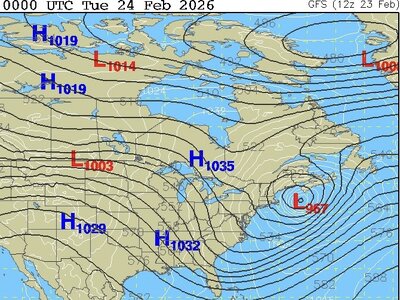
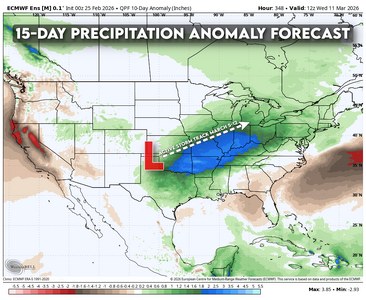
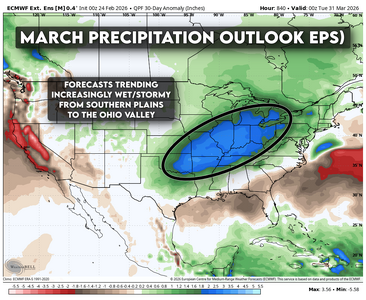
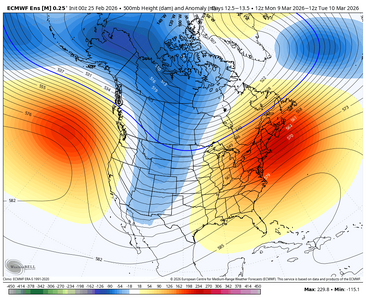
Anyone else notice that the troughs this year seem to appear further east? Just an observation. 500 mb heights & SLPs for yesterday below.
Very interesting observation, William. As a "fun" exercise, I was wondering how the mean upper-air trough positioning looked in April, 2011, still the most active tornado month in the most historic tornado season on record in this century. I was looking for any persistent synoptic similarities in what is occurring now, as a possible precursor to what
might occur later this spring (particularly April, 2026).
As it turns out, February, 2011, does have
some similarity to February, 2026, to date, in that there has been persistent winter troughiness over the eastern CONUS in each case and that the month of February in both of these years was characterized by La Nina climatic regimes, albeit moderate-to-strong in 2011 but weakening in 2026. Of course, there are numerous short-term influences that can affect how and when severe-weather events occur, so long-range forecasting can never depend exclusively upon apparent similarities between any different years. The "apparent" seasonal similarities could be--and likely are--nothing more than random coincidence or natural "white noise."
Nonetheless, the attachment and link below show some good information relating why 2011 and 2026
could end up looking alike after the 2026 spring tornado season is over. We'll just have to wait and see what happens...
AI Overview
During February 2011, the mean upper-air trough position was located over the
eastern United States, part of a persistent atmospheric pattern that featured a strong ridge over the eastern Pacific and a deep, cold trough over the central and eastern US.
Key Aspects of the February 2011 Trough Position:
- Persistent Eastern Trough: The upper-level trough was entrenched over the central/eastern US for much of the month, allowing arctic air masses to drive far south, impacting areas as far as New Mexico and Texas.
- Arctic Vortex Correlation: This pattern was characterized by a persistent Arctic vortex over eastern Canada, which helped funnel cold air into the trough.
- Active Storm Track: The position of this trough (often diving into the Rockies and then over the Mississippi Valley) created a high-intensity, active storm track, resulting in significant winter weather events, including the "Groundhog's Day Blizzard" from Jan 31–Feb 2, 2011.
- Resulting Temperature Anomalies: The positioning of the trough caused below-normal temperatures throughout the eastern U.S. and into the Deep South, with multiple cold, heavy-snow events affecting the region.
This pattern was largely influenced by a moderate-to-strong
La Niña event, which often favors this specific type of trough-ridge configuration over North America.
Also,
April 2011: The most tornadoes on record in April - ustornadoes.com