• While Stormtrack has discontinued its hosting of SpotterNetwork support on the forums, keep in mind that support for SpotterNetwork issues is available by emailing [email protected].

State of the Chase Season 2026

This pattern is looking eerily familiar. Big early-season event(s), followed by the all too common set-up—massive Hudson Bay low, RH gets punted into the Gulf, jet stream support bows northward, SP ridging sets up shop and the 700mb inferno visits from Mexico.

In about a week, this discussion will likely turn to desperate topics like: mesoscale accidents, "just wait until June," Denver cyclones and "I'm heading to North Dakota in July."
 
Last edited:
Maps like that smooth out temporal variations during the period covered and can unnecessarily demoralize chasers, similar to those long-term 500mb flow maps that average out the flow over the period.
I hear you; that's a good point.
And remember @Tony Laubach and his best chasing year ever?
Wait for it...2009. So yeh, put in the work, time & miles, and you can make something out of it.
 
This pattern is looking eerily familiar. Big early-season event(s), followed by the all too common set-up—massive Hudson Bay low, RH gets punted into the Gulf, jet stream support bows northward, SP ridging sets up shop and the 700mb inferno visits from Mexico.

In about a week, this discussion will likely turn to desperate topics like: mesoscale accidents, "just wait until June," Denver cyclones and "I'm heading to North Dakota in July."

Unfortunate, but it seems like it was known this was a strong possibility from about 4-6 weeks ago. At least the active early season period led to some decent events in the Plains and Midwest, although many of them underperformed their model-teased ceilings (particularly this past Sunday and Monday). I've been on six chases in 2026, which is a personal record before May even starts.

There was some concern this year might be as bad as 2018 (The new 1988, apparently irredeemably awful chase seasons occur on 30-year cycles), in which both the early and "peak" seasons were anemic. I didn't get out on a single chase that year until October!
 
Disclaimer: highly unscientific, gut-feeling ramble to follow. There's a wide variety of opinions in the chasing community on the relationship between early season and peak/late season activity. Whenever there's a high-end event or two before May, many chasers become euphoric and start celebrating how "2026 is the year" etc. On the other hand, several folks in this thread have already expressed concern that we're essentially "using up" our quality events prematurely, and that this portends bad things for May and June.

Based only on my ~20 years watching Plains seasons closely, I have a slightly subtle view on this:
  • When we get a blockbuster trough or two in March-April producing outbreaks (e.g., 28 March 2007, 31 March 2023, 26 April 2024), but downtime and seasonable temperatures between those few dynamic systems, I tend to view that as a neutral or even encouraging sign about the remainder of the season.

  • But when long stretches of March-April are warmer than normal with quiescent sloshing drylines that resemble May or June, that's when I start to worry.
I would put this year firmly in the second category, unfortunately. With some brief exceptions, much of the last 6 weeks have behaved like we're a month or two ahead of climatological schedule. We had a few really good Plains events in late April... but they weren't the result of a beautiful, well-timed trough ejection. They were the product of 10+ days throughout the month that had a sloshing dryline, often with modest mid-level flow. By percentage, most of those sloshing dryline days were shit, but a couple found a way to produce. That's another bad thing about seasons where you get your typical May-June pattern prematurely in April: the day-to-day efficiency of subtle finesse setups in producing quality tornadoes is almost always very poor early in the spring, compared to what you'd see later (with warmer Gulf SSTs, longer days, etc.). Chasers feel good in the moment because it's nice to be out in 65 F dewpoints seeing supercells sooner than expected, but really, those conditions are being apportioned to a time of year that's not nearly as conducive to high-quality results.

This April generally reminded me more of ones like 2009, 2012, 2017, or 2022 than it did the past few years. Aprils that were warm, humid, and impressively "active" across numerous days, but thin on high-quality results (that might be a bit too harsh for this year, though, to be fair)... and that were followed by relatively quiet peak seasons, albeit with a few standout June events in 2009 and 2017.

None of this guarantees we won't still see a genuinely impressive stretch at some point in late May or June. Every year is its own beast. If the 2023-25 period taught me anything, it's that there will always be new surprises and curveballs in how chase seasons evolve.

 
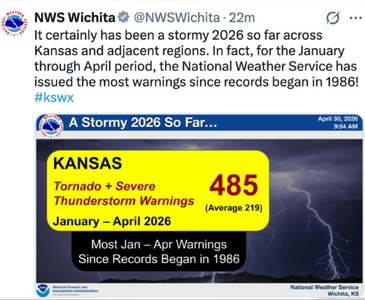
Regarding tornado season to-date: ICT NWS posted an item I found odd this morning. It is nearby. They are boasting about the number of tornado and severe thunderstorm warnings the NWS has issued for the State of Kansas the first four months of the year. It is the most since 1986 when the warning database began.

The thing I found odd is they weren't boasting about accuracy but pure numbers. Given the high FAR in the NWS's warning program, this is probably a bad thing. Example: STL issued a ton of tornado warnings Monday but almost none of them verified. The Crisis in the National Weather Service

I doubt there are meteorologists who believe we don't issue enough SVR warnings. If I were appointed king, I'd probably -- west of the Appalachian Mountains -- raise the hail criterion to 2" and the winds to 70 mph. The reason is the current (1" and 58 mph) causes great overturning (even if the warning verifies, usually only a small part of the polygon actually receives hail/wind . Plus, there is little anyone can do when a hail warning (as opposed to a forecast) is issued.
 

Attachments

  • Screenshot 2026-04-30 at 11.08.59 AM.png
    Screenshot 2026-04-30 at 11.08.59 AM.png
    1 MB · Views: 1
Disclaimer: highly unscientific, gut-feeling ramble to follow. There's a wide variety of opinions in the chasing community on the relationship between early season and peak/late season activity. Whenever there's a high-end event or two before May, many chasers become euphoric and start celebrating how "2026 is the year" etc. On the other hand, several folks in this thread have already expressed concern that we're essentially "using up" our quality events prematurely, and that this portends bad things for May and June.

Based only on my ~20 years watching Plains seasons closely, I have a slightly subtle view on this:
  • When we get a blockbuster trough or two in March-April producing outbreaks (e.g., 28 March 2007, 31 March 2023, 26 April 2024), but downtime and seasonable temperatures between those few dynamic systems, I tend to view that as a neutral or even encouraging sign about the remainder of the season.

  • But when long stretches of March-April are warmer than normal with quiescent sloshing drylines that resemble May or June, that's when I start to worry.
I would put this year firmly in the second category, unfortunately. With some brief exceptions, much of the last 6 weeks have behaved like we're a month or two ahead of climatological schedule. We had a few really good Plains events in late April... but they weren't the result of a beautiful, well-timed trough ejection. They were the product of 10+ days throughout the month that had a sloshing dryline, often with modest mid-level flow. By percentage, most of those sloshing dryline days were shit, but a couple found a way to produce. That's another bad thing about seasons where you get your typical May-June pattern prematurely in April: the day-to-day efficiency of subtle finesse setups in producing quality tornadoes is almost always very poor early in the spring, compared to what you'd see later (with warmer Gulf SSTs, longer days, etc.). Chasers feel good in the moment because it's nice to be out in 65 F dewpoints seeing supercells sooner than expected, but really, those conditions are being apportioned to a time of year that's not nearly as conducive to high-quality results.

This April generally reminded me more of ones like 2009, 2012, 2017, or 2022 than it did the past few years. Aprils that were warm, humid, and impressively "active" across numerous days, but thin on high-quality results (that might be a bit too harsh for this year, though, to be fair)... and that were followed by relatively quiet peak seasons, albeit with a few standout June events in 2009 and 2017.

None of this guarantees we won't still see a genuinely impressive stretch at some point in late May or June. Every year is its own beast. If the 2023-25 period taught me anything, it's that there will always be new surprises and curveballs in how chase seasons evolve.

Interesting thoughts, Brett. Useful distinction between the type of "active" early season that can be a good (or at least neutral) omen for peak season, vs. those that are warning signs that something is amiss and you may not be getting the "typical" spring pattern when you expect it.

That's a connection I'd not really made before, even though I noted as early as March 10th of this year how unusual the pattern was for an early-mid March chase day in the upper Midwest, having more in common on the synoptic scale with a late spring to summer northwest flow warm front setup.

Typically in the early season at this latitude, for a higher-end tornado threat we require an amplified, classically negatively-tilted trough with a strong low-level mass response and cold air aloft overspreading the warm sector (a pattern which we've seen lead to intense tornadoes several times in recent years, such as Winterset 3/5/22 and 3/31/23). I remember discussing this with @Luke Penney as we were en route to the target area.

As an aside, I happened to check out your website. You must have been just to my left for the last few minutes of the Arnett EF3 last year, as that same pond is in my foreground.
 
Great thoughts on the subject. As I always like to say this time of year, for me, there are three tornado chase periods. 1: The early May period when I generally deploy as RH starts working west again, generally after an active period that has scoured RH into the Gulf. This set-up often includes one or two "sneak attacks" that can produce isolated, photogenic supercells in the MAF/LBB/ROW areas with little chaser convergence (especially with crazy fuel prices). 2: The regular May chasing period—fighting chaser convergence. 3: The NW flow events in late May and early June that can produce interesting results, like Campo—again with limited chaser convergence.

Too many chasers want to focus on "big" dynamics and sure bets seen from two weeks out—but chasing does not work that way. The chasers depending on live feeds must be checking into mental institutions after looking at recent forecasts, but there is still a lot of chasing to do—even if it's not perfect set-ups.
 
@Brett Roberts Fantastic insights, although I don’t like your conclusion (not that I disagree)

@Andy Wehrle I hadn’t really even been paying much attention to what was going on as early as March, but that (unfortunately) corroborates Brett’s conclusions

These technical discussions are great, but what it all comes down to is the human, emotional impact. We all have this inexplicable drive and desire to chase supercells. We wait all year for it. And when it doesn’t look like it’s going to work out, it is profoundly disappointing in a way that is truly poignant to us. And inexplicable to anyone who is not a chaser - meaning little empathy for family, friends or co-workers. “Wait til next year!” is no consolation. We say that in sports, but in that scenario by the time one season ends, the start of the next one is only six or seven months away. For us it is pretty much a full year.

Seven months ago, I started playing drums. What an amazing hobby, to get immediate feedback and be able to try again whenever I want, later the same day, or the next day. All year long. Totally in my control. In contrast to chasing: totally subject to the vagaries of the weather, unable to apply learnings or redeem yourself after errors, for days, weeks or years. Why do we do this to ourselves? What an insane and psychologically unhealthy avocation.

To think one of the reasons I chose to tell my boss I am semi-retiring is to be able to chase more. That wasn’t going to help all that much this year, as I am still working full time now. I would have chased in April if I didn’t have a board meeting to deal with. Which kind of helps explain the desire to want more freedom. To @Matthew Crowther ‘s point above, it should give me more flexibility to chase over a longer period starting in 2027 - although money becomes a bigger concern than it is now. But man does chasing seem like a pretty stupid thing to prioritize when you have years like this.

I’ll try to instead take comfort in @Warren Faidley ‘s post. No matter what happens, it seems pretty much impossible that there won’t be some good days at any time between now and mid-June when my window of opportunity closes. As my original tour guide Marty Feely used to say, “There WILL be storms!” Last year kind of sucked for me too, but I went home happy after the June 5-8 sequence. It doesn’t take much to make a season.
 
Just looking back through past threads, 2005 and 2018 were years that we were lamenting a deep, persistent Hudson Bay low in the middle of May. 2005 I remember clearly as in those years, I carpooled with 2-4 people during a trip. We were pulling our hair out with coordinating everyone's schedules, wondering if we were going to be able to get a trip in at all. June of 2005 ended up being quite epic, with Kadoka, Hill City and Spur during the second week of June.

2018 wasn't great, but still had some gems like the Cope landspout-fest and plenty of great lightning (the latter will make a Plains trip good for me personally).
 
Back
Top