• While Stormtrack has discontinued its hosting of SpotterNetwork support on the forums, keep in mind that support for SpotterNetwork issues is available by emailing [email protected].

State of the Chase Season 2026

I realize this may not have any scientific validity whatsoever, although I do remember @Jeff Duda several years ago mentioning something to the effect there are only so many troughs we can realistically expect the atmosphere to generate over time, and a lot of early activity can in fact exhaust the potential for later. I could very well be mischaracterizing this, so don’t quote me. Hopefully Jeff can comment, and offer the latest thinking on the subject, since that was a number of years ago. But as you can see the concept stuck with me and makes me worry every year that I see early activity! 😏
Ha, I remember that discussion from some years ago. Also, I cannot defend that position with scientific data - as far as I'm aware there is no "budget" for troughs that the atmosphere obeys. It just seems to be a sense I have.

So here we are again...if there's going to be a quiet period between March and June I'd rather have it in March. Let's see if it gives way to an active period during a time of year where the days are longer, warmer temperatures are more likely, and we're less likely to see Gulf-clearing cold fronts.
 
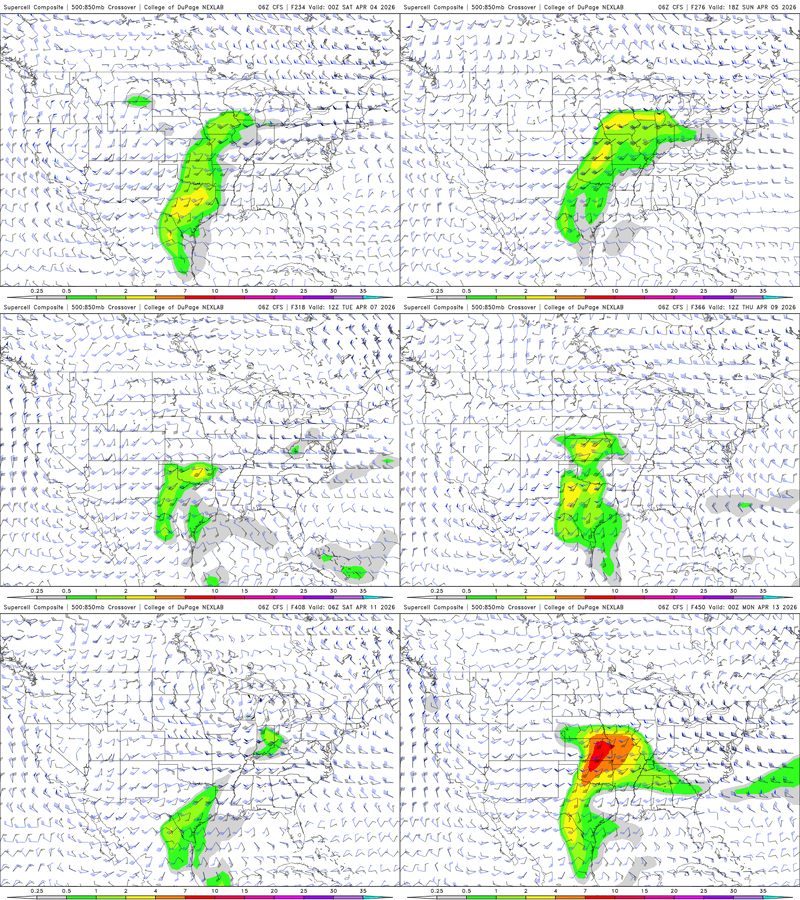
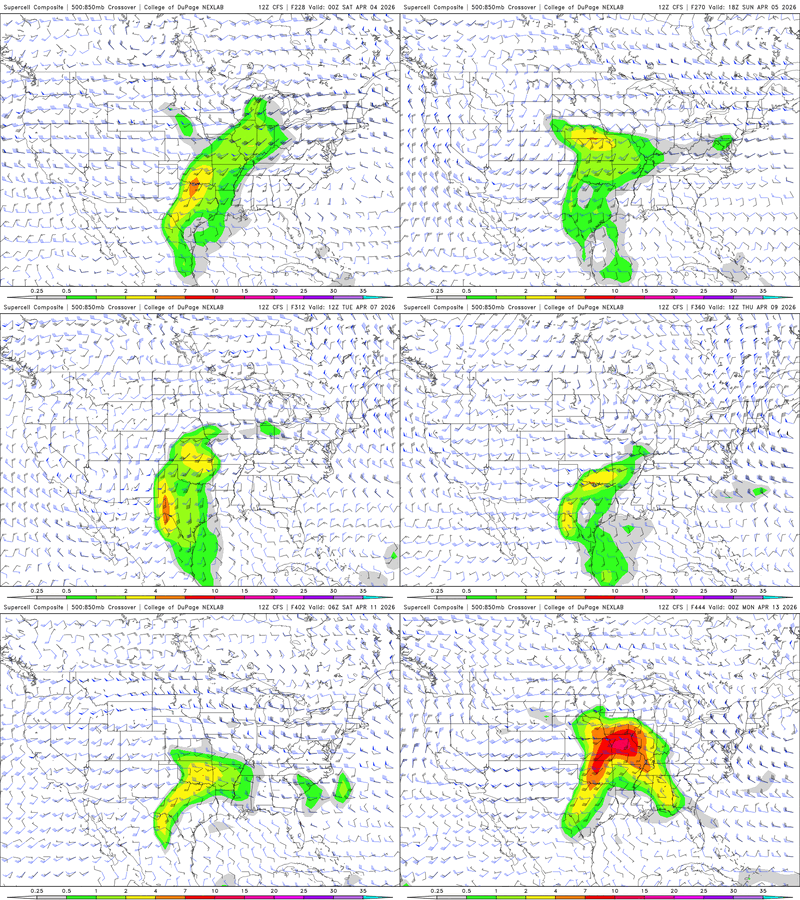
Looks quiet in the near-term as a dominant western U.S. ridge shuts the pattern down and allows for an early spring heat wave to expand from the western U.S. into the Plains through late March. Possible there could be a few shortwaves embedded within a period of flattern zonal flow March 24-31 that allow for a crashing-cold-front style storm opportunity somewhere in the Midwest during that time frame but I'm mostly turning my attention to early April at this point. Not much to get excited about with respect to specifics, but global ensembles and other teleconnections are starting to flicker in the first half of April.

View attachment 28860

View attachment 28861
View attachment 28862

I rambled a little more about it in a new blog here if you want to lean in: SKYDRAMA.NET • Pattern Quiets Down - Next Run of Severe Storms in Early April?

For some reason I didn't get the bell notifications for new posts in this thread starting with this one even though I'm supposedly "watching" it (I'm getting them for other "watched" threads such as the "THAT'S A LOT" one), but I'd certainly take this since I'm on the Founder's Tour for Trey Greenwood's Storm Chaser Coaching project which runs April 3-12. I knew it was a bit of a gamble going that early, but for that reason that tour was less expensive, and there have been plenty of years (including some recent) where May hasn't been all it's cracked up to be.
 
I'm on the Founder's Tour for Trey Greenwood's Storm Chaser Coaching project which runs April 3-12.
_DSC1132.jpg
Andy, not too difficult to figure that you'll likely travel somewhere south & east of Nebraska most of the time for that trip this year!

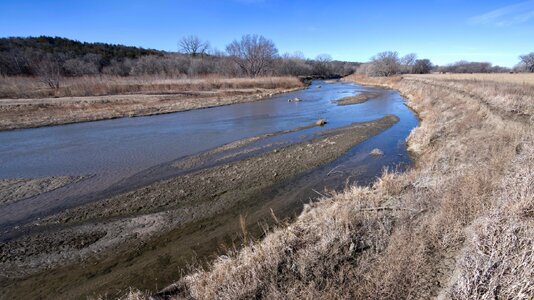
While I don't know of any correlation between precipitation totals & severe weather, evapotranspiration's definitely lowered in most of the Cornhusker State. Areas such as the above went from moderate to severe to extreme on the Drought Severity Index during the last month.

"Islands in the stream," my photo, shows crisp vegetation & prior, higher levels carved into the creek channel, especially during flooding.
 
Last edited:
View attachment 28875
Andy, not too difficult to figure that you'll likely travel somewhere south & east of Nebraska most of the time for that trip this year!

While I don't know of any correlation between precipitation totals & severe weather, evapotranspiration's definitely lowered in most of the Cornhusker State. Areas such as the above went from moderate to severe to extreme on the Drought Severity Index during the last month.

This pic gives a feel for the "crispy" vegetation as well as some of the prior, higher levels carved into the channel, especially during flooding.

In my experience drought is generally not good for severe weather. 2011-'12 had one of the mildest and least snowy winters here in southern Wisconsin in my memory, leading to a very warm and dry late winter/early spring (frequently referenced as the "Morch" on another weather forum I frequent). 2012 ended up being one of the quieter tornado seasons for the Plains, apart from the big outbreak on April 14, and the Midwest was even quieter with a grand total of four tornadoes in Wisconsin all year (average 21-23 depending on the source).

However that was an extreme example. While we were below-average on snowfall for much of this past winter, the recent winter storm last weekend gave us a nice snowpack which is now melting off. However I'm not a huge fan of the much above normal temperatures that are going to be over the Southwest for the next week or two. Could create some EML issues.
 
However I'm not a huge fan of the much above normal temperatures that are going to be over the Southwest for the next week or two. Could create some EML issues.
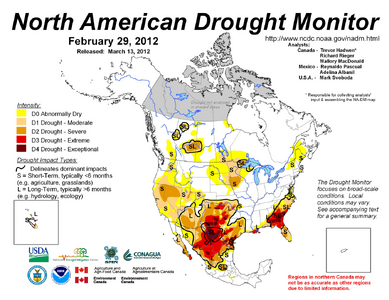
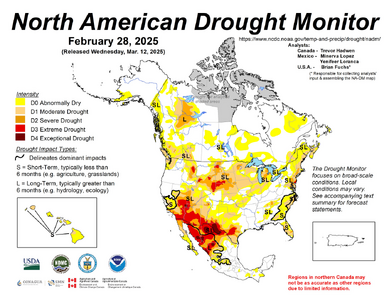
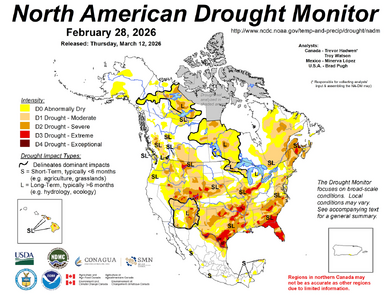
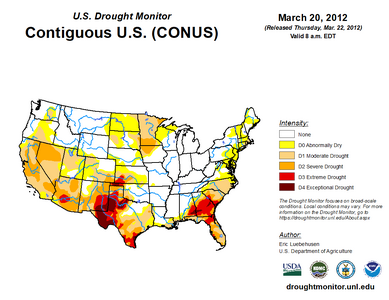
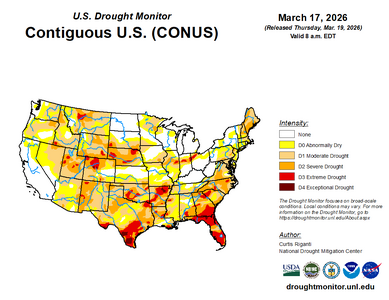
Interestingly enough, drought conditions in the Southwest are actually a lot better than you would expect. Looking at the drought conditions across North America as a whole indicates that the EML source region is doing a lot better than in 2012 and even 2025, especially across northern Mexico. However, these maps are from the end of February so we'll have to see how the current heat wave affects things.
1774029097225.png1774027964481.png1774027986413.png

That said, drought conditions will probably worsen quite a bit given this month's extremely warm and dry conditions. If you're using 2012 as an analog the current conditions in the West have the potential to be much, much worse (snowmelt is currently occurring significantly earlier than in 2012). What concerns me more than EML conditions is the persistence of drought across tornado alley itself. Drought is currently much more widespread there than it was in 2012, and is forecast to remain in place or worsen over the next few months.
1774029249859.png1774029260823.png
1774029358394.png
 
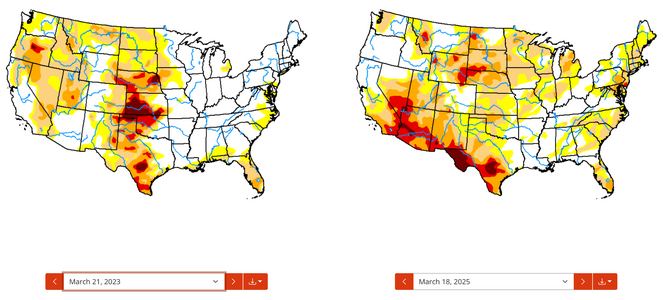
It's very interesting that many chasers and severe weather aficionados acknowledge drought can impact a spring season, yet the interpretation of how and where seems to differ widely. Like Harlan U above, I'm always more interested in soil moisture conditions on the Plains than I am way out in the Great Basin or Sonoran Desert. And in that respect, it's pretty bleak right now, especially in the southern Plains (where IME drought conditions can matter even more than up north).

Of course, soil moisture conditions looked somewhat bleak in March-April in two of the last three years (2023 and 2025), and both of those rallied to become good-to-great chase seasons by late May into June:

dm2325.png

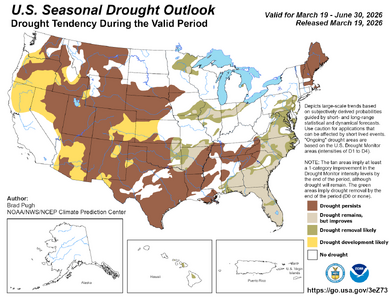
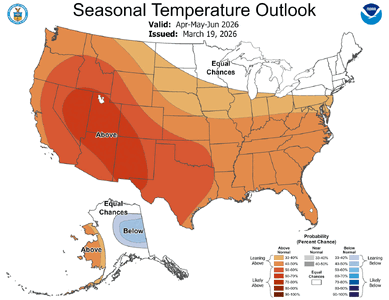
That has not been the norm historically, though. It would be surprising if we pull a mid-season rabbit out of the hat yet again this year with soaking rains in April or early May, but obviously that's not impossible. My baseline expectation is a season that looks more like some blend of 2006, 2009, and 2018, meaning many marginal/weak flow setups will be kneecapped by deep PBL mixing in the afternoon (especially the farther south and west you go)... and we'll be more reliant on "big trough" setups and fortuitous boundary setups to overcome the unfavorable background state. CPC's latest seasonal outlook certainly supports this, as it really couldn't look much worse.

off01_temp.gif
 
That has not been the norm historically, though. It would be surprising if we pull a mid-season rabbit out of the hat yet again this year with soaking rains in April or early May, but obviously that's not impossible. My baseline expectation is a season that looks more like some blend of 2006, 2009, and 2018, meaning many marginal/weak flow setups will be kneecapped by deep PBL mixing in the afternoon (especially the farther south and west you go)... and we'll be more reliant on "big trough" setups and fortuitous boundary setups to overcome the unfavorable background state. CPC's latest seasonal outlook certainly supports this, as it really couldn't look much worse.

View attachment 28891

Explains why 2018 was such an all-around lousy year, as you had that coupled with an anemic jet stream pattern that resulted in a near-total lack of those "big trough" setups.
 
Totally unscientific, but I do not feel very optimistic about the season. This post applies mainly to the southern plains, where I have done most of my chasing in recent years. It is extremely dry in the southwest, really in most of the west and other parts of the country, too, and certainly getting worse in the southwest. Western ridge and eastern trough has been persistent for quite some time. Maybe something will come along to break this pattern, but that is not happening any time soon and I have some doubt whether it will happen throughout spring more than maybe for brief spurts. As I said, unscientific, but given the low accuracy of long-term forecasts in general, maybe not too far off the mark. Time will tell.
 
In my experience drought is generally not good for severe weather. 2011-'12 had one of the mildest and least snowy winters here in southern Wisconsin in my memory, leading to a very warm and dry late winter/early spring (frequently referenced as the "Morch" on another weather forum I frequent). 2012 ended up being one of the quieter tornado seasons for the Plains, apart from the big outbreak on April 14, and the Midwest was even quieter with a grand total of four tornadoes in Wisconsin all year (average 21-23 depending on the source).

However that was an extreme example. While we were below-average on snowfall for much of this past winter, the recent winter storm last weekend gave us a nice snowpack which is now melting off. However I'm not a huge fan of the much above normal temperatures that are going to be over the Southwest for the next week or two. Could create some EML issues.
There is some correlation to big drought years and lack of tornadoes, at least in the summer months. As you can see below, the big heat/drought years 1988 and 2012 stand out.

Lowest U.S. summer (Jun-Aug) tornado counts (since 1985):
2012 – 186
2022 - 220
1988 - 227
2013 - 241
1985 - 241


But this says nothing about individual events and/or the quality of them. And the subtle "mesoscale accident" events that way over-perform, such as the slow-moving prolific tornado producers Hennessey to Perry OK 5/24/08 and Campo CO 5/31/10? You can't gauge a tornado season based solely on what occurs in the large picture or w/ the mean synoptic pattern. Sometimes less is better, and more and more these days, many chasers prefer the less synoptically-evident days, mainly b/c you avoid the chase hordes!
 
But this says nothing about individual events and/or the quality of them. And the subtle "mesoscale accident" events that way over-perform, such as the slow-moving prolific tornado producers Hennessey to Perry OK 5/24/08 and Campo CO 5/31/10? You can't gauge a tornado season based solely on what occurs in the large picture or w/ the mean synoptic pattern. Sometimes less is better, and more and more these days, many chasers prefer the less synoptically-evident days, mainly b/c you avoid the chase hordes!

Agreed. You had 2013 on your list - it’s always been a paradox of a season, generally thought to be subpar yet included a 2-week period in the second half of May that had chase opportunities nearly every day, including high-end ones like Rozel, Shawnee, Moore, and El Reno. (Sure, I failed to see any of them, but that’s a separate issue 😏). If I could be assured of two weeks like that every year and be flexible enough to be on the Plains for the period, I’d take that for the rest of my chasing career and wouldn’t care if there wasn’t a single storm the rest of the season.
 
Currently, the droughty conditions remain consistent with La Niña.
Essentially, SSTs as well as wind & pressure anomalies over the tropical Pacific resemble La Niña still.

NOAA believes April may begin a transition with neutral conditions slightly favored come May, June, July...
with the El Niño not expected until say June, July, August.

But, teleconnections become less robust moving away from winter, and one typically factors in time lags of several months for them.

So generally, I think we’re dancing with the one that brought us...

Further west, one might expect less precipitating convection during a given chase trip; one might offset that with some extra driving.
 
Pattern recognition improves marginally to modestly the first of April and especially going into early the first full work week of April. Marginal to modest are not too bullish relative to normal, because it's supposed to get active in April.

We still have major questions about trough orientation; and therefore, upper winds and frontal angles. Yeah that's always a question in the extended, this forecast is particularly prone to failure modes. Positive tilt trough season showed itself early in the Midwest already.

Good news is we have AN heights forecast in the Mid-Atlantic. Rockies trough is missing first few days of April. Still average heights out West is not ideal. That said a passing trough can get BN heights for a couple days at a time. On those Rockies trough days things look better, and some could pop up after the first few days of April. Otherwise, meh fronts.

Looking ahead the drought situation is suboptimal for the central and southern Plains going into May. Midwest rain won't help that far south and west. June Upper Midwest is still wide open in my book; I discern no bias either way at this early point.

As others have noted a meh May can still yield an amazing Plains trip. See 2013 and 2016 which were BN tornado years.
 
A lot of this thread has talked about drought. My gut says drought is more a symptom of the problem than causation. The source moisture is the gulf, and it's still there. A front cleaned us out, but moisture will return. My bigger concern is the high temps to the west of the plains. As this warm air moves east over the plains and becomes the mid levels of the atmosphere, it is still going to be warm and those lapse rates are not going to be good (not to mention the cap). But that too will likely improve. This jet is not likely to sit up north all spring. Having said that, this season does look to be a frustrating one for a lot of us chasers, especially southern plains ones like myself. The overall pattern is not following climatological norms, and that makes it hard. By the time it improves, it may be too late for much southern plains action. There will be plenty of storms, but unless you chase full time it will be hard to pick the best days in this early part of the season much in advance. The good news is the later part of next week is starting to catch my eye. With that week being holy week and easter, many chasers may have family commitments.
 
The usual wildcards always come into play this time of year.

1: Good.... No major wildfires currently in Canada, the US or Mexico to reduce visibility to less than 40 miles.

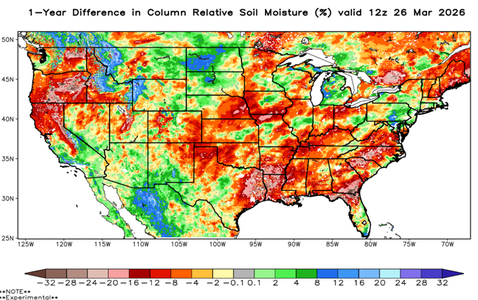
2: Neutral... The 0-100 cm soil RH is lower than this time last year (below), but we still have April to change that.

3: Good.... The NCEP Ensembles suggest a normal 500mb flow pattern returning by the beginning of April.

4: Neutral.... The 700mb temps are still in line with climatology -- but impossible to forecast this far out.

5: Unknown.... The biggest issue ATM will be fuel costs and availability if the war becomes a bigger problem.
 

Attachments

  • soil.png
    soil.png
    398.3 KB · Views: 2
Back
Top