• While Stormtrack has discontinued its hosting of SpotterNetwork support on the forums, keep in mind that support for SpotterNetwork issues is available by emailing [email protected].

State of the Chase Season 2026

Even if you still have a few days of chase vacation remaining, when the risk/reward appears to become too unfavorable to justify continuation, head home...
Something I forgot to mention here related to maximizing your risk/reward probability in a limited time period is to pick a synoptic setup about 3-5 days out in which the 500mb progs [I favored the Limited Fine Mesh (LFM) model depiction] show a full-amplitude open trough approaching the Pacific Coast which becomes increasingly negatively-tilted over time, with short-waves rounding the base that becomes anchored over the Four Corners region for several days. In this particular setup, you will often get a "sloshing dryline" over the TX Panhandle that will produce 2-3+ consecutive days of tornadoes, many very large and photogenic, over treeless terrain with good roads and unlimited visibility in all directions. If you have only one week of chase vacation time, park yourself between AMA-LBB-CDS and feast on days of vortex! (The "Seven Days In May" event, for example, during the early 1970s was exactly that kind of synoptic setup, and is still memorable to this day from my TIP days chasing out of Norman!) As the long-wave trough begins to kick-out, usually western OK to southwestern-central KS (DDC-SLN-ICT) are the next target areas for the following day before the trough finally pulls out of Tornado Alley.

You're likely to be successful doing this in April and May, when this pattern is most likely to develop in any given, even average, tornado season. Bottom line: less wear-and-tear on the body and chase vehicle, fewer driving miles to get into position for the next day, no "dead time" between chase days, and much more likelihood of being rewarded for your efforts...
 
Even if you still have a few days of chase vacation remaining, when the risk/reward appears to become too unfavorable to justify continuation, head home (and save that precious work/family leave time!). It's not a foolproof strategy, but having and sticking to a consistent plan like that takes most of the worry out of the hobby, based on my past experience when I chased every season...

I agree with this. This will be my 30th year of chasing, and I would estimate that close to two thirds of my trips, I have headed home before I had to because the pattern had become unfavorable. I was often frustrated when the pattern turned favorable again, but that was almost always *after* the end of my scheduled vacation; I don’t think by going home early I ever missed anything during the time I could have still chased.

I also agree that having and sticking to a consistent plan has the advantage of taking the worry out of scheduling. For many years, like most people, I had to schedule vacation in advance. It was the luck of the draw, but at least I didn’t have to agonize over whether/when to head out. Over the years, I was fortunate enough to gain more autonomy in my work, and keep my trip somewhat flexible, at least within a three or four week window. As noted, that was a double-edged sword, having to deliberate when to pull the trigger. Randy the example in your other post above about sloshing dryline patterns (don’t recall those happening on my trips very often!) is an easy decision; the harder years were when the pattern was not terrible, but also not ideal. Those were situations where I had only two weeks to chase within a three or four week window, so I had to decide whether to pull the trigger, or wait and hope for something better. Kind of like the old “Let’s Make a Deal” game show - take the visible item behind door number one, or give it up in the hope that what’s behind door number two is better.

Most recently, I’ve had the ability to work remotely, and extend my time out in the Plains from two weeks to three or four weeks. Generally speaking, with that much time, you can’t go wrong choosing early May to early June, or mid May to mid June. Of course, even then you can miss stuff. That’s where long-range forecasting might one day be helpful.

With this type of scheduling, I still delay the start if nothing is happening, and can usually just shift the whole thing and stay later, but still end up coming home early when things quiet down. Although my dream has always been to stay out there the entirety of May and June, and follow the jet stream up to the Dakotas, I’m realizing that may never be affordable. Also, right now with two kids in college, I don’t want to miss what would amount to more than half their summer vacation.
 
Last edited:
"Seven Days In May" event...during the early 1970s was exactly that kind of synoptic setup...from my TIP days chasing out of Norman...
You're likely to be successful doing this in April and May, when this pattern is most likely to develop in any given, even average, tornado season.
I'm glad you had that opportunity, old timer! 😂 For many though, Mother Nature hasn't always been that kind or generous certain years.
 
Although my dream has always been to stay out there the entirety of May and June, and follow the jet stream up to the Dakotas, I’m realizing that may never be affordable.
For many though, Mother Nature hasn't always been that kind or generous certain years.
Yeah, James, that would be ideal if one had the luxury of time and money! When I chased for several years with David Hoadley, he had a preference for the "later season" in June, rather than the more crowded season in April-May, so we spent a lot of time in Nebraska, Iowa, and the Dakotas (I've written about some of those chases in earlier posts). However, in most chase seasons, you can play both TX/OK/KS and NE/SD/ND in two separate outings, depending upon where you live. Many chasers who live in CO and the Midwest do this.

I agree with your observation, William. It seems that in recent years, certainly through the early 2020s, there have been longer periods of drought over many areas of tornado country. Even the mountainous parts of CO have seen much lower than normal snowfall this past winter. (BTW, much of the FL peninsula is also now undergoing extreme drought, since 2025 saw no tropical activity.)

Those kinds of trends have a potential to really mess up the arrival of the "expected" spring storm season across the southern Plains, so what I described from earlier decades may in fact be much more rare nowadays. But these climatic swings are just that, temporary differences and not permanent long-term trends. Just as the 1970s had many sloshing dryline situations over west TX during the TIP years, that same pattern also reemerged again in the early 1990s, just in time for Project VORTEX! I don't recall as many memorable TX Panhandle chases in the early 1980s, however, when I chased out of Norman. So, that 20-year or so period was probably one of those swings. I don't know where the pendulum is right now in that regard...but I'd sure jump on a sloshing dryline situation if one develops this spring!
 
I’ve been like a gladiator knocking things out of the way to keep my May open. The only thing I couldn’t (and didn’t want to) get out of was my youngest daughter’s college graduation which will put me on ice until May 4th. My June has been damn near blocked out with stuff though so May better not feature repeated crashing cold fronts!
 
And now we take you back to our normal programming......

From the Norman forecast office: - "A PATTERN CHANGE BRINGS A FEW ROUNDS OF SEVERE THUNDERSTORM
POTENTIAL MIDDLE AND END OF NEXT WEEK."

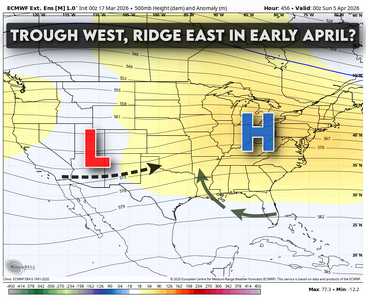
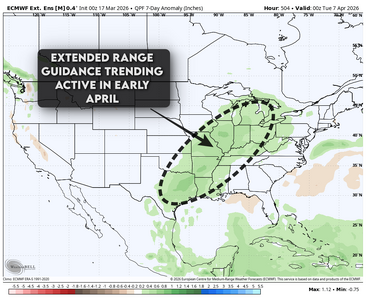
Could be the start of an active period as suggested by some models.
 
Trey Greenwood's 2026 tornado season prediction came out yesterday:
It's definitely worth a watch. I think his past predictions have done fairly well, and his methods seem robust. Some of you might want to see his predictions for May.

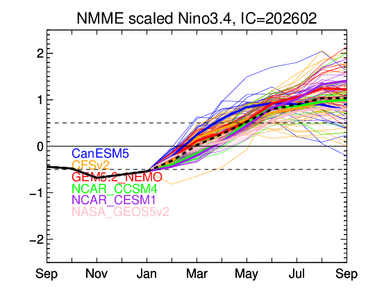
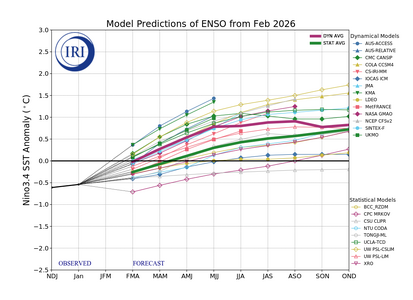
Model guidance seems bullish on the development of El Nino early in the summer.
1772216459638.png1772216480401.png
I'm hopeful for this summer across eastern Colorado. Anecdotal evidence shows that El Nino is usually a good sign for tornado activity here. Analog years like 2023 and 2018 saw average/above average tornado activity across Colorado, although they may not have been the best elsewhere.
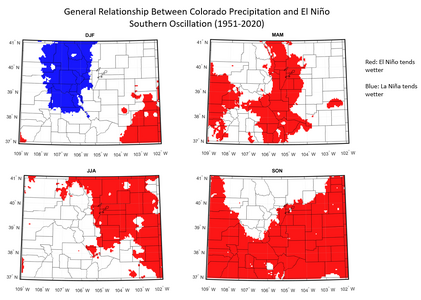
Fig2.12.enso_precip.png
(Reprinted from: Bolinger, R.A., J.J. Lukas, R.S. Schumacher, and P.E. Goble, 2024: Climate Change in Colorado, 3rd edition. Colorado State University, https://doi.org/10.25675/10217/237323)

Interestingly enough, snowpack conditions don't seem to have a strong correlation with Colorado tornado activity over the summer, and many dry years have had average tornado counts, while many snowy years have had low tornado counts. 2018 would be a good example, with a very dry winter and active fire season. Despite that, it seems like there was good chasing to be had in Colorado.

As such, I'm honestly not super worried about the impacts of this dry winter, so long as we can get moisture into the state during the spring months. El Nino will be important for that, as it tends to increase precipitation across the state (see above graphic).
 
Back
Top