Randy knows how to "stir (or stimulate) the pot," so to speak!

Before even going into the actual meteorological science here, you have to look at the state of things and the business.
The concept of "change" is a bottomless pit for ratings/clicks/likes. It is intrinsic to human nature and its connotation is almost universally negative these days. You can blame the climate
change narrative a lot for that. The word has been turned into a harsh pejorative.
Humans fear the unknown, so "change" stated does a great job in implying that. Also, predicting the future. We as a society are
obsessed w/ dystopian/apocalyptic futures. It's nothing new really, just greatly magnified by social media and the age of information.
Having problems, real, exaggerated, or invented, are big business. It can be monetized massively and used for manipulation and control.
But not all change is a problem or bad, but you'd never know that these days.
So the drive/motivation to bring up problems or issues, and thus promote change, is very high. Don't get me wrong, this is not fundamentally a bad concept, but as w/ anything it can and does get abused, and we don't have to kid ourselves in seeing how it is all abused these days!
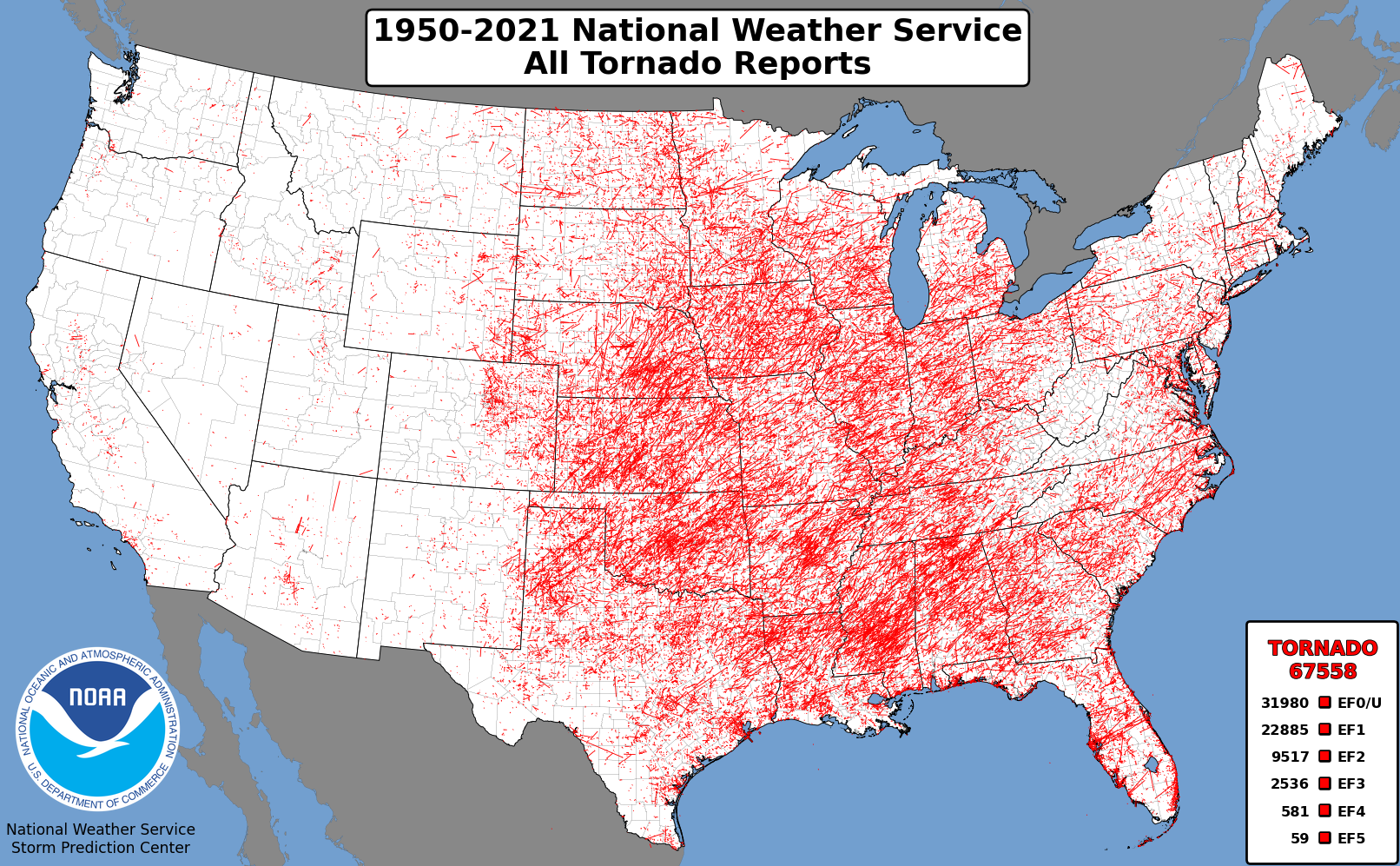
Moving down the ladder as to view, is this apparent tornado frequency and region change a problem really? If it is, is it statistically significant? Does it have scalable impacts? The fact the change occurs, often not much or anything at all is said about *quantifying* the scale of the change. Just b/c change exists, does not mean it needs to be brought up, talked about, addressed, or tons of $$/resources thrown at it to "fix" it.
Going down to the next step to the actual tornado synoptic and mesoscale meteorology, one can talk about atmospheric changes all one wants concerning tornadoes, but the central U.S. being the absolute top by far for frequency of strong/intense tornadoes in the world has very little to do w/ the atmosphere, it is almost entirely due to the geography, which can be considered a *constant*!
1) We have a high N-S mountain chain in the West w/ prevailing westerly flow on top. This does two things on a synoptic-scale.
a) Promotes a strong EML much of the year
b) Lee-side low pressure from that westerly flow over the mountains results in backing of the low-level winds often, so
you get excellent turning of the winds sfc-aloft frequently, even on days where there is nothing much dynamically is
going on
2) E of the mountain range, you have large, flat plains that gradually slope upward, so low-level flow is smoother and
unimpeded for storms and the upward sloping terrain aids in convective initiation and maintenance (e.g. LLJ)
3) A large, relatively shallow, very warm body of water close-by.
4) The Plains are continental climate, while as you get farther E, it becomes more a marine-influenced climate.
Continental climate tends to be more unstable for the EML reason above. Farther E, deeper-layer moisture in the
mean causes mean instability to wane.
So you essentially can't take away the above in a changing climate.
Farther E, tornado potential is more limited overall. Why?
1) The EML weakens or is "used up" by convection that occurs in the Plains and/or the more moist climate
2) Low pressures have matured here vs. initial cyclogenesis and intensification farther W. You have better shear profiles
w/ developing low pressure.
An issue I see a lot these days is that things are too often viewed in a vacuum, or too focused, not considering all factors out there. Some of this is ignorance, but more often it is disingenuous omission of facts b/c it would deflate the narrative (problem/change) put forth in the first place!
And then we have the issues w/ the tornado dataset, not just how detection/documentation has changed over time, but ongoing today b/c tornadoes are only rated by proxy, not directly, for strength. Going from the Plains to the MS Valley and E, there are simply more damage indicators, natural and artificial, to reveal tornado strength better. Also, a significantly larger population and more cameras to more fully document tornadoes here. I would argue that we have many more strong/violent tornadoes in the Plains compared to the E, but we have no way currently to measure that. How many times does a tornado get a low or no rating in the Plains simply b/c it did not hit anything, but clearly from appearance alone, you know it is strong/violent?
Also, I would argue the number of weak/short-lived tornadoes missed/not documented the Plains is significantly higher than to the E, again, simply b/c of less population and infrastructure.
With a dataset w/ so many holes/gaps big and small, you have to wonder the veracity of such claims in trends in either direction. Not that there is zero change, b/c things are always changing to some degree, bu I got back to scaling/quantifying it all. Is it something we have to be concerned about or do anything? Too often for non-scientific reasons, mountains are made out of molehills or it's all about posting content, and veracity/quality be damned.