All excellent discussions above.
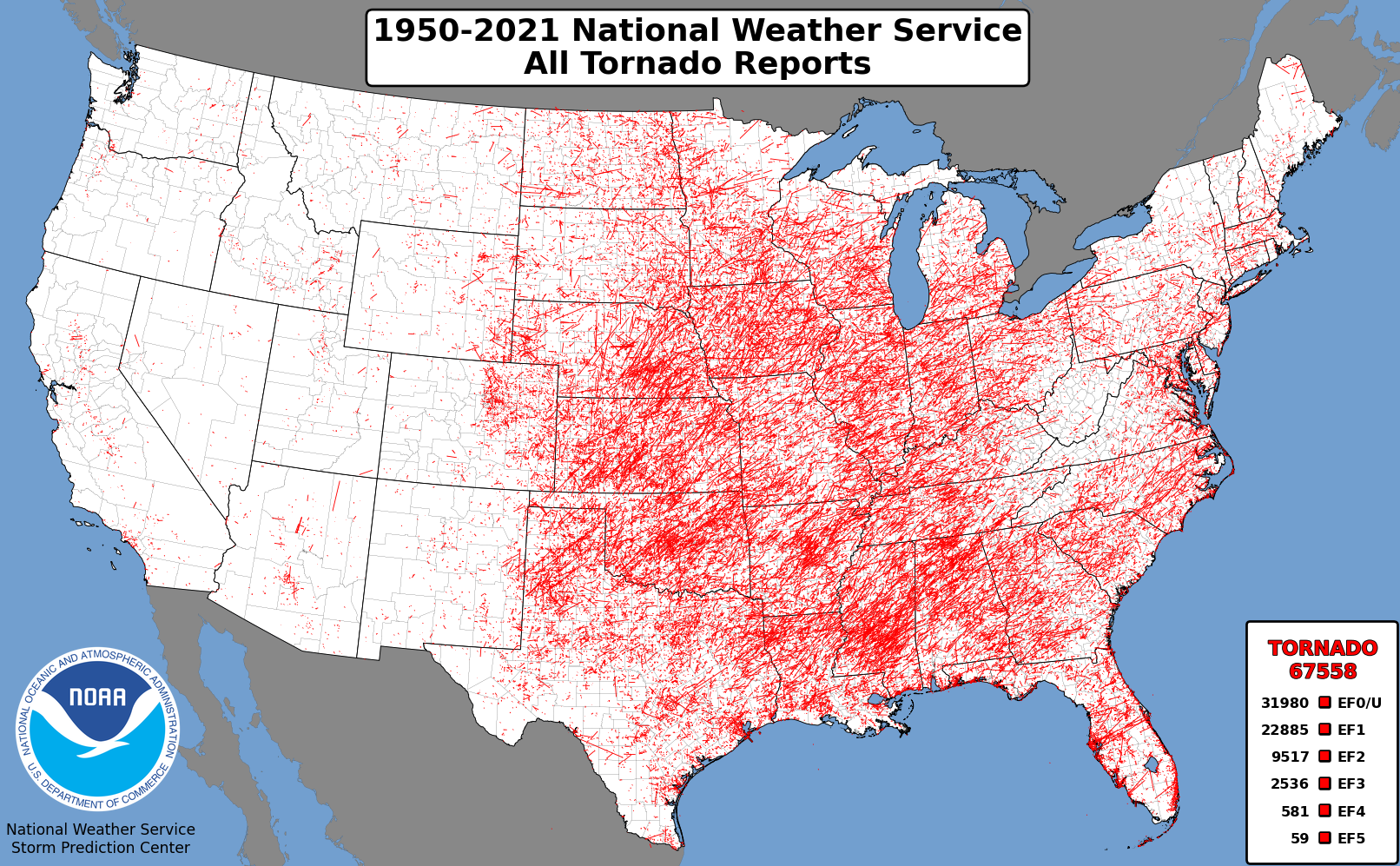
It would be an interesting project to contrast these findings with the Palmer Drought Index trends over similar, long-term periods. If the tornado-shift trend is really permanent rather than cyclic in nature, it might logically follow that this tornado shift might be related to dryer-for-longer climatic conditions over Tornado Alley which potentially disrupt the return of low-level Gulf moisture in spring months that severe (and non-severe) storms are so dependent upon. In addition, a shift in where tornadoes are observed and reported may also be a function of evolving demographic trends: more tornadoes are being reported where more people are moving into; over the "long haul," recorded storm data may become skewed to mirror such population movement and especially urbanization. For example, if more people are leaving rural areas of Oklahoma and Kansas and are relocating in Missouri, Iowa, Illinois, Indiana, Ohio and Kentucky, as part of a systematic trend seeking more urbanized economic opportunity, the tornado threat could also "move" eastward. Perhaps the tornado-frequency centroid is not really moving, but rather reflecting a redistributing or shuffling of population, which may or may not be either long-term or permanent.
But in the end, however, all natural world, observed "trends" are destined to cease sooner-or-later because the natural "norm" over years, decades, centuries and millennia is randomness. Observed trends are human constructs, usually designed to satisfy some short-sighted, fleeting, human-aided agendas which, in turn, perpetuate the "trend(s)" in a seemingly-endless feedback loop. Could the observed shift of Tornado Alley be an example of this: more man-made than of natural occurrence? Likely, it's some combination of both, as random natural events (such as long-term drought) may lead to permanent human actions or changes [such as seeking cooler or wetter (stormier?) places to live].
One thing is for sure, however: like "global warming," the "tornado-shift" question has been kicked around in meteorological circles for nearly half-a-century and is not going away anytime soon...