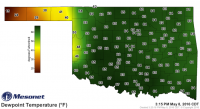
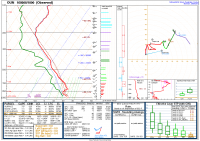
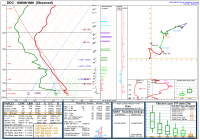
... I ended up foregoing the 14 plus hour drive from Michigan initially because of my concerns with deep layer moisture, but after watching the SPC mesoanalysis page on and off throughout the day, I quickly realized that that wasn't going to be an issue, in turn causing me to question my decision.
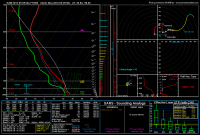
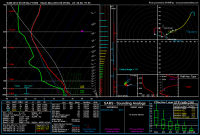
Both soundings show a a pretty solid cap, we these were at 1PM locally.
What are your thoughts?
I can't chase as much as I used to owing for family reasons, and I opted to sit this one out despite being in the Oklahoma City area. By yesterday morning, model forecast wind profiles were going down the tubes (no pun intended), which played heavily in my decision to "save up" my chase days (hey, I'd have to use a lot of familial political capital to ditch my wife and son on mother's day after being out of town for a week ;P ).
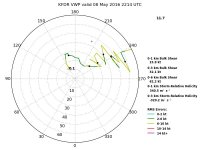
The shear profiles were unremarkable despite, as has been the case several times so far this spring, earlier model forecasts of strong low-level shear. A weakness in the flow around 700-750 mb and, in perhaps a few small area, a veer-back-veer vertical wind profile yielded S-shaped hodographs that looked unsupportive of significant tornadic supercells. [As Jeff notes below, you don't necessarily need veer-back-veer to get an pseudo-S-shaped hodograph. In this case, the weakening of the flow from ~850 to ~700 mb was the nasty part, IMO). Indeed, in the entire risk area in Oklahoma, there was only a single, briefly tornadic supercell. For the most part, left-moving, anticyclonic supercells were preferred over the right-moving, cyclonic supercells; there looked to have been more negative SRH for left movers than there was positive SRH for right movers. Looking at the hodographs across central and western Oklahoma, this is not surprising. The zone of strong destabilization and weakened CINH was also not particularly large owing to the cloud cover that persisted across much of central Oklahoma.
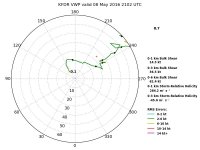
@Jeff Duda posted the following on Facebook (I don't think he'll mind me posting it here since it's weather related), which is the hodograph based on the FDR VWP/VAD valid a little after 22z. "Blech" in terms of a significant tornado threat... (Click any of these thumbnails to enlarge)
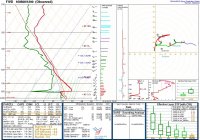
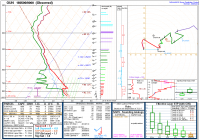
Below is the 00z OUN sounding, which wasn't that far from the briefly tornadic supercell east of Lawton. Note that there is only cross-wise vorticity above 1 km AGL. As was the case a couple of weeks ago, the 0-1 km SRH wasn't too bad, but the 0-3 km SRH was on the low end for supercells. Not too that the cap was going to quickly devour any surface-based storm that approached the I35 corridor, which is pretty much what happened (note convective temperature of 89 F where surface observations showed 2 m AGL temperatures in the low 70s).
If we go into model analyses to look a little west of the I35 corridor to get closer to the storms, we see hodographs that are no better... Example below from the 00z NAM analysis for a location near Lawton (first image) and somewhere between Alva and Coldwater just north of the OK/KS border (second image):