
Jody Radzik
EF2
Please correct me if I'm wrong, but I believe this to be a low top supercell snow squall that formed over the Truchas Mountains in the Sangre de Christo range of the Southern Rockies, 40 miles north of Santa Fe, NM.
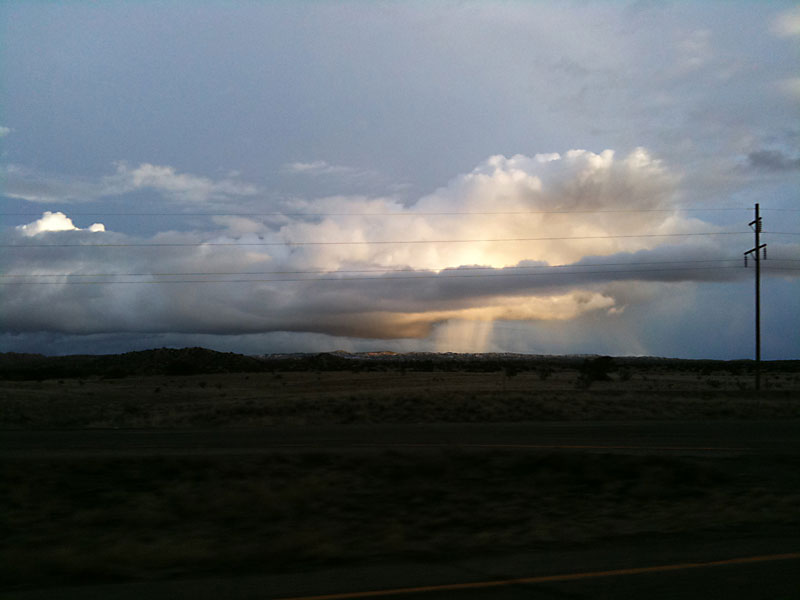
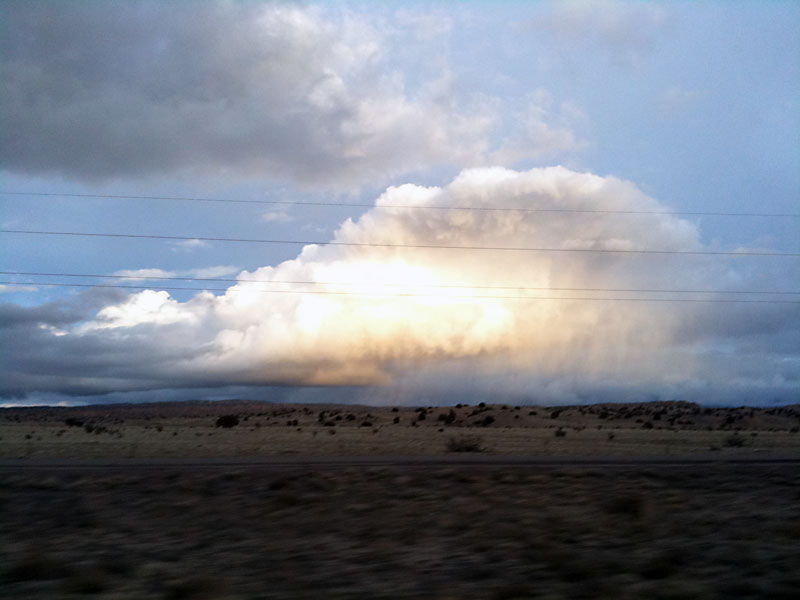



supercell—An often dangerous convective storm that consists primarily of a single, quasi-steady rotating updraft, which persists for a period of time much longer than it takes an air parcel to rise from the base of the updraft to its summit (often much longer than 10–20 min).
Most rotating updrafts are characterized by cyclonic vorticity (see mesocyclone). The supercell typically has a very organized internal structure that enables it to propagate continuously. It may exist for several hours and usually forms in an environment with strong vertical wind shear. Supercells often propagate in a direction and with a speed other than indicated by the mean wind in the environment. Such storms sometimes evolve through a splitting process, which produces a cyclonic, right-moving (with respect to the mean wind), and anticyclonic, left-moving, pair of supercells. Severe weather often accompanies supercells, which are capable of producing high winds, large hail, and strong, long-lived tornadoes. See also convective storm, thunderstorm, splitting convective storm, cell, bulk Richardson number.


2. Jody, do you mean that the time was 0037Z March 1 (i.e. 5:37 MST Sunday, Feb 28)? Looking at the radar archive, it doesn't seem to show much snow shower activity near Truchas - seems to be a bit farther southeast at that time. Could the photo have been taken earlier than that?
I suppose theoretically it is "possible" to get a supercell that precipitates only snow, but it would very VERY unlikely. You'd have to have temperatures aloft to be cold enough to get enough CAPE to get a strong enough updraft to generate such a storm. The Albequerque, NM sounding from 00z 1 March shows only 145 J/kg of SBCAPE, but less than 20 kts of 0-6 km shear and less than 20 m2/s2 of SRH. I doubt such instability and shear could create a supercell. Not to mention, the freezing level was 3300 ft AGL, so any actual snow falling from under the cloud base would certainly have melted into rain or evaporated completely by the time it reached the ground. So technically, that wouldn't even be a snow-producing supercell.

That said, other than the rotation, I was assuming that a snow squall could in fact be a low top supercell.


