
Andy Wehrle
EF5
Throw it (this season) in and strike the match!



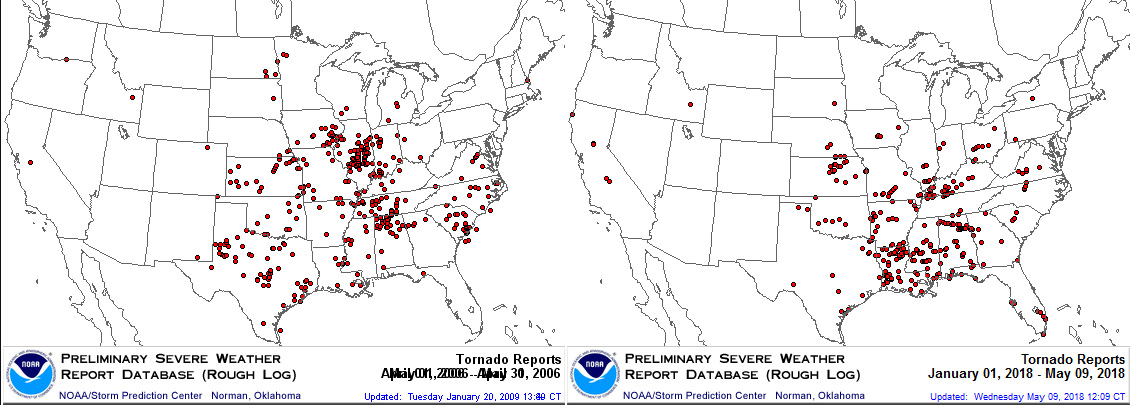

Since 2006 has been brought up a few times as one of the quintessential definitions of an awful chase year, I did a little comparison strictly with tornado numbers and placements. The image on the left below is JUST April and May of 2006. The image on the right is all of 2018 so far (and I think the number of dots will be damn near exactly the same a week from now). It's pretty easy to see that 2018 is far worse than 2006 was. There's always still June to turn this thing around, but purely by tornado numbers in the plains 2006 doesn't hold a candle to 2018's atrociousness.
Here is the site to do that on: http://www.spc.noaa.gov/climo/online/monthly/newm.html#2018Thanks for that Brett. It would be interesting to see a similar comparison just for severe weather reports because I feel like there have at least been more storms this year whereas in 2006 it was just blue sky. Of course, that is just my recollection of the particular time I was on my chase vacation in 2006 so purely anecdotal and subject to my fading memory of that year...


This year has been worse than 2006 YTD, but so was 2014 and several others. What puts 2006 near the very bottom for me is that the prime season (May-June) was basically worthless. March-April were actually somewhat active, which accounts for why we're running behind its pace right now. But, as is typical of early season events, the vast majority of that activity in 2006 was moisture starved and junky. I think April 6 and April 24 were the only remotely noteworthy Plains tornado chase ops of the entire spring, and they were probably both less memorable than this year's Tescott event.Since 2006 has been brought up a few times as one of the quintessential definitions of an awful chase year, I did a little comparison strictly with tornado numbers and placements. The image on the left below is JUST April and May of 2006. The image on the right is all of 2018 so far (and I think the number of dots will be damn near exactly the same a week from now). It's pretty easy to see that 2018 is far worse than 2006 was. There's always still June to turn this thing around, but purely by tornado numbers in the plains 2006 doesn't hold a candle to 2018's atrociousness.

Here is the site to do that on: http://www.spc.noaa.gov/climo/online/monthly/newm.html#2018
Using hail reports up through the end of April only (2018 stats only go through May 9), 2006 had 6183 reports compared to 711 reports for 2018. Now, somewhere along the line their criteria for severe hail may have changed because the stats for 2006 are so much higher. But if you look at the monthly totals for recent years - even poor ones - a typical April will have more severe reports than we've had all year so far. It's been horrifically slow any way you look at it.


What should also be factored in is the redundant reporting that happens more frequently now when you have several chasers/spotters reporting on the same event. I have mentioned this in the past as I believe (from reading the reports on SPC), that there can be as many as 4 or 5 tornado, wind, or hail reports on the same storm in the same location and time. I think, and someone correct me if I'm wrong, the National Weather Service should filter these reports down to one for each cell, time and location.
So with that being the case, a true comparison of this season and how many Tors, hail, and wind events actually occurred wouldn't happen until next year when all the data is sorted. It still looks pretty bleak so far. Also wondering if, when the season is bad and less chasers go out, if the storm coverage reporting-wise is reduced and many events go unreported thus compounding the bad season statistics.They do. That's why Storm Data is published relatively well after the fact, and why the previous year's severe reports aren't made available until usually the following April or May. Looking at SPC's WCM page, it appears 2017 hail and wind reports are in and finalized, but tornado reports are still being worked on.

Also wondering if, when the season is bad and less chasers go out, if the storm coverage reporting-wise is reduced and many events go unreported thus compounding the bad season statistics.


