• While Stormtrack has discontinued its hosting of SpotterNetwork support on the forums, keep in mind that support for SpotterNetwork issues is available by emailing [email protected].

2011-05-24 - FCST KS, OK

Joined
Mar 10, 2010
Messages
116
Location
Parsons, Kansas
OK.. here's my attempt.

Looking at the 18z nam... I would expect initiation at about 4 or 5PM Central. Strong CAPE of 3-4k all afternoon into evening. Shear looks the best across SC and SE Kansas. I am a little raw on the ScewT's and would welcome any thoughts on them for my target areas below. EHI looks solid in the +3 range on the +30 run in SE KS and NE OK.


Target.. Either Ponca City or Ark City... with my prefered location being Ark City.


I get the feeling I am too far east as the triple point appears to be near Medicine lodge. But everything else looks better to the east. My biggest forcasting weakness is when the cap breaks and the exact timing of initiation.

Well, how did I do?
 
Tuesday, May 24, 2011 certainly looks like an interesting setup . Both the NAM and GFS point
to fairly strong flow aloft at moving into the southern plains near 00Z Wednesday. A pretty significant
shortwave trough and winds at 500mb at 50 kts or greater should be moving into central and southern oklahoma
and into north Texas at around the same time. According to NWS OUN THIS IS AN OMINOUS LONGWAVE
PATTERN FOR THE S PLAINS IN LATE SPRING." The NWS FTW is also using somewhat srong language by mentioning "a TORNADIC THREAT MAY ACCOMPANY THIS CONVECTIVE
EPISODE". A surface low should develop near the Texas Oklahoma border and move east during the evening. The dryline should make steady progress eastward but slow or stall near I35 by 06Z Wed May 25. CAPE according to the GFS looks to be extremely high...in the order of 5000JG or more across Oklahoma and as much as 4500JG into north Texas. Now of course with previous storms, cloud cover and left over boundaries may change this potential instability.
..during this La Nina pattern which even though is weakening and approaching a neutral phase I have noticed time after time this spring where the dryline has been on top or east of I35 during this spring. I can think of no more than 5 or 6 tornado watches west
of I35 so far this spring in the southern plains. The average dryline position lately seems to be a good 100 maybe 150 miles east of where it should be this time of year. I mention that only to say I get a bit concerned when you have high potential instability, a negative trough and strong upper forcing moving into the southern plains and a dryline a little bit closer into major cities such as DFW, OKC during late May. This appears to be a significant high end event for the southern plains from north Texas into Kansas and certainly bears watching.

Edit...I will also say that I think this could keep going well into the evening and overnight hours...I think anything is in play from Wichita Falls Texas to Wichita Kansas and as far south as the DFW area.
Edit...just a quick glance at the RUC ....even though it only goes through 15z Tues...it does appear that that 500mb jet is unusually far south and I would not be surprised if a higher end threat becomes a real possibility for north Texas....
.....frankly this reminds me a bit of April 26, 1991...upper level winds are not as strong as that event...but high end instability may make up for the difference...amazingly...I think the upper level winds are actually a bit further south than the April 26, 1991 event.....I was out that day in one of my first early chases and learning experiences....I first drove to Wichita Falls only to find myself already behind the dryline....quickly realizing my mistake and heading north up the turnpike to OKC only to hear on my scanner the first reports of the tornado that would later become the Red Rock tornado....
 
Last edited by a moderator:
Looking at this morning's info I would adjust my target area to Enid as the dryline isn't pushing as far E. I could always position and look at the visible then head back to Ark City or Ponca. EHI is off the charts in central OK, but the shear is not as favorable as I would like. CAPE is pushing 7000.

IF I'm looking at the data properly I could take the warm front play in Eldorado or Newton area to avoid some chaser convergence..
 
12Z RUC run for 2100 shows a dryline punch north Buffalo Ok right along the Ks/Ok border. This area is in the left exit region of the jet at 250, 500, and 850mbar Projected 500mbar vort max east of the Tx/Ok border and N of I-40. Cap will be broken. Mesolow in SW Kansas that moves N and E between 21z and 00z. CAPE becomes extreme (maybe even ludicrous) east of the dryline, and by 00z 3km helicity is also sinigifcant. Storm motion to the NE. Initial target at this point is Alva Oklahoma
 
Hey Robert... what do you think about the shear in the area? The crossover doesn't look that good... everything else is prime, but the shear doesn't loook that good. THoughts?
 
Projected hodograph for is a nice loop, albeit with a kink. Projected 3k helicity isnt much around Alva itself at 2100 but later on and slightly east look out. I dont know - I am very very much beginner at forecasting. Everything cant be perfect. I stll think this will be a big day
 
Projected hodograph for is a nice loop, albeit with a kink. Projected 3k helicity isnt much around Alva itself at 2100 but later on and slightly east look out. I dont know - I am very very much beginner at forecasting. Everything cant be perfect. I stll think this will be a big day

I'm not saying you were wrong... just interested as to how you got there. Thanks.
 
The RUC shows convective precip developing in three main areas this afternoon near 00Z Wed. One....near Enid Ok,Two west of OKC and three just west of Fort Worth Texas. 12Z Roab show a stronger 500mb jet moving across southern AZ and New Mexico this morning and this supports the 06Z models according to NWS Fort Worth. This may push the dryline much closer into the FTW CWA this afternoon .....I still believe a significant high end event may occur across areas north of I20 this evening...this is too close for comfort for the DFW metroplex and points north.
 
IF I'm looking at the data properly I could take the warm front play in Eldorado or Newton area to avoid some chaser convergence..

This is looking better and better with the latest data... based on that data I would probably move my target to Mcpherson, but the shear looks great up there.

Any feedback?
 
This is looking better and better with the latest data... based on that data I would probably move my target to Mcpherson, but the shear looks great up there.

Any feedback?

Personally, I wouldn't chase that far north if I were actually out. The shear that far north is weaker in the mid-levels as the 500mb jet doesn't allow for as much veering. The best shear is further south with 500mb winds turning to the west in southern OK and north TX. This directional change will hold off linear storm modes and promote discrete structures as there will be more directional shear further up in the atmosphere instead of more unidirectional winds from the 700mb to 200mb as is the case farther north.

Does that help you any?

Chip
 
Personally, I wouldn't chase that far north if I were actually out. The shear that far north is weaker in the mid-levels as the 500mb jet doesn't allow for as much veering. The best shear is further south with 500mb winds turning to the west in southern OK and north TX. This directional change will hold off linear storm modes and promote discrete structures as there will be more directional shear further up in the atmosphere instead of more unidirectional winds from the 700mb to 200mb as is the case farther north.

Does that help you any?

Chip

Yeah that does help... I must be looking at the data wrong. as what I am seeing shows the better directional sheer a little to the North. Maybe it's my methodology. What is the best way to determine shear quality across mb? I have always leaned on Crossover looking for the classic right angle as it applied to mb. Typically that has been right on.
 
Yeah that does help... I must be looking at the data wrong. as what I am seeing shows the better directional sheer a little to the North. Maybe it's my methodology. What is the best way to determine shear quality across mb? I have always leaned on Crossover looking for the classic right angle as it applied to mb. Typically that has been right on.

Forecast skew t's are good for finding out what the winds do with each height.
 
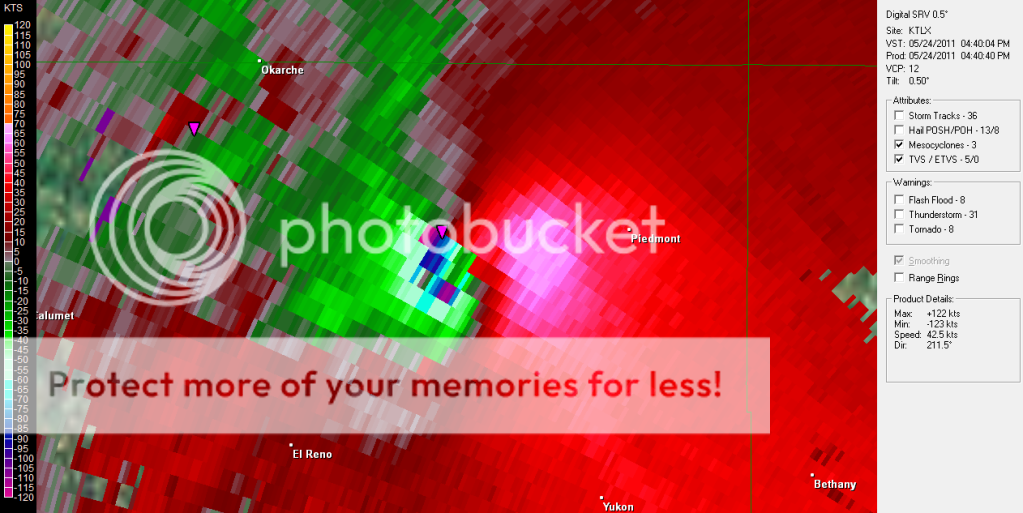
Very strong couplet on the same storm now near Piedmont...

piedmontokcouplet.png
 
Back
Top