A 100% crop is where you take the full size *unedited, non-sharpened* image and then cut a small piece out of it at 100% resolution to see how crisp things are. Usually it's best to do this in the center and then also at the left or right edge. It also matters a lot what aperature you shot the photo at when checking quality -- try one at f2.8, then f4, then f8, to see how well it performs wide open and how far down you have to stop before it gets real crisp. Superwides by nature are pretty hard to get good edge reproduction on.
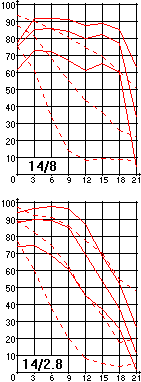
On paper, the Sigma looks pretty good, though not in the same league as the Canon L glass. Looking at the MTF for the Sigma 14 @ f8 & wide open:
It looks pretty good, though I would avoid f2.8 if possible.
Canon's old 14mm seems to wipe the floor with the Sigma, though, but the price is like $1,000 more:
Given the on a 1.6x crop you won't see so much of the edges, and since the Sigma performs really well near the center, it's probably a great match to a digital Rebel or a 20D. I dunno if I'd want to use that on a 35 film based camera or one of the new full-frame digitals, though. (On the other hand, if you need 14 mm and shoot EOS, Sigma and Canon seem to be the only worthwhile choices. And for po' folk like me, Sigma would be the *only* choice!)
*edit*:
How to read an MTF Note that with the Sigma, 10lp/mm, 20lp/mm, and 40lp/mm are shown, whereas with the Canon only 10lp/mm and 30lp/mm are shown. Basically, what this means is that only the 10lp/mm plots can be used for direct comparison between the two lenses. Which is probably the most important plot, anyway.