• While Stormtrack has discontinued its hosting of SpotterNetwork support on the forums, keep in mind that support for SpotterNetwork issues is available by emailing [email protected].

2026-03-06 EVENT: OK/KS/MO/IA

Joined
Jan 14, 2011
Messages
3,642
Location
St. Louis
The first potentially major chase event in the Great Plains this spring will be the second of a two-day sequence brought by the western longwave trough as a potent shortwave ejects into the southern/central Plains on Friday, March 6.

The GFS paints the most favorable picture for tornadoes, with not only a negatively-tilted wave wrapping the warm sector back into the surface low near Sioux City, but the dryline is shown being the initiating boundary all the way up into the low. The Euro, GEFS ensembles and the NAM however depict a much less appealing configuration, with the wave remaining positively tilted and boundary-parallel flow over a southwest-to-northeast oriented cold front. The other big negative is that all of the models have 700mb temps topping out at 6C, with nothing resembling a functional cap in forecast soundings anywhere in the warm sector.

At this time, the GFS's more classic-looking setup unfortunately is the outlier. Even if it wasn't, the lack of capping and strong forcing favors early upscale growth - and a cold front with boundary-parallel flow would just further encourage that outcome. There is a possibility for the other models to come around on the orientation of the synoptic features, but even then, it doesn't appear we'll have the benefit of a capping inversion to keep early upscale growth at bay.

Right now this doesn't look like a "fly or drive across the country/world" setup to jump on, but certainly a good season opener for the Plains.
 
The first potentially major chase event in the Great Plains this spring will be the second of a two-day sequence brought by the western longwave trough as a potent shortwave ejects into the southern/central Plains on Friday, March 6.

The GFS paints the most favorable picture for tornadoes, with not only a negatively-tilted wave wrapping the warm sector back into the surface low near Sioux City

Man, if only model agreement/consistency was better on that scenario. Seen some huge days result from setups like that in this region in recent years, including some pretty early in the season. 3/5/22, 3/31/23 and 4/26/24 in particular. It's not foolproof (nothing with the atmosphere is), but when the pattern is configured like that it has a way of overriding any caveats about thermodynamics, storm mode, etc and just making it happen.

As you said though for this Friday it is the outlier, and the models seem to be sticking to their guns as the event draws closer (including the freshly minted 0Z Wednesday suite).
 
12Z Wednesday models have not answered any questions yet. 06Z Euro is still dug in, leaving the GFS the solo minority report. We'll see what the 12Z Euro does soon.

Most CAMs hint at morning precip. That's not a surprise after Thursday and also with the temperature profiles. If the broader system can achieve something like what the GFS shows, then one might look for the morning rain, midday break, afternoon development scenario.

Kinematics are capable of tornadoes, but storm mode may be a mess. Doesn't look like a travel chase day. Still a boundary left from morning rain could offer locally better low-level parameters on Friday. Location TBD.
 
Eastern Kansas may be the play. This early in the season two days in a row northern target would be wild. Seems like that 10% is for a concentration of cells which could be in the form of a line or nearly so...

Which makes Kansas attractive long as the southeast Kansas morning convection in progress ejects out and dissipates. Can't have that cutting off low level flow. Surface chart indicates it's not a major problem, but one needs time for the LLJ to recover a bit off the surface.

That same southeast Kansas activity is likely laying down meso-scale boundaries. See if a few cells can develop ahead of the CF in Kansas later this afternoon. Models are all over the place. Activate late season non-model techniques.
 
I agree, models are pretty useless right now. All morning the HRRR hasn't even been initializing with what's shown on radar currently. It's a satellite-and-surface-obs-only day. I'm a little concerned about the morning activity. It's taking its time getting east. I'd want it to already be exiting the target area by now, and it's producing anvil blowoff that might stunt heating in eastern Kansas/western Missouri and as Jeff says, you don't want an MCS in your inflow.

Of note is most of the models are signaling some possible tertiary targets in the Midwest. A warm front surprise in Chicago maybe? The background environment over here is adequate: 35kts and above aloft, better moisture than in the Plains targets, but less deep- and low-level- shear. The question is will the Midwest see sustained convection? It appears we might be in between waves, in subsidence all afternoon thanks to a small leading shortwave that just went through. I'm staying close to home today and will be leaning on the cu fields on satellite.
 
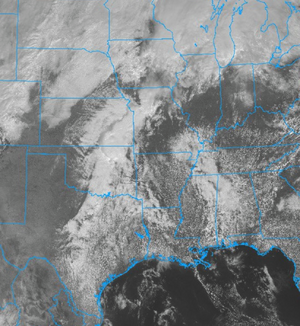
While the HRRR is not, a number of 12z CAMs are doing what I would classify as a decent job depicting the early convection and cloud cover over portions of northeastern Oklahoma and eastern Kansas. In all cases, those CAMs are depicting airmass recovery with re-initiation in the 20-23z timeframe, albeit with some questions around storm mode. However, current observations seem to show earlier and heavier cloud cover than depicted, and possibly longer lasting. Meanwhile, an area of clear skies exists from Missouri through central Illinois into northern Indiana. As noted above, dewpoints and upper level support seem adequate in central IL, but more disagreement among models on initiation there. I think there's hope that current convection gumming up the plains target will intensify this evening as it enters central IL area. Not very useful if you're currently eating lunch in KS.
 
I was initially looking at heading to Emporia but the clouds are too damn thick and I have other obligations tomorrow in the area, so I think my best play today is an isolated cell back on the clearing side where diurnal heating is already occurring. Just arriving in Coldwater now and it's partly sunny with scattered clouds but already 70°.

IMG_9021.png
 
Is anyone else seeing a lot of model data sites either very late or not updating? All of the NSSL CAMs, Pivotal, and WoF all have their last update time between 00z and 12z. Did the links all change, or is there some sort of outage going on? COD is still current, so an outage doesn't seem to be the case. Maybe one of the data feeds the other sites pull from?
 
Is anyone else seeing a lot of model data sites either very late or not updating? All of the NSSL CAMs, Pivotal, and WoF all have their last update time between 00z and 12z. Did the links all change, or is there some sort of outage going on? COD is still current, so an outage doesn't seem to be the case. Maybe one of the data feeds the other sites pull from?

I had the same issue Wednesday night around 20:35 MST. I just assumed it was the latest runs hadn't dropped yet because the models I was looking at did not coincide with anything I was seeing from the SPC. It wasn't until shortly after midnight when everything started to line up.
 
I was talking to my Dad and he said to consider playing the triple point up between Mankato and Manhattan, but I didn't care for the terrain or the 3.5 hr scamper up there, so I've decided to head back to the NE. I'm eating lunch in Wichita now and then headed up to Emporia (which ironically was my primary target this morning until I saw the cloud cover).

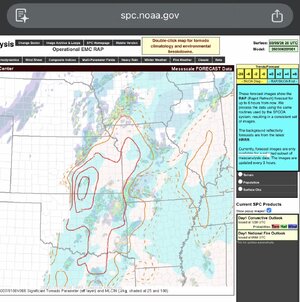
SPC has an STP of 4 for Wichita at 8 pm. And the HRRR spits out a couple of isolated cells here.
IMG_9025.jpeg
 
Back
Top