
Luke Penney
EF1
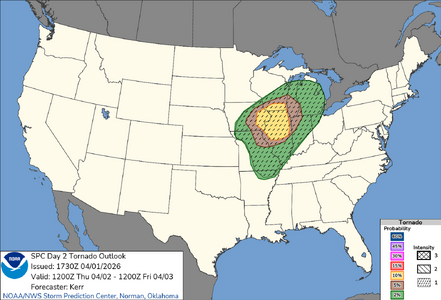
On Thursday and Friday we might be getting a pair of potential chase opportunities all the way up here in the upper Midwest again. (This thread is just for Thursday; I or someone else can create a Friday thread if it's looking promising when we get closer. Friday's set-up does look surprising similar to Thursday at first glance.)
We have a shortwave trough with a notable surface low coming through, along a near-stationary front. Models are showing lots of storms earlier in the day, with a new line of storms forming up afterwards in the mid- or late- afternoon, and it's these later storms where conditions are promising.
The earlier precipitation plus powerful winds from the south (40+ knots at 925mb) mean that unseasonable moisture is expected.
This set-up has a warm front along the IL/WI border, with a cold front coming in from IA. The most interesting-looking storms are forecast to initiate near the cold front, which makes me nervous about undercutting, but almost all the models I've seen are putting the storms in the warm sector, ahead of the low-lying cold air. (Naturally, it'll be good to watch for a storm right on the warm front for the increased vorticity and convergence there.)
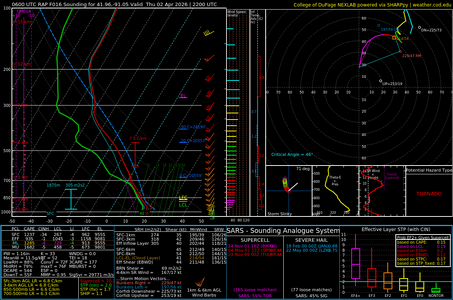
The CAPE in general is nothing to write home about (1,000-1,500 J/kg), but the 3CAPE is impressive, present over a wide area with 50+ to even over 200 J/kg, potentially. Mid-level lapse rates generally look good (on the order of 7 °C/km); low-level lapse rates are much more of a question mark (presumably depending a lot on how much the earlier clouds clear out).
There's 50+ knots of wind at 500mb, but unfortunately it's somewhat parallel to the front, and models show a mixed-linear mode to storms. Low-level hodographs are very enlarged, but they are more snarled-together at higher levels. There's a lot of vorticity around the target storms, which is promising for creating the "tornado cheat code" of 3CAPE+vorticity. There's also a lot of storm-relative helicity.
Overall, I like the low-level dynamics of this set-up, but the potentially linear mode and undercutting cold air are significant concerns. I also suspect this set-up is relatively sensitive to the details of how it plays out (e.g., how quickly the earlier storms depart; and the area where there is good hodographs, CAPE, and not cold low-lying air isn't huge).
We have a shortwave trough with a notable surface low coming through, along a near-stationary front. Models are showing lots of storms earlier in the day, with a new line of storms forming up afterwards in the mid- or late- afternoon, and it's these later storms where conditions are promising.
The earlier precipitation plus powerful winds from the south (40+ knots at 925mb) mean that unseasonable moisture is expected.
This set-up has a warm front along the IL/WI border, with a cold front coming in from IA. The most interesting-looking storms are forecast to initiate near the cold front, which makes me nervous about undercutting, but almost all the models I've seen are putting the storms in the warm sector, ahead of the low-lying cold air. (Naturally, it'll be good to watch for a storm right on the warm front for the increased vorticity and convergence there.)
The CAPE in general is nothing to write home about (1,000-1,500 J/kg), but the 3CAPE is impressive, present over a wide area with 50+ to even over 200 J/kg, potentially. Mid-level lapse rates generally look good (on the order of 7 °C/km); low-level lapse rates are much more of a question mark (presumably depending a lot on how much the earlier clouds clear out).
There's 50+ knots of wind at 500mb, but unfortunately it's somewhat parallel to the front, and models show a mixed-linear mode to storms. Low-level hodographs are very enlarged, but they are more snarled-together at higher levels. There's a lot of vorticity around the target storms, which is promising for creating the "tornado cheat code" of 3CAPE+vorticity. There's also a lot of storm-relative helicity.
Overall, I like the low-level dynamics of this set-up, but the potentially linear mode and undercutting cold air are significant concerns. I also suspect this set-up is relatively sensitive to the details of how it plays out (e.g., how quickly the earlier storms depart; and the area where there is good hodographs, CAPE, and not cold low-lying air isn't huge).