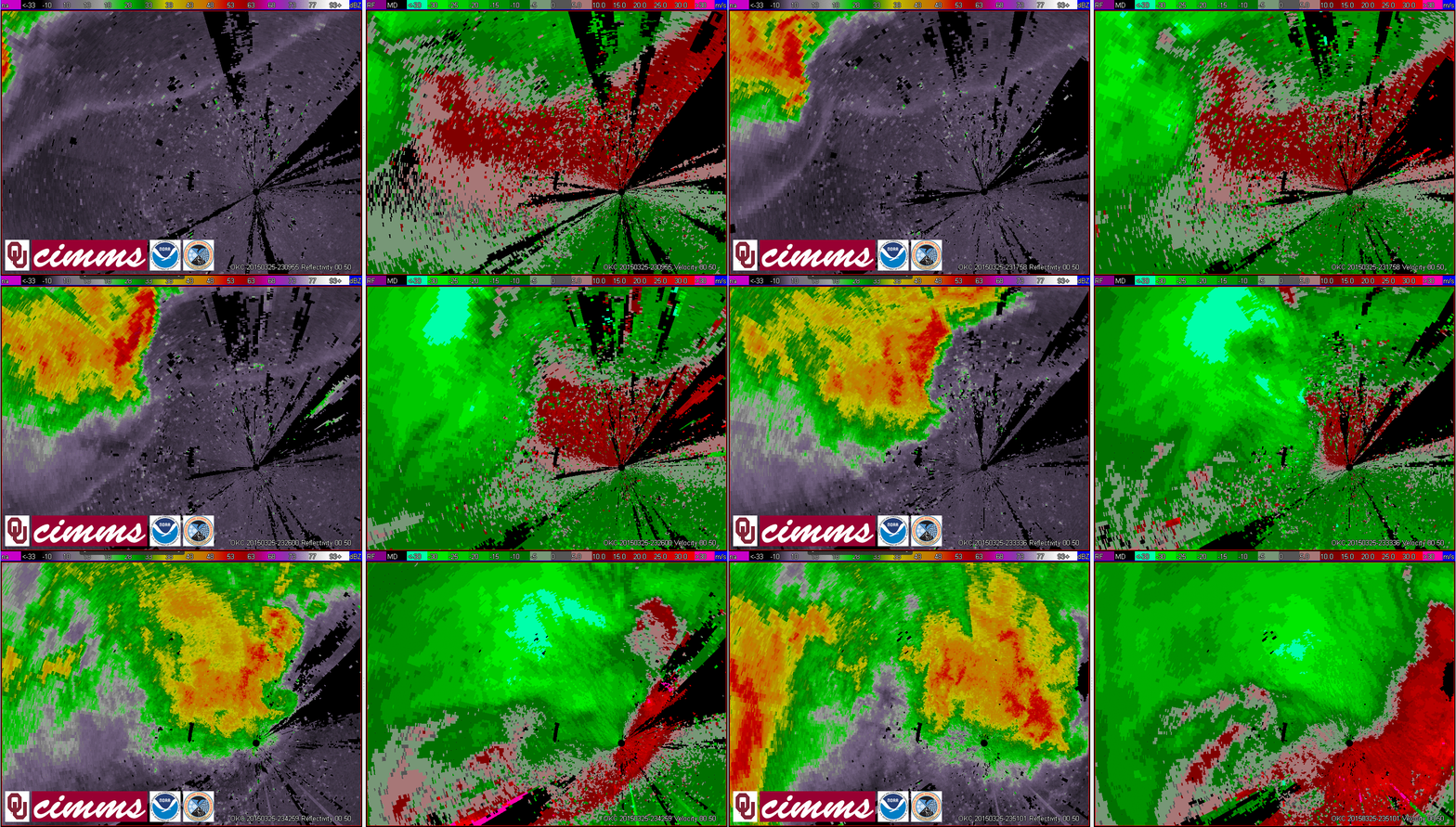
I see both sides of the perspective from the Norman/Moore area.
I don't know what the internal NWS criteria is for issuing a tornado warning, or perhaps, more specifically, what OUN's individual threshold may be if a WCM at a specific office can have a somewhat unique set of criteria for that individual office.
With that having been said, monitoring the situation from home, the storms that fired west of OKC were within what I would argue was a justifiable blue box zone for basically a SVR threat. Hence, I see why the Tweet was posted regarding the tornadic threat being nullified, with the undercutting cold front and outflow dominant environment that was present. As others have noted, it appears that the situation changed rapidly with the interaction of an existing OFB. It's not uncommon to see storms with similar mid-level rotation in an environment that, for all intents and purposes, otherwise isn't conductive to tornadogenesis, thus the hesitation to issue a tornado warning. I can see where in this case a legitimate oversight from a warning forecast point-of-view is certainly possible, i.e., this isn't as clear cut of a "you dropped the ball big time" as other cases might be, or if nothing else is accentuates how fluid the atmosphere is and how quickly a situation can change where even a person with relative expertise cannot always be able to accurately issue tornado warnings with substantial lead times in certain environments where the threat may be far more dubious.
Since I don't know what the criteria normally is for a tornado warning vis-a-vis OUN, I can't really jump on the criticism bandwagon yet, although I did notice that the first warning was apparently a mistake and had to be re-issued for the Moore area. With that being said, there probably is cause for the NWS to re-evaluate what happened here and perhaps look at how the protocol could be modified in the future to try and issue a correct warning with more lead time in a similar environment. I'm also willing to bet that some of the damage reports, especially east of I-35, were in fact related to straight-line winds and/or gustnadoes, which, if the damage survey does confirm that was the case, were covered by SVR warnings relative to that specific type of damage.
If nothing else, aside from all of that, the standard caveat always applies: you were under a SVR thunderstorm watch, and in any such environment, tornadoes can develop with little or no advanced warning. Sometimes these things are going to happen and the NWS cannot always offer substantial lead time, but there is also room to learn from certain situations to prevent a future repeat from a warning standpoint too.



 But why bother differentiating SVR/TOR boxes? Both can cause the same type of damage, so why do we tell the public the different meteorological causes?