So often in articles like these, it states something like "scientists baffled" or "don't know why." I find that a weasel way to increase overall alarmism by presenting more uncertainty. In reality, there are reasonable explanations out there for the "unexpected" but they ignore them b/c it does not fit the narrative of CAGW. And heaven forbid they mention anything that deflates CAGW. Often, the MSM and unfortunately some scientists are selective and cherry-pick things to support a narrative. [Emphasis added]
I absolutely agree that the mainstream media intentionally ignores stories like this to push a narrative. However, I would argue that the discussion of the growing glaciers is essentially cherry picking. If there's one mountain range on Earth where glaciers are growing, and then the rest of the planet is experiencing a large decline in glacier mass, does the one area with growing glaciers invalidate climate change? A pertinent discussion of global glacier mass can be found in the following article:
First Global Comparison of Glacier Mass Change: They’re All Melting, and Fast - Eos
Some interesting observations about glaciers can be found on the following blog:
From a Glaciers Perspective
In recent years, large icecaps and glaciers across the world, but especially in the Andes, have found themselves with no snow cover at the end of the summer. The implication of this is that melting is occurring across the entire icecap/glacier, with no snow accumulation whatsoever (this being necessary to the formation of glacier ice).
One item that gets conveniently ignored about warmer temps is that areas that are very cold (thus annual precip is often quite low), as temps warm, annual precip *increases*. Avg temps in these areas are so cold to begin w/, even w/ significant warming, much or all of the year is still below freezing and thus support snowfall.
A study I came across recently concerning Antarctica, and how the continent has been *cooling* in recent decades.
Why is that? Take a look at this article and paper from 2015.
So rising CO2 is actually resulting in cooling of the content b/c of its unique geography and climate. Imagine that! /s
I'd say this is pretty significant, esp. given Antarctica holds the vast majority of land ice that contributes most to sea level rise by melting.
I do concede to your point that cooling trends in the polar regions are often ignored in favor of the "everything is universally getting worse" climate change narrative. We have understandably seen precipitation and snowfall increases in parts of the polar regions as a result of greater overall atmospheric moisture, and for the time being it's still cold enough for all of it to fall as snow. I would note that despite the cooling trend found in the interior of Antarctica, areas at the edges of Antarctica are still hemorrhaging ice.
It's also important to look at things from a global perspective when discussing global climate changes. From the article you linked:
"Central Antarctica is the
only place on the planet where increased CO2 concentrations lead to an increased LW energy loss to space. In the Northern Hemisphere the lowest, but
invariably positive, forcing values are seen over Greenland and Eastern Siberia." [Emphasis added]
Any idea that overall planetary warming works in a 1-2-3 linear fashion is an inane one. There are countless feedbacks, both positive and negative, that regulate/modulate global climate and provide many checks and balances to prevent it from going haywire. If this was not the case, life as we know it would not exist. If "tipping points" for climate did exist, the entire system would have collapsed long ago, and life never would have been able to flourish and evolve into what it is now. You need a system that regulates itself well to remain stable enough over many millions of years to support such enormous and diverse life forms we see on Earth.
Great point about feedback loops. As far as scientists can tell there really aren't any "runaway feedback loops" as you may sometimes see prophesized in the media. Earth's climate has changed a lot in the past but things have still remained relatively stable and the planet has never become totally uninhabitable.
And given CO2 has varied from 180 to as much as 5000 ppm while life has existed, what is claimed about "the end" due to AGW I find holds no real water.
It is important to note that the past extremes of CO2 all occurred tens of millions of years before the advent of humanity. CO2 levels have been relatively stable throughout humanity's time on earth, remaining between ~180 and 300 ppm. The speed and rate at which CO2 levels have been increasing is also possibly unprecedented in recent geologic history.
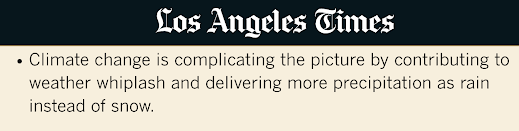
An example I have seen is w/ CA wet/dry periods. When it is dry/drought, it is all-out blaming climate change, as if droughts never occurred before in CA and the ignoring the normal climate being feast or famine (i.e. some years wet, some years dry - so sharp/severe by default). Now, when it is wet, do they ever say "this is good for water supply" or "this alleviates or ends the drought'? No, they cannot give up on climate change impacts angle and push made-up terms like "wx whiplash" and "hygrometeorological whiplash" and find negatives, even if they are concocted or negligible. Attached is recent excerpt from the LA Times.
One important thing to consider, especially in the western US, is that rainfall can actually have harmful effects as stated in the LA Times. In the West the water supply mostly depends on winter snowpack, which has the property of being able to store moisture well into the summer months. Conversely, rain is not stored and instead rather quickly runs off into the ocean. An article by the State of Washington Department of Ecology elaborates further:
https://ecology.wa.gov/blog/january-2026/did-record-rainfall-end-washington-drought
If temperatures are warm enough, as they were during the first major atmospheric river on December 8-10, rain can fall at higher elevations and melt the existing snow. This relationship is easily seen in a graph from the Grouse Camp SNOTEL site in Washington (admittedly, I chose this site because it displays one of the most extreme declines in snowpack, but you can see a similar pattern across much of Washington and the Pacific Northwest. [
NWCC iMap]) Note the decline in snowpack as precipitation picks up around December 10th. What you can see here is that the overall precipitation is much above normal, but simultaneously the snowpack is well below normal. In the end, snowpack tends to matter more in the West.
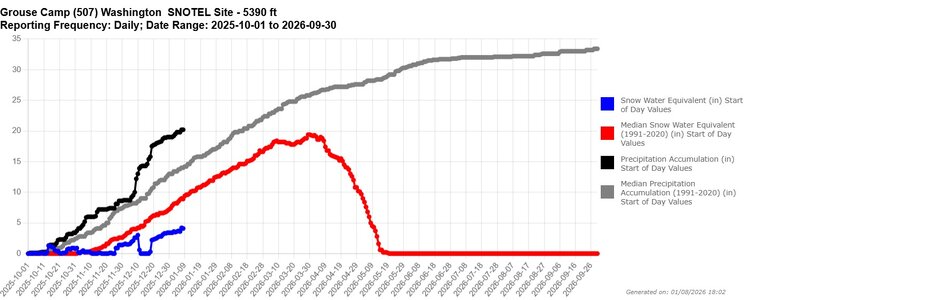
The examples I provided here pertain to Washington and not California (California's snowpack has greatly benefitted from recent atmospheric river events) but I think it's important to note that rainfall is not always a strictly positive thing, and that the rhetoric seen in the LA times is not entirely untrue. Huge rainfall events can have negative consequences such as melting snowpack, or in California's case accelerating plant growth which produces fuels build-up in forests and can later lead to massive fires when the weather abruptly swings from wet to dry.