
-
While Stormtrack has discontinued its hosting of SpotterNetwork support on the forums, keep in mind that support for SpotterNetwork issues is available by emailing [email protected].
You are using an out of date browser. It may not display this or other websites correctly.
You should upgrade or use an alternative browser.
You should upgrade or use an alternative browser.
Key elements in forecasting tornadoes?
- Thread starter kmreid
- Start date

ahaberlie
I generally agree with the SPC and most of the time I am trying to single out places to go the day of the event. So really, if I were you, I would outsource my critical thinking to the pros, and then do some nowcasting the day of.
I like to use the mesoanalysis product provided by the SPC for day-of forecasting. I like to find out where boundaries are and try to figure out where they are going to be during prime time.
Boundaries are places where there is a wind shift, temperature drop, or dewpoint drop, generally. These critical areas are where storms get their low-level spin support.
Radar sometimes shows these boundaries as "waves" of slight reflectivity returns that can eventually be an area of focus.
Visible satellite is also your friend. Look for puffy white lines of clouds parallel to the frontal boundary in the warm sector. Also, fast moving whispy clouds can sometimes be your friend as they provide cool dry air to a boundary region and can cause explosive development.
Of course, this is all simplified. But, it takes awhile to be a good forecaster (which I unfortunately am not, yet.) This entails looking up a lot of material on the matter and forming an intuitive understanding of the dynamics of a good tornado day. There is a ton, maybe even a literal ton, of great posts on stormtrack by enthusiasts all the way up to PhD candidates on this topic if you do a search.
Also, beware of wishcasting and budgetcasting. Be objective in your forecasts and if you can't make it there because of time or money, the crapshoots usually never work out.
As a direction for your search, the consensus is this...
Temperature/Dewpoint are important. CAPE is important. Directional and speed shear is important. Boundaries and lifting mechanisms are important.
A list...
LCL
CAPE
Hodograph
Stuve Diagram
Radiosonde Soundings
GFS, NAM, SREF
Helicity
Vorticity
Storm motion vs. boundary orientation
That should help focus the search, I think.
I like to use the mesoanalysis product provided by the SPC for day-of forecasting. I like to find out where boundaries are and try to figure out where they are going to be during prime time.
Boundaries are places where there is a wind shift, temperature drop, or dewpoint drop, generally. These critical areas are where storms get their low-level spin support.
Radar sometimes shows these boundaries as "waves" of slight reflectivity returns that can eventually be an area of focus.
Visible satellite is also your friend. Look for puffy white lines of clouds parallel to the frontal boundary in the warm sector. Also, fast moving whispy clouds can sometimes be your friend as they provide cool dry air to a boundary region and can cause explosive development.
Of course, this is all simplified. But, it takes awhile to be a good forecaster (which I unfortunately am not, yet.) This entails looking up a lot of material on the matter and forming an intuitive understanding of the dynamics of a good tornado day. There is a ton, maybe even a literal ton, of great posts on stormtrack by enthusiasts all the way up to PhD candidates on this topic if you do a search.
Also, beware of wishcasting and budgetcasting. Be objective in your forecasts and if you can't make it there because of time or money, the crapshoots usually never work out.
As a direction for your search, the consensus is this...
Temperature/Dewpoint are important. CAPE is important. Directional and speed shear is important. Boundaries and lifting mechanisms are important.
A list...
LCL
CAPE
Hodograph
Stuve Diagram
Radiosonde Soundings
GFS, NAM, SREF
Helicity
Vorticity
Storm motion vs. boundary orientation
That should help focus the search, I think.
Last edited by a moderator:
Zach Young
Drylines and fronts are just large-scale boundaries between airmasses that have different properties. Drylines between moist and dry air regardless of temperature; fronts between warm and cool air regardless of moisture. There is naturally some variation of temperature and moisture over any given distance, but fronts and drylines are located where the change is especially sharp. The map I look at first to get an overview those features is the dewpoint map. Sharp changes in surface moisture can be used to identify all drylines, and most fronts. Look for wind shifts near those changes to help locate the boundary. For example, SE winds east of a dryline (in the moisture) and SW winds to the west (in the dry air) or a "cyclonic" (counter-clockwise) turn across a front.
One thing that might help is to set up an animation of the computer models (on twisterdata.com for example) when you know there is a front coming and set the loop on a high rate of speed. This way you'll clearly be able to see the major boundaries moving.
If you think of forecasting like a "stew", then being able to identify the major features is sort of like being able to identify the "pot". Once you have that down, you can start to add the meat and potatoes that were mentioned above.
One thing that might help is to set up an animation of the computer models (on twisterdata.com for example) when you know there is a front coming and set the loop on a high rate of speed. This way you'll clearly be able to see the major boundaries moving.
If you think of forecasting like a "stew", then being able to identify the major features is sort of like being able to identify the "pot". Once you have that down, you can start to add the meat and potatoes that were mentioned above.
Bryan Stokes
EF3
kmreid,
There's already seem great advice given in this thread, but what helped me tremendously is learning to read surface observation charts and how to identify fronts, dry lines, moisture return, etc. Keep in mind that I'm pretty new too (only been at this for 4 years), but it's really helped me understand the big picture and can also be an excellent nowcasting tool on the day of the chase.
One site for current observations can be found by clicking here. Once you're at this site, just click on the map to bring up surface obs for a particular area. If one doesn't understand how to read a sfc obs chart, a basic primer can be found here.
Try checking that out and let us know if it helps. If not, perhaps we could talk about it some more.
Bryan
There's already seem great advice given in this thread, but what helped me tremendously is learning to read surface observation charts and how to identify fronts, dry lines, moisture return, etc. Keep in mind that I'm pretty new too (only been at this for 4 years), but it's really helped me understand the big picture and can also be an excellent nowcasting tool on the day of the chase.
One site for current observations can be found by clicking here. Once you're at this site, just click on the map to bring up surface obs for a particular area. If one doesn't understand how to read a sfc obs chart, a basic primer can be found here.
Try checking that out and let us know if it helps. If not, perhaps we could talk about it some more.
Bryan

I would strongly recommend you check out theweatherprediction.com to understand how to forecast tornadoes. The person who authored that site does a pretty good job explaining a lot of things to people who don't know a lot about the subject already. He even wrote quizzes and questions to test your understanding.
More fundamentally, there are four ingredients that are needed for severe storms to occur. In no particular order of importance (because even if you have three out of the four you still won't get tornadoes):
1) Moisture: clouds are nothing but condensed water vapor. You need moisture not only to get clouds and storms to form, but gaseous water vapor is also less dense than dry air. More moisture leads to greater instability.
2) Energy/instability: CAPE is used most frequently as a means to measure the amount of energy and instability. Simply put, parcels need to have CAPE. No CAPE, no storms. The more moist a parcel is, the greater chance it will possess CAPE, and the more CAPE it will possess.
3) Lift: even the wettest, most unstable air parcel may not form a massive thunderstorm if there is no way to access or realize its CAPE. There's a reason it's called CAPE - the PE stands for potential energy. You need lift to convert that potential energy into kinetic energy. That is to say, an unstable parcel must be lifted to its level of free convection (LFC) in order for a thunderstorm to form. Lift comes from a variety of sources: fronts, PVA, WAA, orography, and other non-frontal convergence. If identifying fronts or other lifting mechanisms on surface or upper-air maps is something you don't understand well, theweatherprediction.com will help you with that.
4) Vertical wind shear: although storms can form without wind shear, you need it for storms to organize into supercells. While tornadoes can form from non-supercell storms, the vast majority of tornadoes, and nearly 100% of strong to violent tornadoes, form from supercells. If you want to forecast the occurrence of a tornado, you really just need to forecast the likelihood of supercell formation. Keep in mind, however, that strong low-level wind shear (i.e., in the lowest 1 km or so), strong low-level CAPE (i.e., high 0-3 km CAPE), and low lifting condensation levels (LCLs) have been linked to enhanced probability of tornadic activity from supercells that form. However, the science has not yet advanced to the point where it can reliably forecast tornadoes using standard observational and modeling networks, as some supercells in highly sheared and strongly unstable environments do not produce tornadoes whereas others do. Theories explaining this behavior have only begun to emerge within the last 10-15 years. Despite the emergence of these theories, again, the observational and modeling capabilities do not yet exist to reliably predict tornadoes explicitly.
More fundamentally, there are four ingredients that are needed for severe storms to occur. In no particular order of importance (because even if you have three out of the four you still won't get tornadoes):
1) Moisture: clouds are nothing but condensed water vapor. You need moisture not only to get clouds and storms to form, but gaseous water vapor is also less dense than dry air. More moisture leads to greater instability.
2) Energy/instability: CAPE is used most frequently as a means to measure the amount of energy and instability. Simply put, parcels need to have CAPE. No CAPE, no storms. The more moist a parcel is, the greater chance it will possess CAPE, and the more CAPE it will possess.
3) Lift: even the wettest, most unstable air parcel may not form a massive thunderstorm if there is no way to access or realize its CAPE. There's a reason it's called CAPE - the PE stands for potential energy. You need lift to convert that potential energy into kinetic energy. That is to say, an unstable parcel must be lifted to its level of free convection (LFC) in order for a thunderstorm to form. Lift comes from a variety of sources: fronts, PVA, WAA, orography, and other non-frontal convergence. If identifying fronts or other lifting mechanisms on surface or upper-air maps is something you don't understand well, theweatherprediction.com will help you with that.
4) Vertical wind shear: although storms can form without wind shear, you need it for storms to organize into supercells. While tornadoes can form from non-supercell storms, the vast majority of tornadoes, and nearly 100% of strong to violent tornadoes, form from supercells. If you want to forecast the occurrence of a tornado, you really just need to forecast the likelihood of supercell formation. Keep in mind, however, that strong low-level wind shear (i.e., in the lowest 1 km or so), strong low-level CAPE (i.e., high 0-3 km CAPE), and low lifting condensation levels (LCLs) have been linked to enhanced probability of tornadic activity from supercells that form. However, the science has not yet advanced to the point where it can reliably forecast tornadoes using standard observational and modeling networks, as some supercells in highly sheared and strongly unstable environments do not produce tornadoes whereas others do. Theories explaining this behavior have only begun to emerge within the last 10-15 years. Despite the emergence of these theories, again, the observational and modeling capabilities do not yet exist to reliably predict tornadoes explicitly.
ahaberlie
Twisterdata has nice maps that have colors that make sense as hotter or colder.. typically what you would see on the local news. If you see a drop from hotter (redish) to cooler (greenish/blueish) there is usually some sort of boundary there. Cold and warm fronts have very classic boundaries.. where outflow boundaries can be kind of trickier (and in some cases translate the location of a warm front, for example)
However, I do like looking at real time data the day of.
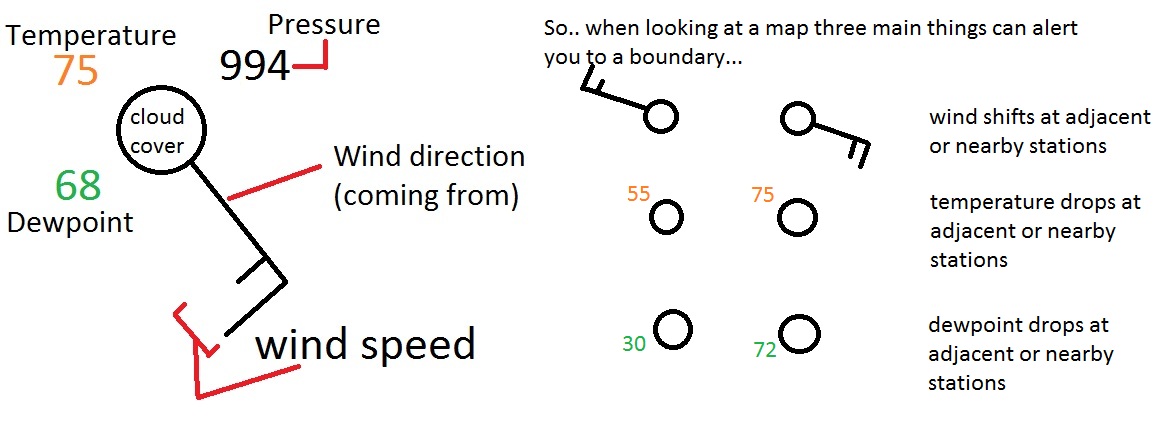
On a weather map, you have a lot of locations sending in data and all of the locations have a symbol associated with them.
First, there are the numbers.. the top number is temperature the bottom number is dewpoint and another number that isn't so important is the pressure in Kpa(right?)
Then, there is a circle.. if it is "clear" it means a clear sky.. the more "filled" it gets, the cloudier the report from that station is.
Lastly, there is a "barb" which is a line pointing towards the circle which is the wind direction and speed.. the barbs or lines perpendicular to the line pointing towards the circle are representing the wind speeds...
Here are some good resources
http://www.see.ed.ac.uk/~shs/Understanding Stuve_v3.htm
illustration I made.. the numbers are somewhat arbitrary.. the main point is to see differences. Sometimes they are not nearly this obvious! But is it a good start.
However, I do like looking at real time data the day of.
On a weather map, you have a lot of locations sending in data and all of the locations have a symbol associated with them.
First, there are the numbers.. the top number is temperature the bottom number is dewpoint and another number that isn't so important is the pressure in Kpa(right?)
Then, there is a circle.. if it is "clear" it means a clear sky.. the more "filled" it gets, the cloudier the report from that station is.
Lastly, there is a "barb" which is a line pointing towards the circle which is the wind direction and speed.. the barbs or lines perpendicular to the line pointing towards the circle are representing the wind speeds...
Here are some good resources
http://www.see.ed.ac.uk/~shs/Understanding Stuve_v3.htm
illustration I made.. the numbers are somewhat arbitrary.. the main point is to see differences. Sometimes they are not nearly this obvious! But is it a good start.
Last edited by a moderator:
Thank you so very much for all of the help! I am glad that I have a few months to do some studying before the next chase season begins. It is hard for me to explain, I understand how things are supposed to work but visualizing them is where I falter. I am getting there slowly but surely. I just want to make sure that I have an idea of what I am getting into before I get on the road next year. I want to keep myself and others safe by having an understanding of where I need to be in terms of storm motion. I will most definitely keep all of your hints in mind. Stay tuned for more questions because they are sure to come!
-Kayla
-Kayla

JustinPhillips
EF0
i like to look at EHI as my big one, but also you need to look at CAPE, Shear, and etc, but to me it seems like EHI had led to me forecasting alot more tornadoes this year than past years, could also just be a really lucky year but i do think EHI is as important as all the other factors, but obviously, using models, whereever you find the combination of all these ingredients, is likely where you want to be
Mike Johnston
EF5
Well, one method I use to try to educate myself on a possible event day is: in the morning, open up and read the SPC's Day One Convective Outlook. Read it slowly sentence by sentence. At the same time, open a second window to the SPC mesoanalysis page. For every feature/condition the outlook references, try to see if you can identify it on the mesoanalysis. For example, if the outlook references an upper level trough with a base approaching the four corners region, try to see if you can locate and identify the feature on the mesoanalysis. Try to project the movement of this feature over the next 12 hours, perhaps using the RUC model.
Having identified and located the various factors the Convective Outlook is projecting, try to identify the critical factors that will change during the course of the day. For example, if the Outlook seems to be relying on steep lapse rates over an area to contribute to instability, then it's a good idea to monitor how those lapse rates are evolving with the heating of the day. Often, a map of lapse rates at 7:00am will tell you little or nothing about what they will be in the late afternoon. But, by early afternoon you can start to pick up on the evolution of the lapse rates by looping the mesoanalysis map. Another example is the dewpoint. Often, it's tempting to get quite excited when there is a pronounced increase in dewpoints over an area in the morning hours due to strong advection. Be careful, though, because the dewpoints will often "mix out" during the afternoon hours. Another variable that is often a wild card is the latitiude of a developing surface low pressure on the lee side of the Rockies. Sometimes, the actual latitude of the developing low can be 1/2 of a state-length or more removed from the concensus forecast. This can make a real difference in your positioning.
One thing you mentioned is storm motion. At least take a peak at this a few times during the day of the chase. The mesoananalysis helicity maps have barbs that indicate expected storm motion in terms of both direction and speed, which you'll want to make a mental post-it note of once you're actually on the road and have a storm in your sights.
Having identified and located the various factors the Convective Outlook is projecting, try to identify the critical factors that will change during the course of the day. For example, if the Outlook seems to be relying on steep lapse rates over an area to contribute to instability, then it's a good idea to monitor how those lapse rates are evolving with the heating of the day. Often, a map of lapse rates at 7:00am will tell you little or nothing about what they will be in the late afternoon. But, by early afternoon you can start to pick up on the evolution of the lapse rates by looping the mesoanalysis map. Another example is the dewpoint. Often, it's tempting to get quite excited when there is a pronounced increase in dewpoints over an area in the morning hours due to strong advection. Be careful, though, because the dewpoints will often "mix out" during the afternoon hours. Another variable that is often a wild card is the latitiude of a developing surface low pressure on the lee side of the Rockies. Sometimes, the actual latitude of the developing low can be 1/2 of a state-length or more removed from the concensus forecast. This can make a real difference in your positioning.
One thing you mentioned is storm motion. At least take a peak at this a few times during the day of the chase. The mesoananalysis helicity maps have barbs that indicate expected storm motion in terms of both direction and speed, which you'll want to make a mental post-it note of once you're actually on the road and have a storm in your sights.

Rob H
EF5
Don't look for a magic bullet like STP, EHI, or whatever - as some might suggest. Jeff put it perfectly, if you focus on learning the four ingredients and how they create storms/tornadoes and how they can be measured you'll be in a good position. Look at this example of how badly the RUC and STP failed for the Greensburg EF-5:
http://www.jondavies.net/050407greensburg/050507spcstpc02_anno.gif
From Jon Davies' case study @ http://www.jondavies.net/050407greensburg/050407greensburg.htm
edit: Also, it depends on location and time of year, but surface dewpoints are usually the first thing I look at. 55deg is as close as you can get to a magic number - it's not likely to have tornadic supercells with surface dewpoints lower than that. Dewpoint forecasting is fairly accurate (when compared to things like CAPE or SRH) and easily observable whether you're looking at recent METARs or sticking your finger in the air like The Extreme.
http://www.jondavies.net/050407greensburg/050507spcstpc02_anno.gif
From Jon Davies' case study @ http://www.jondavies.net/050407greensburg/050407greensburg.htm
edit: Also, it depends on location and time of year, but surface dewpoints are usually the first thing I look at. 55deg is as close as you can get to a magic number - it's not likely to have tornadic supercells with surface dewpoints lower than that. Dewpoint forecasting is fairly accurate (when compared to things like CAPE or SRH) and easily observable whether you're looking at recent METARs or sticking your finger in the air like The Extreme.
Last edited by a moderator:
Similar threads

- Replies
- 6
- Views
- 332


- Replies
- 12
- Views
- 2K


- Replies
- 7
- Views
- 1K

