• While Stormtrack has discontinued its hosting of SpotterNetwork support on the forums, keep in mind that support for SpotterNetwork issues is available by emailing [email protected].

Firing of 800 NOAA Employees

Go to the link provide in the article showing NHC staff.

73 staff total w/ 4 vacant positions listed and add one for a person still listed that took an early retirement
offer. So that means a 7% vacancy. That percent is basically normal for many offices at any given time, as
there are always *some* vacancies (ppl leave, transfer, retire, etc) and the larger the staff, the more
absolute number of vacancies occur any any time, but you can't focus on absolute numbers for larger
offices. What matters is percent here. CNN is ignoring this -- "OMG, vacancies at NHC, the hurricane
forecasts will be degraded (by default)!" National centers, like NHC, SPC, and WPC have not been hit
as hard as WFOs and other parts of the NWS. CNN also ignores this, treating the NWS as all the same
in terms of impact and sitting on a high-horse stating in the article title for staffing "it's not." Typical
self-righteous arrogance in way too many articles and social media today.

To put this all in perspective, many WFOs are down at least 10%, some 20%, and a few 30% for staffing.
So NHC is actually in *good* shape overall. The fact they have vacancies is nothing unusual, esp. for a
large center like them. So the Commerce Secretary is correct. Yes, you can nitpick what "fully staffed"
means (and that what a lot of media does to spin a story), but again, a center that typically has 73
for staff, it would be *unusual* not to have a least a few vacancies due to the normal business cycle
and movement!
 
Looks like now that Musk is out of the picture, things may be taking a turn for the better. Hopefully, a lot of those who were let go will be able to get their jobs back. Not sure how many will want to, though. Bottom line, a lot of unnecessary chaos, but at least it may be taking a turn for the better now.

 
Turns out it was easier to fire 550 NWS meteorologists than it is to re-fill 450 of the vacancies that were created.

Thinking ahead is not a strong suit for the government/bureaucracies, including this administration.
Cut! Cut! Cut!
Oops, we cut muscle and bone,
Hope they hire US citizens, and not H-1bs (I know that this makes me a "bigot" in some people's eyes, So Be It!)
 
Turns out it was easier to fire 550 NWS meteorologists than it is to re-fill 450 of the vacancies that were created.

Even for CNN, that was one of the most one-sided articles I have ever read. It quoted Spinrad, the former, meteorologically incompetent, and highly political head of NOAA, but none of the current management of NOAA.

Second, it didn't explain why it was more difficult to hire back the meteorologists because (liberal) CNN probably didn't like the answer: private sector meteorology often pays more with more rewarding work and this latest "government shutdown" finally made it obvious that government work is not more secure than atmospheric science work in the private sector.

In the 35 years I ran WeatherData, I can't tell you the number of times I heard (often from childless people in their 20's, the people who should be the least worried about job security), "Your job offer is superior in every way to the NWS's but I worry about job security." I even had a few people tell me, "My dream has always been to work for the NWS but you are making it difficult because you pay so much more than they do!" [It is a rough world out there! :rolleyes:]

A fair article would have pointed this out and also would have discussed the various proposals asking the question as to whether the current structure of the NWS is appropriate going forward. Do we really believe NWS should take the time to make multiple cutesy graphics per shift but not launch rawinsones?
 
Even for CNN, that was one of the most one-sided articles I have ever read. It quoted Spinrad, the former, meteorologically incompetent, and highly political head of NOAA, but none of the current management of NOAA.

Second, it didn't explain why it was more difficult to hire back the meteorologists because (liberal) CNN probably didn't like the answer: private sector meteorology often pays more with more rewarding work and this latest "government shutdown" finally made it obvious that government work is not more secure than atmospheric science work in the private sector.

In the 35 years I ran WeatherData, I can't tell you the number of times I heard (often from childless people in their 20's, the people who should be the least worried about job security), "Your job offer is superior in every way to the NWS's but I worry about job security." I even had a few people tell me, "My dream has always been to work for the NWS but you are making it difficult because you pay so much more than they do!" [It is a rough world out there! :rolleyes:]

A fair article would have pointed this out and also would have discussed the various proposals asking the question as to whether the current structure of the NWS is appropriate going forward. Do we really believe NWS should take the time to make multiple cutesy graphics per shift but not launch rawinsones?
Mike, while everything you say is probably entirely true, it does not change the reality that the number fired under Musk was excessive, and that when that mistake was realized, it was a lot harder to hire people back than it was to fire 550 people. In fact, I would argue that the salary realities you note strongly support my point that the initial firings were unwise. In a situation where you had experienced employees serving the public for less remuneration than they could get in the private sector, that would be all the more reason for being cautious about firing them. And with the reality you note, it makes it much harder to un-do the mistake of firing way too many people, since even the less-experienced employees they are now trying to hire will be hard to get for the exact reasons you mention.
 
Even for CNN, that was one of the most one-sided articles I have ever read. It quoted Spinrad, the former, meteorologically incompetent, and highly political head of NOAA, but none of the current management of NOAA.

Second, it didn't explain why it was more difficult to hire back the meteorologists because (liberal) CNN probably didn't like the answer: private sector meteorology often pays more with more rewarding work and this latest "government shutdown" finally made it obvious that government work is not more secure than atmospheric science work in the private sector.

In the 35 years I ran WeatherData, I can't tell you the number of times I heard (often from childless people in their 20's, the people who should be the least worried about job security), "Your job offer is superior in every way to the NWS's but I worry about job security." I even had a few people tell me, "My dream has always been to work for the NWS but you are making it difficult because you pay so much more than they do!" [It is a rough world out there! :rolleyes:]

A fair article would have pointed this out and also would have discussed the various proposals asking the question as to whether the current structure of the NWS is appropriate going forward. Do we really believe NWS should take the time to make multiple cutesy graphics per shift but not launch rawinsones?
Good points, Mike.

One reason for the delay was the govt shutdown, which impacted all govt agencies. So the slow to hire narrative singling out the NWS is cherry-picking. Despite they claim they said the NWS continue processing applications during the shutdown, it can only go so far b/c OPM operations are significantly curtailed during a shutdown regardless. The complete process goes far beyond the NWS as an agency for hiring. And I know one can go into the reasons and causes of the shutdown, but that's a completely difference subject and not relevant here (although some would try to make it so).

And really, this is recycled news. These cuts and rehires were already covered ad nauseam months ago. You see this a lot in journalism and the MSM these days, recycling old news and bring up canned tropes, as if there not enough new news domestically and internationally out there to cover? It is *lazy* journalism.

And what does, "a cold, snowy winter looms" have to do with this? First, we don't know that yet. Just b/c it has been cold so far in the East (bias due to population off the top), does not automatically mean the rest of the winter will be cold, or snowy for that matter. This is meaningless "throwing irrelevant information on the pile" to push more negativity to the already biased narrative put forth here. Second, the NWS should be properly staffed regardless of how the wx will or not will be. We know that impactful wx will occur, so don't insult the reader's intelligence.

From the article:
"going into yet another critical storm season with more than a dozen forecast offices forced to get by with serious staff
vacancies, potentially undermining the accuracy of forecasts and warnings during powerful winter storms."


Speculation, we don't know that will actually occur, or be significant enough to make any noticeable difference. And w/ the vacancies that has existed for many months, has there been a significant decline in accuracy or products overall? And some quote this specific case or that, but there are busts and misses all the time, so how does one know any of these actually would have not occurred anyway if the NWS was fully staffed? Again, speculation here. Not saying the NWS should not be fully staffed and I agree having so many vacancies is not good, but this excessive gloom and doom as to overall impact to products and services all too often is grossly exaggerated.

They said the same thing as the 2025 hurricane season was upon us, and were there any issues overall? NHC was staffed well, just w/ typical vacancies you'd see in any office w/ dozens of staff, yet that was pushed as a potential serious degradation of products and services for the hurricane season. We avoided any U.S. hurricane landfall, but that was incidental and is beside the point. Far too often we get "what if's and "could be's," never mind biased and agenda-laden narratives laced w/ inaccuracies

From the article:
"Winter storms can be deadly, and short staffing at the NWS has the potential to erode forecast
accuracy and delay warnings, experts said."

No kidding. Tell us something we do not know. Stop insulting the public's intelligence w/ the obvious. Typical drama-infused canned writing.

Linked the article was this story from Oct:

This is incorrect, the former typhoon approached *upstream* of western AK, so missing RAOBs to the east would have no noticeable impact on forecasts. The models still would have forecasted and intense ET transition and very high impact.

From the article:
"as initial model projections had the forecasts suggesting the worst conditions would strike farther to the south and west than they did. Models like the NWS’ Global Forecast System (GFS) consistently showed a stronger storm to the northwest of where it eventually struck. The communities that ended up seeing the worst storm surge flooding were not in the original forecasts."

Can one objectively say the lack of RAOBs was the reason why the GFS had an inaccurate forecast? The GFS, like any model, has its issues and biases. And acting like the GFS operates in vacuum. The are many other models available for the NWS and all, let alone ensemble runs, that give us a much better idea of operational forecast model issues and shortcomings in any given situation. And this ignores the actual subjective skill of the meteorlogists making the forecast. We are not robots that just blindly take model output and run w/ that!

And the title of the article and what they say in it:
“I’m sure it had some impact,” the official told CNN, though the errors the GFS made were within the average error for the model.

The title blames Trump's cuts budget cuts directly, and yet the GFS error was within the avg error for the model. See the deceptive and manipulative narrative put forth here? They know most ppl will just see the title of the article, and not read the article itself, or just skim over it, missing the details. This is deplorable journalism and reeks of bias and agenda, never mind overly-dramatic headlines for clicks and likes.

The content of MSM articles is one issue, but an even bigger issue is *how* they are written and crafted/edited for max effect. This isn't informing the public, it is insidious manipulation to skew reality/truth b/c of agenda/ideology and the like.

 
I was at OU for over a decade, and have been connected to the surrounding Norman meteorology community for two decades. I can only share my perspective and experience, which is that NWS jobs were highly competitive and widely coveted by students and young professionals over that whole period (with the disclaimer that I haven't worked directly in that community day-to-day for a few years now, so I can't confidently rule out that there's been some shift in the situation recently).

I don't have hard data on the salary distributions for private sector jobs that would be considered comparable to NWS jobs, whatever that might mean. But I can say confidently the many anecdotes I heard over all those years, and the widespread perception at OU, was that the NWS paid better than private jobs of a comparable nature -- particularly after the first couple years, given the structure of the GS scale. I think most fresh graduates with a B.S. might expect fairly comparable starting pay between NWS and private sector shift-based forecasting roles (although there'd be extraordinary competition in both cases, which naturally drives down pay on the private side). But they'd expect pay 5 years into their career to be better in the NWS in virtually all cases, in addition to the job security. And, FWIW, it's not as if that NWS pay 5 years in was exorbitant or disproportionately high for their qualifications.

In short, the idea that NWS positions are difficult to fill because the private sector offers a wealth of comparable forecasting jobs with higher pay and better benefits completely flies in the face of everything I've seen, heard, and experienced 20 years into my career. I know dozens, if not hundreds, of people from the Norman/OU weather community who'd laugh until they cried at that notion. But, just to be clear, I am not and never have been a "forecaster" professionally.
 
In short, the idea that NWS positions are difficult to fill because the private sector offers a wealth of comparable forecasting jobs with higher pay and better benefits completely flies in the face of everything I've seen, heard, and experienced 20 years into my career. I know dozens, if not hundreds, of people from the Norman/OU weather community who'd laugh until they cried at that notion.
in addition to the job security.


And, this is based on........ nothing. You say you have "experience" in the quote above but then you say you've never been a forecaster.

Please consider WeatherData about which I wrote above. I am replying because I worked hard to provide a quality environment for the team that worked for the company that provided both financial and professional rewards:
  • If going without a paycheck for two months at a time fits your definition of "job security" that's fine but it doesn't fit mine nor does it most peoples'. I've never understood the lionization of the NWS but to each his or her own. We never missed a payroll. Not once.
  • In the NWS, if you want to be a forecaster you must work rotating shifts which every study that has ever been done says shortens your life.
  • At WeatherData, we set it up that people who liked working overnights and weekends (and there were usually more than enough who preferred those hours) and liked to get the extra pay, did so. If we didn't have enough at a given time, we assigned people to work overnight but we did it (with extra pay) for six months or so at a time. That is far healthier than rotating shifts.
  • Wichita has the lowest cost of living of America's top 50 cities. If you made $45,000 as a forecaster in ICT, you would have to make $60,000 (I looked it up) to have the same standard of living in, say, Chicago. Except that doesn't include taxes. It is probably closer to $65K with taxes. Storm chasing is easy from ICT.
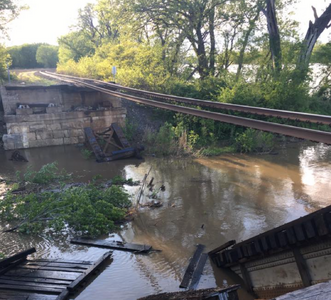
  • Because we covered all of North America, our forecast and storm warning mets rarely had a boring day. And, because we specialized in extreme weather, we knew when we had saved lives -- which was surprisingly frequent. Attached is a photo taken by a Union Pacific (UP) track inspector near Topeka in 2016. We had issued a flash flood warning over a segment of (UP) track over which Amtrak travels at 70 mph. Union Pacific dispatches for both railroads and stopped trains until it had been inspected. Good thing! The NWS didn't issue their FFW until nearly an hour later.
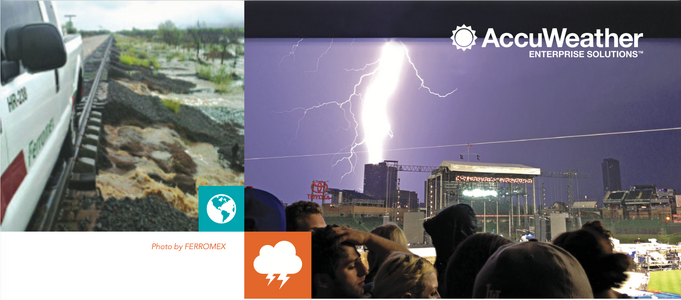
  • You will also find a second photo, split screen, that shows lightning hitting the ground behind the stage at a Wrigley Field Chicago Pearl Jam concert (NWS doesn't issue lightning warnings) 45 minutes after we issued a warning and the field seating was cleared. At the same time we issued a flash flood warning for Ferromex, the largest railroad in Mexico. That area of Mexico has no radar coverage so we developed a proprietary method of issuing flash flood warnings. Ferromex shut down train traffic for the night and found the washout the next morning, preventing a derailment and injury to the crew. These won the AMS's Award for Outstanding Specific Prediction for 2016.
If you want to work at the NWS, great. But it should be based on an apples-to-apples comparison of the opportunities.
 

Attachments

  • Track washout west of Topeka, Kansas, Union Pacific, April 26, 2016, 4-26-16.png
    Track washout west of Topeka, Kansas, Union Pacific, April 26, 2016, 4-26-16.png
    2.1 MB · Views: 3
  • Screenshot 2025-12-10 at 12.20.48 PM.png
    Screenshot 2025-12-10 at 12.20.48 PM.png
    2.1 MB · Views: 3
Last edited:
But they'd expect pay 5 years into their career to be better in the NWS in virtually all cases, in addition to the job security. And, FWIW, it's not as if that NWS pay 5 years in was exorbitant or disproportionately high for their qualifications.
I had forgotten to address this comment. For reasons unknown, as he had never visited our facility, the late Dr. Chuck Doswell decided to write a piece on his blog that people in the private sector in general, including WeatherData, worked in the private sector "for only a year or two."

Perhaps that is where Brett Roberts got some of his misguided notions. Turns out that a couple of months later Dr. Greg Carbin -- then of SPC -- came to Wichita from OUN to give a presentation to our AMS chapter. Before we took him to dinner, we gave him the "grand tour" of WeatherData. Because of Chuck's piece, I asked each of our employees to tell Greg how many years they had worked for us. At the time, zero had worked for 1 to 3 years. The shortest tenure was 4 years. We had 3 employees that had gone past the 20 year mark.

It probably never occurred to students and others that those working for the government in OUN had a motive to say disparaging things about the private sector -- they didn't want the hiring competition.

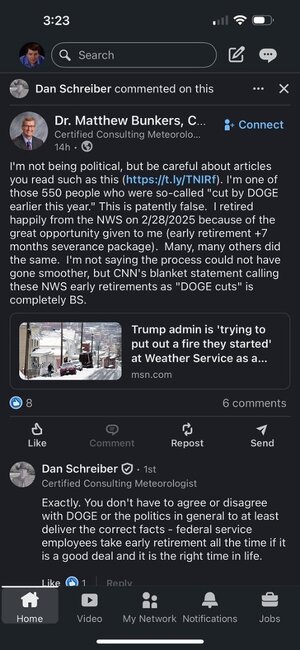
Addition: While looking up someone else on LinkedIn, I ran across this from a current AccuWeather/WeatherData storm warning meteorologist.
Hardly seems like a discontented person.
 

Attachments

  • Screenshot 2025-12-11 at 1.27.14 PM.png
    Screenshot 2025-12-11 at 1.27.14 PM.png
    79.2 KB · Views: 1
Last edited:
Back
Top