• While Stormtrack has discontinued its hosting of SpotterNetwork support on the forums, keep in mind that support for SpotterNetwork issues is available by emailing [email protected].

Abnormal Tornado Activity

Wow guess I should proof read my post. "Data sets of more than a few hundred years would be necessary to formulate any true conclusions. "
Still learning to think and chew gum at the same time.
 
Just from personal observations (non-scientific) since I first started Plains chasing in 1987, the frequency of productive storm chasing in the western regions of the Central Plains has dropped significantly. There are still isolated events, but the frequency is much less. It was not uncommon for the DL to set-up near the TX/NM line quite often, and although it would frequently mix east, it now sets-up much further east.
 
If you plan to do research, I would also break down the frequency data sets by severe types, e.g., tornadoes, hail, and severe warnings. Just because you have less tornadoes does not necessarily mean you have less storms. There is also the x-factor, of having more chasers and advanced radar technology confirming more events than 20+ years ago.
 
If you plan to do research, I would also break down the frequency data sets by severe types, e.g., tornadoes, hail, and severe warnings. Just because you have less tornadoes does not necessarily mean you have less storms. There is also the x-factor, of having more chasers and advanced radar technology confirming more events than 20+ years ago.
fair enough
 
Technological advances, an increase in scientific knowledge and understanding, social
changes, and modifications of standards and practices have affected the overall net
increase in tornado count in the U.S. over time.
Boris' list is a great example of why it is hard to compare the frequency of weather events over time. We also all know that weather patterns naturally ebb and flow over time, so it is really hard to draw accurate concussions without large data sets like Mark pointed out.
Just from personal observations (non-scientific) since I first started Plains chasing in 1987, the frequency of productive storm chasing in the western regions of the Central Plains has dropped significantly. There are still isolated events, but the frequency is much less. It was not uncommon for the DL to set-up near the TX/NM line quite often, and although it would frequently mix east, it now sets-up much further east.
I have to agree with Warren on this - it certainly fells like we in a downturn now (although I only have about half the number of years chaseing as he does but that is still a lot). I would add that southern plains to that. It used to seem like most chases I made was driving northwest from DFW to the dry line in West TX. Maybe central OK, but these days are less often now.

Having said that, we did have a multi-day dryline event over the southern plains last week, but it just didn't really work out well. Between capping and weak flow parallel to the dry line, it underperformed by chaser standards. We have another chance this weekend.

I also think there is a tendency over time to remember things as fonder than they where. We remember the big days/events, but forget about the disappointing ones. We also grow in knowledge. I know I am a lot picker about setups now than I used to be as I know better now. Some of those events that seemed good at the time, likely would not be seem as good by my knowledge today. With the advent of social media we also see other people's big days more and that changes the lens through which we judge our own chases by.
 
If you plan to do research, I would also break down the frequency data sets by severe types, e.g., tornadoes, hail, and severe warnings. Just because you have less tornadoes does not necessarily mean you have less storms. There is also the x-factor, of having more chasers and advanced radar technology confirming more events than 20+ years ago.
It wasn't really for research. I was just wondering becasue it just seemed off
 
Tornadoes are very "streaky." That is, any given area can go long periods with few or no tornadoes, then a favorable weather system can produce a whole lot in a short time. A single outbreak can produce an average month's or even year's worth of tornadoes for an area in a matter of days.

Both large-scale factors (e.g., where the jet stream is) and small-scale factors (e.g., boundaries from previous storms) have a significant impact on whether and where tornadoes are produced. And even those large-scale factors can shift around a lot.

Because of this, exceptions are the norm when it comes to tornadoes, and it's difficult to identify patterns in the data. That's not to say it can't be done - it just would take a lot of careful work. (Including that the researcher would need to account for how tornado reporting has changed over time, as mentioned elsewhere). And therefore, one month of unusual tornado activity in the Midwest doesn't tell us much one way or the other, because "unusual tornado activity" is kind of always happening.

That said, there are long-term factors that could affect where tornadoes are most likely. For example, Boris made a very pertinent suggestion earlier that a shift in temperatures has the possibility of moving where tornadoes are more likely. And indeed, global temperatures can be changed by both natural causes (e.g., the Milankovitch cycles that affect how much energy the Earth receives from the sun) and man-made causes (e.g., the increase in greenhouse gases in our atmosphere from burning fossil fuels, which reduces heat radiated to space). In the geological record, we can see that Earth's temperature has varied a lot over its history: there are times with glacial sediments at the equator, and times with palm trees at the poles.

So is it possible that tornado probabilities are shifting location? Absolutely. But are we actually seeing that today? Significant work would need to be done to determine whether that's the case (and it's even possible that we don't have good enough data to really determine that).
 
Tornadoes are very "streaky." That is, any given area can go long periods with few or no tornadoes, then a favorable weather system can produce a whole lot in a short time. A single outbreak can produce an average month's or even year's worth of tornadoes for an area in a matter of days.

Both large-scale factors (e.g., where the jet stream is) and small-scale factors (e.g., boundaries from previous storms) have a significant impact on whether and where tornadoes are produced. And even those large-scale factors can shift around a lot.

Because of this, exceptions are the norm when it comes to tornadoes, and it's difficult to identify patterns in the data. That's not to say it can't be done - it just would take a lot of careful work. (Including that the researcher would need to account for how tornado reporting has changed over time, as mentioned elsewhere). And therefore, one month of unusual tornado activity in the Midwest doesn't tell us much one way or the other, because "unusual tornado activity" is kind of always happening.

That said, there are long-term factors that could affect where tornadoes are most likely. For example, Boris made a very pertinent suggestion earlier that a shift in temperatures has the possibility of moving where tornadoes are more likely. And indeed, global temperatures can be changed by both natural causes (e.g., the Milankovitch cycles that affect how much energy the Earth receives from the sun) and man-made causes (e.g., the increase in greenhouse gases in our atmosphere from burning fossil fuels, which reduces heat radiated to space). In the geological record, we can see that Earth's temperature has varied a lot over its history: there are times with glacial sediments at the equator, and times with palm trees at the poles.

So is it possible that tornado probabilities are shifting location? Absolutely. But are we actually seeing that today? Significant work would need to be done to determine whether that's the case (and it's even possible that we don't have good enough data to really determine that).
"Streaky" is an excellent word here, and you see it from the synoptic to mesoscale level.

And sometimes it is non-linear. I always say in wx, "when it is good, it can be *really* good!" Meaning it can goes off the scale as to high-end and relentless activity (not just w/ tornadoes, any type of event).

Case in point, April 2011. Sure, the Superoutbreak at the end of the month everyone recalls, but outside of the event, there were over 500 other tornadoes that month, giving by *far* the most tornadoes in any month (#2 is 216 less than April 2011 759 tornadoes). No April up to this time had had 300 tornadoes, let alone over 700! And we did not have another April w/ at least 300 tornadoes until 2024.

Or look at that wild 9-day period May 3-11, 2003, in the Plains/Midwest -- 363 tornadoes w/ 62 F2+.

Even within an record event, you can get other not as apparent records that can go over the top. For instance, between midnight and noon April 27, 2011, 76 tornadoes (5 EF3s) occurred in the South w/ a single QLCS. This is the biggest morning tornado outbreak on record by a sizable margin, and then you had the main show later that day. That shows truly how ideal and epic the set up was that day.

Or those days where it did not look synoptically evident until the last minute. May 3, 1999 in OK is an excellent example, and being a more local "superoutbreak" that far exceeded anyone's expectations.

Given the virtually endless comnbinations of the global circulation, internal and external factors, and all other vagaries large and small, it is not too surprising we see what we see at times. Within normal climatic variation, the law of large numbers and averages dictate that such things are going to happen, and not necessarily w/ a regular frequecy. And looking at the entire wx range picture for a location on the globe like the CONUS, we get a remarkable range of all wx types, owing to our geography and latittude, and other less apparent factors come into play. For instance, the Atlantic is the most variable tropical basin in the world when it comes to TC activity over the long term.

 
I realized I didn't answer Clayton's original question about potential trends and how they might influence later-season tornado activity. That's not something I know much about, so I won't give much of an answer to that anyway. There does seem to be some level of pattern you can look for, like how straight vs. wavy the jet stream is, and what ocean temperature patterns are doing (cf. the early discussion in the State of the Chase Season 2026 thread), to make guesses at longer-term tornado potential, but that seems to have a higher degree of speculation in it.
 
I realized I didn't answer Clayton's original question about potential trends and how they might influence later-season tornado activity. That's not something I know much about, so I won't give much of an answer to that anyway. There does seem to be some level of pattern you can look for, like how straight vs. wavy the jet stream is, and what ocean temperature patterns are doing (cf. the early discussion in the State of the Chase Season 2026 thread), to make guesses at longer-term tornado potential, but that seems to have a higher degree of speculation in it.
The the general rule of thumb that has been said many times. Slight risk or better in the spring in the Plains...chase! :) Some of the best chase days have been slight risk days w/ no apparent focus or synoptic forcing. Perhaps the best example of this was the Chapman KS EF4 5/25/2016. Slight risk day, and for many who caught this tornado, it was there #1 chase all-time!
 
A few of my previous conceptions of tornadoes that have been challenged since I started chasing:
  • The Texas panhandle is legendary for big tornado days: It's rare for the Texas panhandle to have violent tornado outbreaks. June 1995 was an anomaly, I expected that kind of season to be more recurrent than it was.
  • The Midwest is a gold mine of mostly-unchased tornadoes: Most of the Midwest's tornadoes are non-photogenic: QLCS, HP/rain wrapped or nocturnal has characterized most of what I've seen since moving here in 2010. After 16 years, I've only seen two fully-condensed daytime tornadoes in the St. Louis area (within the metro area).
  • All of Illinois is a quality chasing state: Central/northern Illinois is the Midwest's tornado hotspot. Just look where all of the wind farms are: they're where the surface winds are stronger on average. There aren't any wind farms once you're a few miles south of I-72.
 
Last edited:
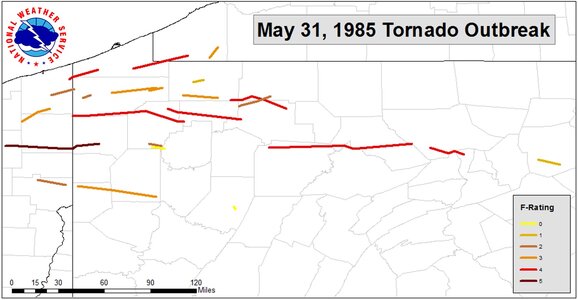
View attachment 29165
My two cents...
There's nothing normal about tornado occurrence and frequency. In fact in statistics, they follow the Poisson distribution for rare events.
A great example: What's the chance of having all these tornadoes in PA one evening that included an F-5? Oh, about one in 2 or 3 million.
Thanks for pointing this event out William. I think similar odds/chances exist for the Worcester MA F4 on 6/9/1953.

The 5/31/1985 so far E tor outbreak was extraordinary on multiple levels, *yet* it happened despite astronomical odds! As I bring up every time I hear that wx events today are "worse," I say, "how did events long ago that put shame to what occurs now happen?" It is a valid question, but history is the enemy of many narratives/agendas. It's all about what happens now, and the powers that be preying on the logical fallacy of recency bias.

The MSM and many others these days are now using probabilities and statistics to push that all wx events now are extreme and not supposed to happen. I get it, probabilities and statistics for many is a dry subject and not so intuitive to understand. I still struggle w/ them! But that makes things *ripe* to abuse it all to mislead/dupe/manipulate the masses for any particular narrative/agenda.

I saw these posts on X some time time ago and they outlines things well.

- sigma -
Normalized anomalies used to be a good technique in meteorology to
compare events by removing the mean and variance calculated from
long-term gridded reanalysis data (30 yr), but now it's the hottest
thing in climate activism. Normalized anomalies should not be
interpreted as return periods in this way. The distribution of
atmospheric variables, including 500 mb geopotential height, is not
normal, and the climatology used for these normalized anomalies only
contains 30 yr at each grid point w/ a 15-day centered mean and
standard deviation.

You can verify this by scanning the globe at any given time looking
at this quantity. Say there is a Kona low at -5.5 sigma near HI.
Obviously, that's not a 1-in-a-million yr event. And look at the sigma
values for 500 mb heights for any strong TC in the tropics, It will
exceed -10 sigma often, so is that a one in a "zillion" year event? :rolleyes:

The key to doing this right is to embrace the fact that extreme events
are tail (low-probability) events in non-Gaussian distributions of
common atmospheric variables.

When scientifically illiterate people try to normalize non-Gaussian
disturbed data, you get the current nonsense.

The wx in the real world doesn’t follow a Gaussian/normal
distribution curve. Extreme events are far more common in a
non-Gaussian distribution that reflects the physical world we live
in. Bell curve graphs are an inappropriate use of statistics. Not
only not Gaussian, but also the shape of the distribution changes w/
warming depending on location. The SEUS, for example, has less
extreme high temps.


*****

Atmospheric state variables (e.g. temp, vapor pressure, pressure,
etc) are integrated into a highly complex, multi-variate,
non-linear system. Axiomatically, meteorological variables
exhibit non-Gaussian characteristics. That is, they don't follow a
normal (Gaussian) distribution. “Unlikely events” like intense
heatwaves, as it turns out, aren't as “unlikely” as it might seem in
a non-Gaussian world.


*****

A 1000-yr flood is not a flood that happens once every 1000 yr. It
is a flood that at a particular point in time is estimated to occur
w/ a probability of 0.001. It is not a concept suitable for
detection and attribution of climate change. One of the confusing
things about extreme event return periods is that they change,
sometimes dramatically, when an extreme event actually occurs.
That's b/c return periods beyond the period of record are based on a
curve fit to observed data based on statistical assumptions


*****

Every day, multiple locations on Earth experience statistically
extreme wx events and this has been going on since the Earth
developed an atmosphere. It’s inevitable, but not statistically
significant of any change in climate.


And from an observational/operational standpoint, this can be verified. I see so often these days many using 500 mb heights as a measure of how extreme a heat wave is, yet the actual values of the heights are nothing that does not occur every year in the CONUS and has for as far back as records go. Yet it is hyped, "This heat dome (I loathe that made-up term, latest wx buzzword) is in the 99.5 pecentile" w/ the assortment of "hot" colors to boot. And many times, the actual temps at the sfc are not extreme or nothing that does not occur often. Also, using 500 mb heights as a direct correlation to sfc temps is unwise. First, we don't live at 500 mb, and second, what is the sfc pressure? You can have very high 500 mb heights, but if the sfc pressure is high, then it can be not that hot at all, and actually quite cool (New England w/ back door cold fronts in the spring and summer, as one example).

I attached a list of all RAOB 500 mb heights 600 dm and above in North America 1957-2006. As you can see, these values are a lot more common than I bet many thought (199 times). So why is it in the summer when 500 heights approach 600 dm for a heat wave, it is considered unsual or not supposed to happen, and you get these anomaly plots portraying it is "unprecedented"?
 

Attachments

Back
Top