• While Stormtrack has discontinued its hosting of SpotterNetwork support on the forums, keep in mind that support for SpotterNetwork issues is available by emailing [email protected].

Abnormal Tornado Activity

Joined
Jan 27, 2025
Messages
23
Location
Vienna, Illinois
I was just thinking about it and I noticed that this years tornado season is not like it has been in the past recent years. In early spring the most of the storms have been in Dixie Alley and Southern Hoosier Alley, Southern Illinois and Southern Indiana. Most of the storms this year have been in the upper Midwest and through the "tornado alley" area which is usually active more towards late May and early June. Does anyone have any thoughts or answers why this trend is looking like this and what could it mean to later season activity?
 
could be the "global warming" everyone's talking about lol. Nah, in all reality if not the tornado alley thing, it could be the fact that one day its 80, 90 degrees out, the next its 34 degrees, but I doubt that. not sure what it is, I can do some research if you'd like
 
from the NWS:
A study published recently in npj Climate and Atmospheric Science, by Vittorio A. Gensini of Northern Illinois University and Harold E. Brooks of the National Severe Storms Laboratory, looked into the possibility that tornado frequencies are changing across the United States. Their findings include a decrease in the traditional "Tornado Alley" of the Great Plains and an increase in the Southeast's "Dixie Alley". This study generated a fair amount of buzz, so we thought we'd briefly list out a few of the more important points mentioned in the study:

  • After removing non-meteorological factors, the annual frequency of U.S. tornadoes through the most reliable portions of the historical record has remained relatively constant.
  • Detecting spatial shifts in tornado frequency is challenging. Tornadoes are short-lived and affect very small geographical areas. Also, tornado reporting procedures have varied dramatically over the years and from one region to another.
  • The study used the Significant Tornado Parameter (STP) to account for tornado frequency. STP is designed to highlight the existence of atmospheric ingredients favoring large storms capable of producing EF2-EF5 tornadoes, like what is typically seen in the Great Plains.
  • It should be noted that even if the atmosphere is supportive of tornadoes with the right winds, moisture, and instability, thunderstorms won't form without a strong enough trigger to spark them (like a cold front). The STP does not account for whether or not a trigger is present.
  • However, STP values correspond with tornado reports closely enough such that STP is a suitable index to use. STP is especially useful in January, February, March, May, and December.
  • The period analyzed in this study was from 1979 to 2017.
  • A significant upward trend in tornado frequency was found in portions of the Southeast, Midwest, and Northeast.
  • Both tornado reports and tornado environments indicate an increasing trend in portions of Mississippi, Alabama, Arkansas, Missouri, Illinois, Indiana, Tennessee, and Kentucky.
  • It should be kept in mind that STP is designed to evaluate environments favorable for large storms typical of the Great Plains, and not necessarily small spin-ups that we see in regions farther east.
  • Unfortunately, increases in tornado frequency in the American South juxtapose with a population that is especially vulnerable to tornadoes. The Southeast already represents a maximum in the occurrence of tornado casualties.
Keep in mind that this study was not associated with nor is it necessarily endorsed by NOAA or the National Weather Service. This information is presented here simply because of public interest.

It should be noted that this is just one study. Nevertheless, it is important for residents of the Ohio Valley and southeast United States to always be prepared for severe weather, including tornadoes. Right now, when the weather is quiet, is an excellent time to put together a tornado safety plan for your family. Have a survival kit and your plan in place well before severe weather strikes!
 
  • The STP does not account for whether or not a trigger is present.
  • However, STP values correspond with tornado reports closely enough such that STP is a suitable index to use. STP is especially useful in January, February, March, May, and December.
The STP is a significant stretch to actual tornadoes. And tornadoes do occur in the months of April and June!

A more likely explanation (although it, too, has holes) is that tornado alley migrates as Ted Fujita found: There Is Nothing New About the Hypothesis Tornado Alley Has Moved East .
 
from the NWS:
A study published recently in npj Climate and Atmospheric Science, by Vittorio A. Gensini of Northern Illinois University and Harold E. Brooks of the National Severe Storms Laboratory, looked into the possibility that tornado frequencies are changing across the United States. Their findings include a decrease in the traditional "Tornado Alley" of the Great Plains and an increase in the Southeast's "Dixie Alley". This study generated a fair amount of buzz, so we thought we'd briefly list out a few of the more important points mentioned in the study:

  • After removing non-meteorological factors, the annual frequency of U.S. tornadoes through the most reliable portions of the historical record has remained relatively constant.
  • Detecting spatial shifts in tornado frequency is challenging. Tornadoes are short-lived and affect very small geographical areas. Also, tornado reporting procedures have varied dramatically over the years and from one region to another.
  • The study used the Significant Tornado Parameter (STP) to account for tornado frequency. STP is designed to highlight the existence of atmospheric ingredients favoring large storms capable of producing EF2-EF5 tornadoes, like what is typically seen in the Great Plains.
  • It should be noted that even if the atmosphere is supportive of tornadoes with the right winds, moisture, and instability, thunderstorms won't form without a strong enough trigger to spark them (like a cold front). The STP does not account for whether or not a trigger is present.
  • However, STP values correspond with tornado reports closely enough such that STP is a suitable index to use. STP is especially useful in January, February, March, May, and December.
  • The period analyzed in this study was from 1979 to 2017.
  • A significant upward trend in tornado frequency was found in portions of the Southeast, Midwest, and Northeast.
  • Both tornado reports and tornado environments indicate an increasing trend in portions of Mississippi, Alabama, Arkansas, Missouri, Illinois, Indiana, Tennessee, and Kentucky.
  • It should be kept in mind that STP is designed to evaluate environments favorable for large storms typical of the Great Plains, and not necessarily small spin-ups that we see in regions farther east.
  • Unfortunately, increases in tornado frequency in the American South juxtapose with a population that is especially vulnerable to tornadoes. The Southeast already represents a maximum in the occurrence of tornado casualties.
Keep in mind that this study was not associated with nor is it necessarily endorsed by NOAA or the National Weather Service. This information is presented here simply because of public interest.

It should be noted that this is just one study. Nevertheless, it is important for residents of the Ohio Valley and southeast United States to always be prepared for severe weather, including tornadoes. Right now, when the weather is quiet, is an excellent time to put together a tornado safety plan for your family. Have a survival kit and your plan in place well before severe weather strikes!
I would argue that one really needs to start in 1990 or perhaps 1995 for the U.S. tornado
database to best determine trends. Why?

Technological advances, an increase in scientific knowledge and understanding, social
changes, and modifications of standards and practices have affected the overall net
increase in tornado count in the U.S. over time.

1) There is a significant spike in annual tornado count starting in 1953. This was the year
the Severe Local Storms (SELS) unit, forerunner of SPC, was established for around the
clock severe storm monitoring. Tornado reporting was encouraged by the U.S. Weather
Bureau for documentation and watch/warning verification purposes, hence the increase in
count.

2) Starting in 1990, you see another spike to above 1000 in tornado count. Part of the
reason for this is that this year marked the first installation of Doppler radars
(WSR-88Ds) and around this time, storm chasing was beginning to ramp up in
popularity. Both of these factors resulted in more tornadoes being reported, verified,
and documented.

3) During the 1990s, the National Weather Service (NWS) underwent the Modernization
and Associated Restructuring (MAR). Investigation of tornado reports and post-damage
storm surveys at each new Weather Forecast Office (WFO) county warning area
increased, leading to a more representative count of tornadoes per year.

4) Storm chasing really took off after the release of the movie 'Twister' in 1996 and has
continued to grow ever since. This continued to sustain and increase higher annual
tornado counts.

5) By the middle part of the first decade of the new millennium, digital cameras were
rapidly replacing traditional slide and print film. This eliminated the long processing
times of film, allowing for not only more tornadoes to be verified and documented, but
also in a more timely manner.

6) By the end of the first decade of the new millennium, the expansion of social media such
as Facebook and Twitter allowed instant reporting of tornadoes in real time. Wireless
Internet had been firmly established for the now ubiquitous smartphone/mobile device
and combined with built-in digital still picture and video cameras, this made tornado
reporting and verification even faster and more efficient.

7) At the start of the 2010s, all WSR-88Ds were upgraded with dual-polarization
capabilities. This allowed the detection of the tornadic debris signature (TDS) within
storms. This further assisted in the detection and documentation of tornadoes,
especially those in remote areas and embedded in microbursts/downbursts.

8) By the mid-2010s, specialized satellites had been launched with spatial resolution
as high as 5 meters. Open areas with little in the way of damage indicators could
be examined after a storm suspected of producing a tornado occurred. Narrow
swaths in crop fields could now be detected indicating brief tornadoes that
otherwise would have been missed due to remoteness, darkness, or heavy
precipitation.

9) Also by the mid-2010s, drone use became widespread and this assisted in more aerial
surveys of suspected tornado paths, and also allowed surveys in areas not easily
reachable from the ground

The increases in U.S. annual tornado counts have been affected markedly from changes in
technology, population, and public awareness, as three examples. Detection and
documentation of tornadoes continues to improve with time. For example, we are finding
tornadoes in the Rockies and Great Basin are more common than once thought as
population continues to grow and people visit more remote areas with the mobile
capabilities to take pictures/videos of the tornadoes. It is also has become apparent that
tornadoes with squall lines are more common than once thought, due to very detailed and
thorough surveys done by the NWS. Currently, it is estimated about 18% of all U.S.
tornadoes occur with squall lines.

 
That could be the case, but also it is the same zone that is active right now is usually more active during later season and usually early season is super calm compared to years in the past
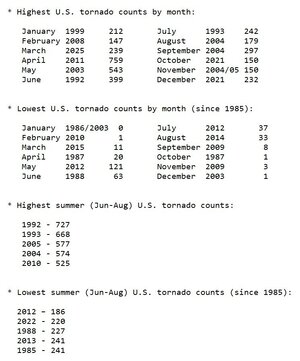
Attached are some U.S. tornado stats I put together. A few things to note:

Record months for total tornadoes in the cool season have occurred in the last 5 years for March, October, and December.

In the last 15 years, 3 of the 5 lowest summer (June-August) tornado totals have occurred.

Tornado total records most for June and July were both set over 30 years ago and the most summer tornadoes as well.

From 2009 to 2014, 7 months set their record low tornado total.

The record high totals August and September, both in 2004, can be almost entirely attributed to a high number of hurricane landfalls.

The record low totals for May, June, and July, can be attributed to significant, large-scale drought these years (1988 and 2012).
Also, #1 and #3 for lowest summer totals these same two years.

---

The only thing I can take away from the above that makes sense from a large-scale perspective, tornadoes in the cool season are becoming more common, and during the peak warm season, less common. This would tend to jibe w/ warmer overall temps. Warmer temps lead to more CAPE in the cool season (shear is still plentiful), but at the same time, the jet stream retreats sooner and farther N in the summer, and warmer overall temps imply a higher LFC (higher T/Td spreads in the BL), so this reduces tornadoes this time of year.

Thoughts?
 

Attachments

  • torstats.jpg
    torstats.jpg
    98.9 KB · Views: 2
Attached are some U.S. tornado stats I put together. A few things to note:

Record months for total tornadoes in the cool season have occurred in the last 5 years for March, October, and December.

In the last 15 years, 3 of the 5 lowest summer (June-August) tornado totals have occurred.

Tornado total records most for June and July were both set over 30 years ago and the most summer tornadoes as well.

From 2009 to 2014, 7 months set their record low tornado total.

The record high totals August and September, both in 2004, can be almost entirely attributed to a high number of hurricane landfalls.

The record low totals for May, June, and July, can be attributed to significant, large-scale drought these years (1988 and 2012).
Also, #1 and #3 for lowest summer totals these same two years.

---

The only thing I can take away from the above that makes sense from a large-scale perspective, tornadoes in the cool season are becoming more common, and during the peak warm season, less common. This would tend to jibe w/ warmer overall temps. Warmer temps lead to more CAPE in the cool season (shear is still plentiful), but at the same time, the jet stream retreats sooner and farther N in the summer, and warmer overall temps imply a higher LFC (higher T/Td spreads in the BL), so this reduces tornadoes this time of year.

Thoughts?
I would offer something but I don't have anything TO offer lol
 
Back
Top