Boris Konon
EF4

'We are missing data': NWS weather balloon changes scrutinized as tornados hit Midwest
For much of Monday, the agency didn't anticipate a tornado threat for Kansas City — then five hit that evening. Did a change in weather balloon launches leave forecasters in the dark?
 www.nbcnews.com
I find this article promoting misleading/false information for several reasons. I am verbose below, but is not a 1-2-3 subject/issue. I'm sure Mike Smith and Randy Zipser will have some things to say!
1) The title, "we are missing data." Vague and generic clickbait. Data is always missing here and there for any number of reasons. No quantification, just "data" so the implication is that it is a lot or serious. Also, just b/c some data is missing, does not mean it automatically translates into a problem worth talking about.
2) The MSM gets all up in arms when tornado warnings are not issued. Now they harp on no tornado watches? A significant number of tornadoes occur when no watch is in effect. Watches have definition -- a certain coverage and duration criteria expected that needs to be met. One tornadic supercell, no matter what it ends up doing, does not mean a watch is/was required. Anyone ever hear of "mesoscale accidents?" Also, what is more important overall in saving lives?, the warnings, not the watches.
3) Concerning mesoscale accidents, they happen at times. Just the limit of the forecast science. It is no one's "fault," but the MSM acts like missing tornadoes should *never* happen. 8/24/2016, the event in IN/OH -- 22 tornadoes and quite a surprise. Who or what was to blame then? They can't resist looking for blame/fault. Sometimes, there is none.
Storm Prediction Center 20160824's Storm Reports
Also, if these KS tornadoes were in the middle of nowhere w/ no societal impact, this would not even be a story. Cherry-picking is going on here. Look at the Campo CO surprise event on 5/31/2010. Can you imagine if that supercell formed over or very close a city or larger town? But it only made headlines in the severe wx/chaser community.
4) This idea that RAOBs missing makes or breaks things is becoming outdated. There is much more data available in real-time now updating far more often than RAOBs. ACARS for instance. GOES mesoscale sectors can send us imagery up to every 30 seconds. NOAA20 and 21 provide NUCAPS soundings twice a day over the entire CONUS in-between 00 and 12z RAOBs times, and so on. These fill a big gap in data. So we are far from "missing (or inadequate) data" overall.
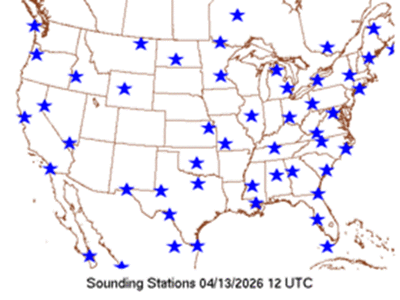
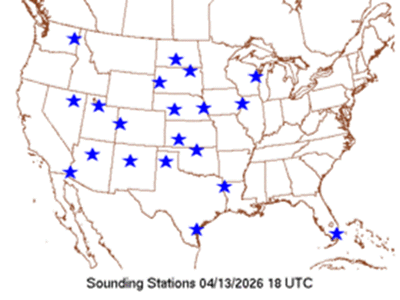
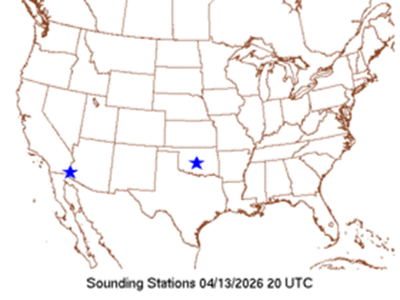
5) It talks about how RAOB times have shifted. Ok, so the data is not really missing, just done at a different time (18z instead of 12z). And I would argue that 18z is a better time in the day for the CONUS as it is closer to max heating and convective initiation, and we now have most models running at 18z initialization time now. I attached maps of the available soundings at 12z and 18z for 4/13. Just upstream of the tornado event, you had a number of RAOBs at 18z and an OUN RAOB at 20z. The first KS tornado was not until 00z. So how much of issue is there of this time shifting or RAOBs really? Who’s to say in this case concerning mesoscale phenomena, no 12z RAOBs hurt this forecast overall? You have more recent data at 18z closer to the event.
6) Can one definitely say or determine that the RAOB change times resulted in no tornado watch issued? The burden of proof is on the ppl or organization making the accusations or raising questions, not the other way around. Model data is just one of many, many things that go into a forecast, severe wx or otherwise. To treat it or imply it is a simple 1-1 correlation in this case is ridiculous
7) And finally, I find this article a thinly veiled excuse to bring in politics and blame the current administration for this "problem."
This all can be viewed as case of the MSM stirring the pot for merely content and agenda, making more of an issue than it is really is, omitting key facts about the nature of forecast science, and oversimplifying a complex situation.