• While Stormtrack has discontinued its hosting of SpotterNetwork support on the forums, keep in mind that support for SpotterNetwork issues is available by emailing [email protected].

2026-04-24-27 EVENT: OK/TX/AR/LA/MS/MO/KS

The squall line on the cold front spun up at least two QLCS tornadoes east of St. Louis as it ingested the old outflow. The first was between New Baden and Trenton, the second between Germantown and Carlyle. Both had very clear TDSs on radar. The Germantown-Carlyle TDS was large, indicating a likely larger and stronger tornado than the first.

I did a quick survey of the New Baden-Trenton tornado path (it's 3 miles from home). Remarkably, it has an almost identical path to the March 14, 2025 EF2, only shifted north by about 1/2 mile! This was a relatively weak tornado, EF1 max. The worst damage was on Highway 160 south of Trenton, where a farmstead had extensive tree damage and a single main power pole along the highway was toppled. I could not get a good look at structures on the property, but they did not appear to have much if any damage. There was no structural debris downstream. I only found tree damage at one other location to the southwest, and I did not see any other power poles toppled. Power is out along I-64 from the rest areas to the New Baden exit, but I did not find the source of that.
 
A couple of places where it would not surprise me if there was a tornado would be Florissant and southeast of Sullivan, both in MO. There was a report of 4 structures destroyed in Florissant, with a TOR warning at the time. Looking at radarscope, I could not see the basis for that warning, but unlike a lot of others that did not seem entirely warranted to me, this one may have verified. I also would be rather surprised if there was not a tornado southeast of Sullivan - there was a persistent velocity couplet there, even a few frames before the warning was issued, and there appeared to be a pronounced correlation coefficient dropout coincident with the couplet for several scans. That is a hilly, wooded, rather thinly populated area; if a survey is done, I suspect there would be evidence of a tornado there.
 
Time sensitive (5:20pm CDT): Take a look at this Google traffic map. Just incredible. Rush hour in St. Louis, and all green. I've *never* seen this here before outside of winter storms.


So the threat of svr wx and no one went to work or left early?

This practice IMHO is doing more harm than good, esp. from an economic POV. It is a non-trivial amount of $$ lost when you shut down or "panic" like this. W/ time more and more, we are being "held hostage" by the wx.

Don't get me wrong, there are times when you need to shut things down/evacuate/leave early, but, and a lot of this is due to how the MSM hype wx and the "end of days" b/c of climate change, there comes a point of diminishing returns! And IMHO, we crossed that point years ago. Even typical inclement wx that has low risk overall (snow esp.), *panic* and shutdown no matter what. As I said in another post, the forecast science has advanced tremendously in the last 30 years alone, but we do not seem to be taking full advantage of this progress.

An example, say a HIGH risk day for central OK is forecast. These days we can nail the timing of where and where the storms will develop very well. So if no storms are forecast before 6pm local time, is that a reason to dismiss all schools early and have ppl leave early from work?

Again, the costs of doing this are non-trivial, and can be quantified very well. However, there is no guarantee tornadoes that occur will be intense/long-tracked and even if so, hit major populated areas, and you have more fine-tuned timing available. Also, not all svr risks are created equal, just b/c you have a MDT or HIGH risk, does not necessarily = big tornado outbreak, but the MSM and officials don't seem to make this distinct a lot. It's not "one size fits all," but it seems a lot that is how it is treated.

See the problem there? This goes back to the outdated notion "better safe than sorry, and also, and you *will* see officials and politicians say this even today, "you never know w/ the wx!" Weasel "get-out-jail-free" excuse!
 
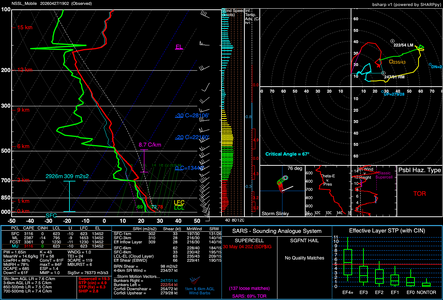
NSSL mobile did do a sounding around 19z from Fayetteville Illinois which was right on the main boundary near US 64.

A few things I observed...

1. Early morning convection stabilized the atmosphere north of the boundary. The air immediately north of the boundary never recovered though further north it did so there were storms along the warm front, but they weren't as severe as they could have been and I'm not sure there have been many verified tornado reports in that region.

2. The best forcing for ascent over the most open warm sector arrived pretty late, which is why why you saw the tornadoes supercells down in Northern Arkansas and Southern Missouri late in the game. I think this precluded things popping further north in Southern Illinois in the PDS watch, but I also noticed that low level lapse rates were poor down there.

3. Renewed convection along the boundary back towards Kansas City probably helped to further impede discrete supercell development that could have rooted in the boundary and taken advantage of better instability had earlier convection not persisted into the noontime hours.

There may be other factors I overlooked but that's what was most apparent to me. I saw a brief, weak tornado northwest of Bethalto on the storm that came through St. Charles County later in the afternoon but the rest of the storms were just anemic and died once they got east of the metro area.


1000018408.png
 
So, what happened Monday? We were in MO and IL, SPC issued a PDS watch, we watched one very small cell in far southern IL struggle and quickly die, even in later updates their MD mentioned strong tornadoes, with cells ahead of and in the main line to the west, it was a complete and total bust, only 3 tornado reports despite 3 tornado watches and a MOD risk. To the eye the cells we were on looked "soft" and were elongated NW-SE. One cell in MO west pf PBF did have a good hook briefly but also did not produce. The only tornado in the mai area was of the QLCS variety. Not ragging on SPC at all, but in my 30 plus years of chasing, I am hard pressed to remember too many forecasts that busted this hard. Probably good fodder for some future study on what exactly went wrong. I do give some props to the HRRR and other CAMs, they were never very impressed, especially for any cells SE and east of the primary line in MO and IL.

Headed home to Atlanta (not chasing today, looks messy and I have some commitments tomorrow.) Going to likely be a long down period ahead, I feel sorry for folks with chase vacations or in tours in early May.
 
The outflow boundary wasn't very far from stalling ahead of those early afternoon storms, it was basically 15-20 miles away from being caught by all of those updrafts. Had that occurred, we could have had a tight cluster of three violent tornado-producing supercells going from the center of the city through the I-70/I-64 corridor.

I think we're seeing recency bias with some of these. Anxiety post-Moore contributed to the May 31, 2013 traffic jam south of OKC. Katrina caused the massive evacuations out of Houston for Rita. People around here are definitely more on edge after May 16 last year. Some of my neighbors left yesterday to go stay with family and friends that had basements. We've had much higher-end tornado environments in the STL metro since I've lived in the area, including a High Risk right after the April 22, 2011 EF4 , none of them have had anywhere near this much effect. Social media might have a lot to do with it too.
 
I can't see how people taking the threat seriously and reducing non-essential travel in these instances is a bad thing. I have a friend in STL who simply worked from home to avoid being out and about and I am sure lots of other people did the same.

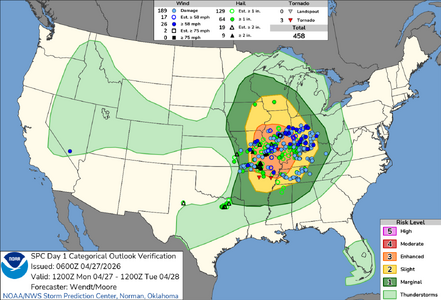
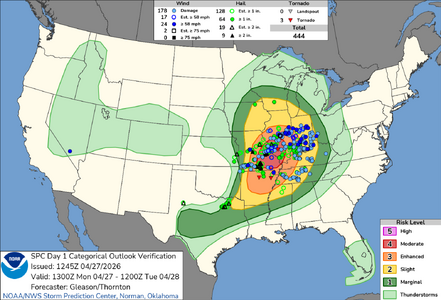
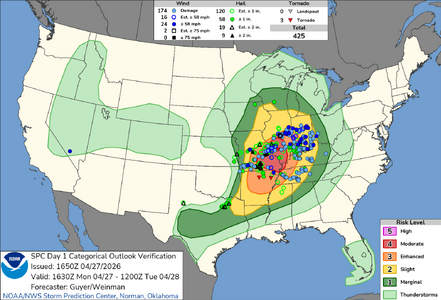
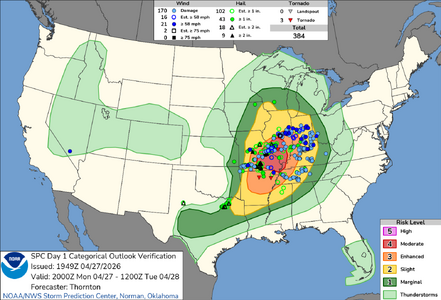
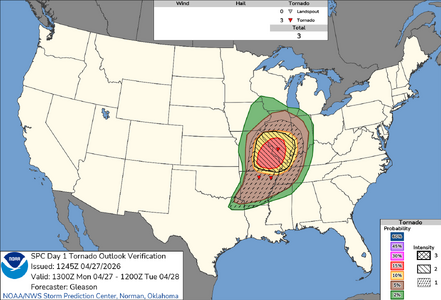
Also, here are the SPC verifications for the four Day 1 outlooks posted. While the tornado count was thankfully low, can the day be called a bust when there was this much severe weather?
 

Attachments

  • day1otlk_v_20260427_1200.png
    day1otlk_v_20260427_1200.png
    682.6 KB · Views: 7
  • day1otlk_v_20260427_1300.png
    day1otlk_v_20260427_1300.png
    700.4 KB · Views: 3
  • day1otlk_v_20260427_1630.png
    day1otlk_v_20260427_1630.png
    699.1 KB · Views: 2
  • day1otlk_v_20260427_2000.png
    day1otlk_v_20260427_2000.png
    694.1 KB · Views: 3
I consider the tornado part of yesterday to be a bust (unless a significant change comes from damage surveys/later reports, but that seems unlikely). Compared to what it looked like, we got very little. And (responding specifically to James) while wind and hail is significant, that's also not the same as intense tornadoes; plus comparing specific outcomes is useful for improving future forecasts.

SPC verification (copied here at 12:00 PM CT on April 28, 2026):
1777393612477.png

I too was wondering why it turned out the way it did - the outlook seemed quite promising even that morning. This thread has some comments on it already, esp. around storm positioning in relation to the fronts.

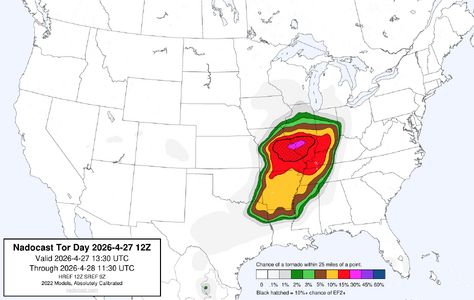
Side note, I checked out Nadocast's experimental outlook; it was also quite positive on the day:
1777394699074.png

(For the north area - southeast Iowa and north Illinois - the outcome wasn't surprising, since it hadn't been looking great even that morning. After the night/morning storms, there was some surface temperature/CAPE recovery in the west during the day, but that had little overlap with where the winds were better in the east.)

One comment on the PDS watch: The majority of the models runs I saw put afternoon storms in that area. However, it seemed to me like its parameter space was worse than west Missouri, so I was confused why that was the place for the PDS watch. The SPC Mesoscale Discussion points out large hodographs; perhaps that was a big driver toward "if we can get tornadoes, they're likely to be powerful"?
(The other MDs around that area: 579, 583, 584, 586, 588, 589.)
 
Last edited:
I consider the tornado part of yesterday to be a bust (unless a significant change comes from damage surveys/later reports, but that seems unlikely). Compared to what it looked like, we got very little. And (responding specifically to James) while wind and hail is significant, that's also not the same as intense tornadoes; plus comparing specific outcomes is useful for improving future forecasts.

SPC verification (copied here at 12:00 PM CT on April 28, 2026):
View attachment 29224

I am also pondering what happened - the outlook seemed quite promising even that morning. This thread has some comments on it already, esp. around storm positioning in relation to the fronts.

Side note, I checked out Nadocast's experimental outlook; it was also quite positive on the day:
View attachment 29225

(For the north area - southeast Iowa and north Illinois - the outcome wasn't surprising, since it hadn't been looking great even that morning. After the night/morning storms, there was some surface temperature/CAPE recovery in the west during the day, but that had little overlap with where the winds were better in the east.)

One comment on the PDS watch: The majority of the models runs I saw put afternoon storms in that area. However, it seemed to me like its parameter space was worse than west Missouri, so I was confused why that was the place for the PDS watch. The SPC Mesoscale Discussion points out large hodographs; perhaps that was a big driver toward "if we can get tornadoes, they're likely to be powerful"?
(The other MDs around that area: 579, 583, 584, 586, 588, 589.)
So the nadocast likely explains the "ghost town" effect on the highway in STL at normal rush hour.

I am not a fan of many contours plotted for certain type of parameters b/c it makes it appear worse or menacing psychologically that is actually is.

For instance, on the nadocast, is .1% really of any practical value? And going every 1% from 1-3%, again, what value is this other than it looks more "scary" to the untrained eye? And it has a small 30% area right over STL, while the SPC outlook does not. Which one do you think ppl will believe more?

The hatched areas for EF2+ chances, that really should be on a separate plot b/c again, too many contours on one map.

There are social factors present that go beyond the hard meteorological science that need to be considered here.
 
A few thoughts on the discussion above. I mostly agree with what Boris said about media over-hype and the shortcomings of shutting down school, work, etc. over weather that MAY happen. Specifically with regard to schools, I think that letting them out early for severe weather risk days is a very BAD idea. The kids are going to be safer at school, assuming there is an adequate disaster plan, than they are likely to be at home or elsewhere unsupervised until their parents get home, or than they are likely to be in transit home. More broadly, a lot of people IMHO over-react to what turn out to be relatively minor winter weather events and to forecasts of weather that may or may not happen. 70 years ago, when I was in grade school, I never once got a day off from school just because it was cold, and it got considerably colder in northeast Iowa then than it does now. Now school is cancelled on a regular basis because of cold weather, including in northeast Iowa but many other places, too. There is a cost to excessive school and work cancellations or early releases, as Boris pointed out, and I think it is done too often, although there are some times that do call for it, especially with severe winter storms. But early school releases for severe weather make no sense to me. If there is a major threat of severe weather around the time school normally gets out, it would be safer to just hold the kids at school, use the disaster plan to appropriately shelter them, and then send them home once the threat has passed.

Regrading media hype, I agree that they often over-hype weather events for ratings. (Although I don't think that has much to do with the "climate change narrative" since I see this overhyping in media on both sides of the climate argument. For example, CNN and Fox News/Weather both over-hype weather events, and probably reap increased ratings by doing so.) Having noted that over-hyping, I would add, though, that I do not think the media deserve all the blame for yesterday. Someone made a post prior to this event - apparently in some thread other than this one because I cannot find it now - that a MDT risk did not seem more warranted yesterday than in some other recent events. I think that if SPC had stuck with the ENH risk it had earlier, a lot of this media hype would not have happened. Now I know that if things had set up differently it could have been a lot different, but the potential limiting factors (early convection, outflow boundary position, storm timing, etc.) were well known and discussed a lot in this thread and elsewhere. So the risk, though considerable, was conditional. Not saying SPC should not have gone to MDT given the potential, but if they had not, I think a lot of the media hype and work/school changes would not have happened. After all, if the risk is as considerable as in yesterday's SPC probabilities, we want the media to get the word out.
 
Back
Top