• While Stormtrack has discontinued its hosting of SpotterNetwork support on the forums, keep in mind that support for SpotterNetwork issues is available by emailing [email protected].

2026-04-23 Event: IA/MO/KS/OK/TX

Joined
Aug 19, 2005
Messages
340
Location
Atlanta, GA
Time to discuss the next Plains event. Maybe this time OK will produce, unlike the past two tornado bust days. No real surging cold front, modest WSW mid-upper flow, plenty of CAPE. Unlike the last event at this time range, models in better agreement with Euro pretty much in step with the GFS, not a ton of ensemble spread.
Prelim target: northern OK/south central KS.
 
Well, the target mentioned above may not have convection at all, despite it being a relatively weak cold front, almost all models show a squall line maybe extending into central KS with no dryline convection. One or two CAMs have a lone supercell or two in OK, but that seems like an awfully risky play. We are leaving today anyway, more to set up for the weekend, but maybe we will get lucky tomorrow,
 
Based on the Wednesday 12Z CAM's and the ICON (for synoptic-scale features), it looks to me like northeast Kansas and southeast Nebraska will be a likely area for tornadoes. A mesolow will develop between TOP and OMA. Pressures will be falling (something that wasn't the case with last week's events) and will be quite low (below 1000mb) for this late in the season. Nice difluence with the 500mb trough becoming more negatively tilted during the day.

My target would be around Topeka - Hiawatha. While hilly, the road network is good and many of the hilltops have few trees with good visibility. Look for isolated supercells and/or a tail-end Charlie.
 
Between my chase partner being unbale to chase today and a lot of things to do both at work and home, I don't plan on making the drive from my base in DFW to the more obvious target area in KS. So my focus is on the dryline in OK.

I can't find a single model that convects along the dry line this afternoon/evening except for the RRFS A (and I don't think any of us take that model seriously right now). In my many years of chasing I've learned that while convective allowing models often over convent, that taking a null convection run and wish casting it to convent rarely works out well for my chase.

But here is the kicker - when I click along the dryline in OK to get a forecast sounding to see why it isn't convecting it is hard to see why it isn't. The thermodynamics are there. Even the kinematics look good (for a change vs last week). Lots of instability, no (or at least very little) cap, and convective temp reached. Every model I clicked for a sounding on showed "TOR" and I even got one that said "PDS TOR". All this but no convection in models.

So today looks like a high risk of bust, but high reward if it happens day on the dryline. Today is a day to really pay attention to the real observations (heck every day is). When I look at that I notice that the OUN morning observed sounding has an observed CIN about 80 less than the HRRR run at the time. This could be an indication that the models think the cap is stronger than it really is. If this trend continues and we get some clearing in the clouds to get it a tad warmer, today could be an interesting chase day on the dryline. The potential is there. Risk of bust is high.
 
I was not able to watch things unfold “live” last night, and it’s a good thing or I would have been going crazy for not being out there 😏 But I’m having trouble getting my arms around what happened. The YouTube video showing the two tornados says one chaser was in Nardin and the other in Blackwell. Those towns are only 10 miles apart. So I assume these were from two mesos in the same complex? Was this a Pilger type situation? If so, why were the two tornados not close enough to be seen together?

And that was not the same supercell as the one that produced the tornado in Enid, correct? There are clearly two different tornadic supercells by about at ~8pm CDT on the archived radar, one in Enid and one near Ponca City. Based on archived radar and SPC storm reports, it looks like the Enid storm had not even formed at the time the northern storm produced, but I’m not sure of the exact time of those dual tornados.

 
I was not able to watch things unfold “live” last night, and it’s a good thing or I would have been going crazy for not being out there 😏 But I’m having trouble getting my arms around what happened. The YouTube video showing the two tornados says one chaser was in Nardin and the other in Blackwell. Those towns are only 10 miles apart. So I assume these were from two mesos in the same complex? Was this a Pilger type situation? If so, why were the two tornados not close enough to be seen together?

And that was not the same supercell as the one that produced the tornado in Enid, correct? There are clearly two different tornadic supercells by about at ~8pm CDT on the archived radar, one in Enid and one near Ponca City. Based on archived radar and SPC storm reports, it looks like the Enid storm had not even formed at the time the northern storm produced, but I’m not sure of the exact time of those dual tornados.
Braham was 650pm CDT and Enid was 8pm CDT
👍
 
I was not able to watch things unfold “live” last night, and it’s a good thing or I would have been going crazy for not being out there 😏 But I’m having trouble getting my arms around what happened. The YouTube video showing the two tornados says one chaser was in Nardin and the other in Blackwell. Those towns are only 10 miles apart. So I assume these were from two mesos in the same complex? Was this a Pilger type situation? If so, why were the two tornados not close enough to be seen together?

And that was not the same supercell as the one that produced the tornado in Enid, correct? There are clearly two different tornadic supercells by about at ~8pm CDT on the archived radar, one in Enid and one near Ponca City. Based on archived radar and SPC storm reports, it looks like the Enid storm had not even formed at the time the northern storm produced, but I’m not sure of the exact time of those dual tornados.
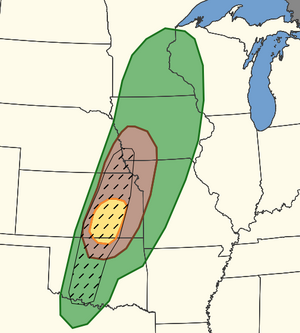
Enid is about 30 miles to the southwest of Nardin/Blackwell, as the crow flies. I heard something about two tornados close together as well but haven't really looked into it much. You are correct that the Enid storm hadn't even formed when the northern storm produced. Nothing was south of the northern storm for a while.
 
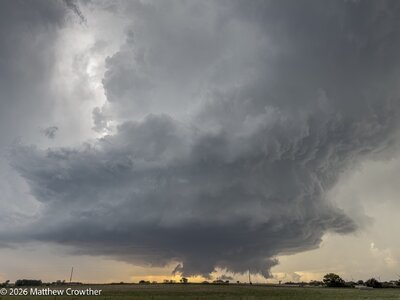
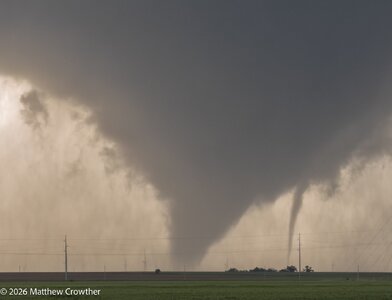
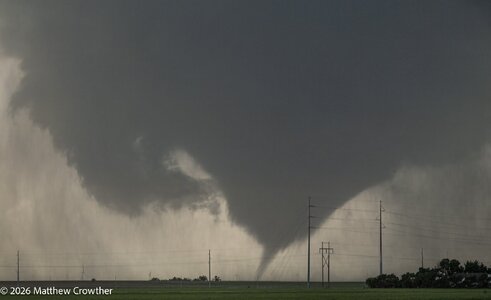
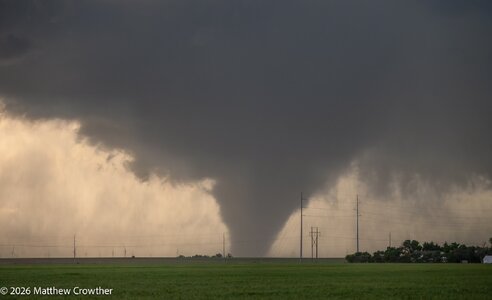
We were on the Braman tornadoes- got great structure from the east when it was in the weak multi-vortex stage, then went a bit too far south to near Blackwell and saw the more classic stage with satellite
 

Attachments

  • IMG_4098.jpg
    IMG_4098.jpg
    187.9 KB · Views: 8
  • IMG_4139.jpg
    IMG_4139.jpg
    235.9 KB · Views: 6
  • _DSC1539.jpg
    _DSC1539.jpg
    419.1 KB · Views: 6
  • _DSC1527.jpg
    _DSC1527.jpg
    206.1 KB · Views: 8
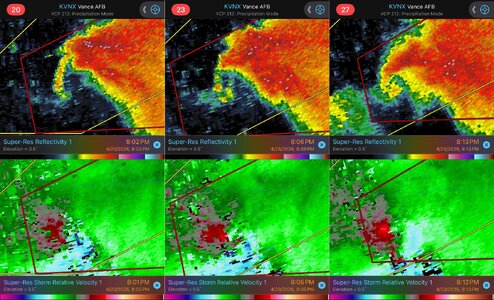
The Enid storm started developing well to the southwest of the ongoing Blackwell storm/tornadoes. It went tornadic fairly quickly. Its radar presentation was a pretty classic look of something that was about to produce a high-visibility sig tor: a low-reflectivity hook similar to Dodge City 2016. As soon as I saw this first frame I was saying, yeah, that's going to be a tornado of the year candidate.

april2326radar1.jpg

It appeared the Enid storm's updraft was right on the boundary with the hook on the western flank of the storm. Possible hybrid nonsupercell tornadogenesis and quick transition to supercellular/RFD-driven? Calling Jon Davies!

I thought for sure we'd be seeing drone video for the ages from that, but alas, the tornado was entirely within the military-restricted Class D of Vance AFB and the adjacent airport, and you can't get the standard LAANC clearance to fly there.

Daniel Shaw's shot here is a classic with the RFD clear slot spiraling in like the cinnamon roll we were discussing before:

 
Last edited:
It appeared the Enid storm's updraft was right on the boundary with the hook on the western flank of the storm.

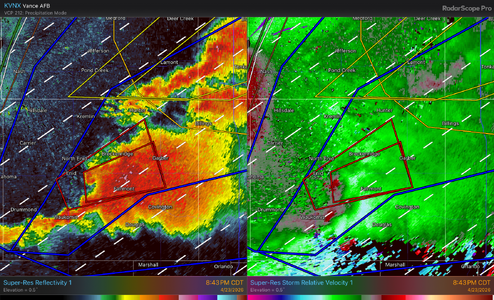
Sorry for all the questions, but I wasn’t able to look at what was happening until around 8:45 CDT… Was this an OFB you are referring to, and was it generated by the activity further north? I know the dryline was in the vicinity, was this near the boundary intersection?

The orientation of the hook to the forward flank precip in the image you sent is not unexpected given the shape of the hodograph, but it’s amazing that the meso was still apparent even when it appeared to be totally cut off by precip to its south and southeast when I first looked at radar at 8:45 CDT. Not sure if the tornado was still on the ground at this point, but the warning still said confirmed tornado, so that’s pretty incredible if it was still going given this precip orientation (timestamp is ET, it annoys me that you can’t set a different time zone in RadarScope!)

IMG_3121.png
 
Back
Top