• While Stormtrack has discontinued its hosting of SpotterNetwork support on the forums, keep in mind that support for SpotterNetwork issues is available by emailing [email protected].

2025: Year Without a Winter in the Western US

For a great overview of current drought conditions, including some crazy stats (95% of stations in Colorado are in snow drought), see a recent Drought.gov article posted on February 5th:
Snow Drought Current Conditions and Impacts in the West | February 5, 2026 | Drought.gov

For a TLDR of everything I'm about to say, please see this excellent post by the Colorado Climate Center: How does this year compare to the snow droughts of the past? - Colorado Climate Blog

2025-2026 Winter Comparison With History
I mentioned in my first post on this thread that the period of record used to generate most of the scary graphs above only stretches back to 1987. When talking about climatology, this isn't a very long period of record, and also has the affect of possibly making this year look worse than it actually is. I've mentioned that we're experiencing "record" low snowpack, but of course the period of record (POR) for SNOTEL automated snow observations is only 39 years long.

I've seen a number of comparisons recently between this winter and the huge, historically significant winter droughts of 1976-1977 and 1980-1981. Those years fall just outside of the POR for most SNOTEL stations, and so they don't show up on the statewide SNOTEL graphs seen above. So, I'd like to examine how comparable our current winter is to those dry winters of old.

There weren't any SNOTEL stations in Colorado for the winter of 76-77, but a few locations had them for the winter of 80-81. Using data from these individual stations, we can see that at most stations the current snowpack is actually a lot better than in 1980-1981, which was probably the worst snow year in modern history. Vail Mountain is an exception, and at that location this winter is currently worse than 1980-1981.
View attachment 28529


View attachment 28530


I guess this is good news in that the current conditions aren't really unprecedented, and that similar scenarios have played out in the past. However, I think it's noteworthy that Lake Mead and Powell weren't completely drained before the winters of 76-77 and 80-81, so they were able to absorb the hit from low runoff. We're not in a similar position today, and the reservoirs are both already near the level at which power generation becomes much less efficient or stops entirely, and inputs from snowmelt aren't expected to be particularly large this summer.

The Colorado Basin River Forecast Center puts out monthly presentations examining the snowpack situation and predicting runoff. Their most recent presentation, from February, can be found at the following link: https://www.cbrfc.noaa.gov/present/2026/cbrfcwsupfeb2026.pdf
It's pretty grim, and we might be in serious trouble this summer if things don't change.


Snow Course Markers
I recently discovered (through the Colorado Climate Center) that there's a network of manual snow observation sites across the Rockies that has been operational since the 1930s. Observations of snow water equivalent and snow depth are taken once monthly in February, March, April, and May. In select locations this network has a 90+ year record of mountain snowpack, and more broadly it spans 50-80 years, giving us a much more complete picture of historical snowpack than the recently introduced SNOTEL stations.

So, how does this winter stack up to other dry winters over the past 90 years? At almost all snow course stations in Colorado, the lowest SWE values in a 50-90 year history were recorded during the winter of 1980-1981, followed closely by the winter of 1976-1977. A few locations across southern CO have all-time low records during 2000 or 2017. Only a few stations have recorded their lowest SWE for February in 2026.
View attachment 28531


The picture is a little different in other areas. In New Mexico and Arizona, there are a number of "worst years" at each site, probably because values of 0 were recorded multiple times.
View attachment 28532


To the north, it appears that 1976-1977 was particularly bad, followed by 2023-2024 in some areas.
View attachment 28533

You can check out this data for yourself at the following link: NWCC iMap


The takeaway from all of this?
This year is definitely bad, but similar snow droughts have occurred in the past. However, the dry winters of 1976-1977 and 1980-1981 were sandwiched between a number of wet years. Reservoir storage was at acceptable levels before these dry winters happened, allowing their negative effects to be mitigated. We don't have that luxury this year, as reservoirs west-wide are already nearing record low conditions.

In the following graph, note the greatly reduced frequency of wet periods after 2000, and the increasing consistency of droughts. (Graph from NCEI's Climate at a Glance Climate at a Glance | National Centers for Environmental Information (NCEI))
View attachment 28534
In comparison to 1977 and 1981, I believe that this winter's snow drought impacts will be made much worse by the fact that the west is already experiencing drought conditions, and essentially has been for 25 years.

Additionally, it's very interesting to note that all of this is not a consequence of low precipitation. This winter has been marked by above-normal precipitation mostly everywhere (see my first post on this thread) but incredibly warm temperatures. Some may argue that this is the mark of climate change. The snow drought this year has been caused by anomalous ridging (weather) and not necessarily climate, but you really can't help but think that global warming has at least tacked a few degrees onto the existing highs. Going forward, it seems that years like this may become more of the norm...
Interesting you mention 1976-77 as being a snow drought. Well, that winter was absolutely epic for cold and snow in the eastern U.S.
See here:
https://nwafiles.nwas.org/file/nwafiles/digest/papers/1977/Vol02No4/1977v002no04-Wagner.pdf

January 1977 was possibly the coldest month experienced in the eastern half of the country in the past 200 years. You had departures as low as -19 F for the month in central Appalachia. So is it any surprise the West lacked snow?

If something like the above occurred today, it would be blamed on climate change. Absolute high-end extremes at or above anything in recent decades have occurred when the globe was cooler. So how does that work really? If the same sensible wx (extremes and everything else) occur in cooler mean temps and lower CO2, and higher mean temps and higher CO2, well, see the issue here? Wild extremes and anomalies happen regardless of global temps or CO2 levels. Yes, there some variance, but there are numerous other natural external and internal factors impacting climate system over time that result in variance, and this can drown out defined signals solely based on CO2 levels, such as solar activity (e.g. Maunder Minimums) an Milankovitch cycles (changes in the Earth's eccentricity, obliquity, and precession). Items such as these dominiate, not CO2 levels. Don't get me wrong, CO2 level are a factors, but just b/c something is a factor, does not mean it is significant (statisically or otherwise), doom going to happen, or counterintutitive sensible wx impacts can not occur.
 
This winter has been much better than the 2024-2025 winter in my area concerning snowfall. Last winter we barely scraped up 9" of snow for the whole season. This winter we are sitting at 25.6" total since the first snow in November.
Our biggest snow of the season came on November 29th when we picked up 9.3" of snow. December 13th was our second largest snowfall at 6.1", and then in January it only snowed once...typically our snowiest month. January 2026 only brought 2.4 inches of the white stuff to my location. By the looks of things, we will go all of February without any snow, which is the first time in a while I can remember that happening.
In late January we had 12 straight days of below freezing temperatures, being the first time since 2021-22 that has happened in our local area (Central/Western Illinois). Even with snowfall being close to average or slightly above, I would consider this winter to be fairly mild compared to the winters I'm used to growing up as a kid. Most of the snow events were far and few between. While way before my time, those winters in the 1970s are the benchmark for an epic winter still to this date across most of this region.
 
Meteorological winter is over, and the NCEI's official data for the winter was just released today. I'll be taking a look at temperatures this time instead of snowpack since that has already been discussed in detail.

Winter Rankings
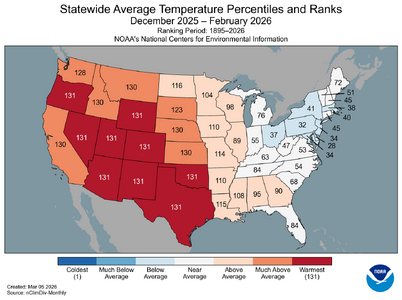
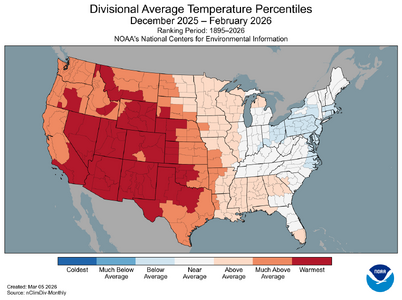
Looking at the 3-month DJF winter period as a whole, there are some incredible stats. For most of the West, and even some surrounding areas, it was hands down the warmest winter on record. In comparison, the unusual cold the East has been experiencing this winter was not particularly notable compared to the historical period, and this winter wasn't even in the top 30 coldest for most northeastern states.
Some 1/3 of the country's land mass experienced its warmest winter (rank 131) on record, with additional areas seeing their 2nd warmest winter (rank 130) on record.

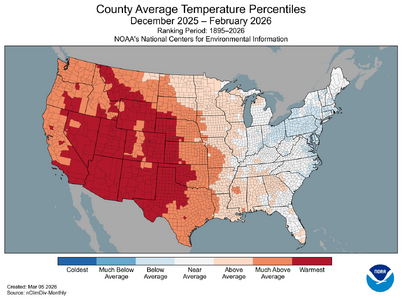
The following maps are from the NCEI's U.S. Maps page (link) and they show how this winter's temperatures ranked compared to history.
1773106464762.png


1773106867127.png


Taking a finer view (county level), it's interesting to note that the mountainous counties of Colorado actually didn't have their all time hottest winter this year. I think 1981 takes that spot. Snowpack conditions are also comparable to but not worse than 1981 at most locations.
1773106887303.png


Winter Temperature Departure from Average
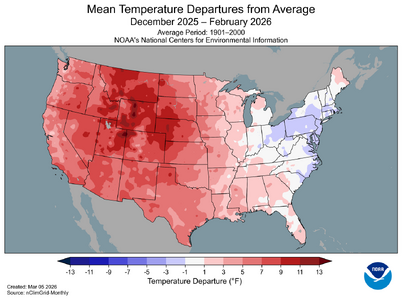
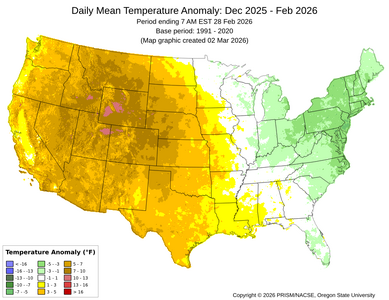
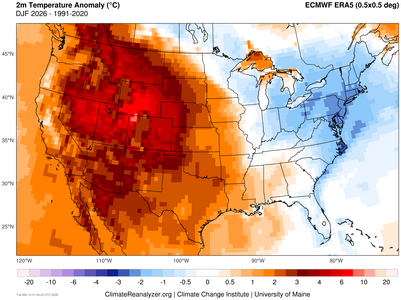
The above maps show how this winter ranks compared to other winters, but how hot was it really? Looking at average temperature plots from several sources, it appears that most of the high plains and intermountain basins, including places like Denver, Cheyenne, Salt Lake City, and Billings saw average temperatures of 9-10 degrees above average for the entire three month winter period.

From the NCEI:
1773107467462.png


From the PRISM Group:
1773107490954.png


ECMWF ERA5 Reanalysis (watch out, this one's in degrees Celsius!)
1773107767786.png

The last 2 maps are also notable because they use the base period 1991-2020 to calculate their temperature departure from average. This was a time where the CONUS had already warmed significantly above 20th century norms, and to see anomalies ~10 degrees above that is shocking.


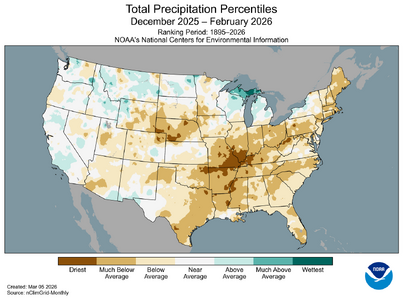
Precipitation
Precipitation anomalies this winter were generally not that notable across the west. And yet, there's still been a historic snow drought due to the anomalously warm temperatures seen above.
1773109419750.png


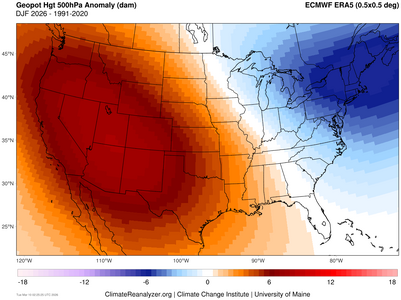
Ridging
The cause of all this? Apocalyptic ridging for almost the entire winter over the Western US. I'm actually not sure what was responsible for the ridging this winter, but I think it came down to La Nina and the impact of some of the other circulations.

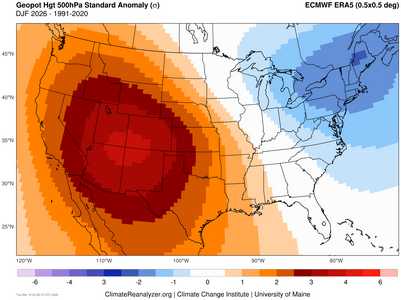
500mb height anomalies from the ECMWF's ERA5 Reanalysis tool illustrate how severe the ridging was this winter:
1773109685089.png


And a normalized map for a more fair comparison:
1773109700191.png


Yes, that's really an anomaly of 2.5-3.5 standard deviations above average. Yikes. There weren't any comparable years in the reanalysis data, but 1981 and 2015 were in the ballpark. You can see for yourself at the link I provided.

All in all, it was an unbelievably hot winter across the West. This will almost certainly have severe consequences for western reservoir storage and the summer wildfire season.

From a storm chasing standpoint, western drought often has negative impacts on the chase season, although the summer advection of moisture from the Gulf will sometimes be enough to override whatever drought conditions may be present. We'll just have to see how it plays out this year, especially given the crazy ENSO forecast for the summer.
 
Since the last post above is March 9, I thought I would add a little about what has happened since then - notably a record-shattering heat wave. That on top of what was already the warmest climatological winter in many states in 131 years of record-keeping. In Albuquerque yesterday, the high was 91 - not only breaking the standing record for March set the previous day, but also warmer than any temperature ever recorded there in April. And of course, the earliest 90+ reading on record. Where I live, in Pagosa Springs, CO, the official temperature is measured at between 7600 and 7700 feet above sea level. Friday the high was 79 - the third consecutive day that an all-time March record was set. All-time March records have fallen all over the west, including a national record for March of 110 in Martinez Lake, Arizona - which, according to a report I saw later on a Denver TV station, was broken the next day with reports of 112 at four locations in Arizona and California.

Obviously, all this is very bad news for the ski industry, for our reservoirs, and for the wildfire season. Despite heavy snows in much of Colorado in mid-February (Wolf Creek got nearly 5 feet), the snow pack is now once again far below median for this time of year all over Colorado. The snow base at Wolf Creek has gone from something like 90 inches after that storm to 43 inches now, and is barely above half the median for this time of year. And as others have noted, the snowpack at lower elevations is considerably farther below median, in many cases now zero.
 
I'll just consider this to be my little March update to the thread.

After getting no measurable snow in February, there were only 2 snows in my part this month.
(mountains did get more than that) But from those 2, we did pretty good here...

First one: March 6
This early march storm turned out to be fairly good, providing over 6" of measurable snow (likely closer to 8" as some melted)
But no matter what, it was the largest snowfall of the year. It was also heavy wet snow which provided ~ 3/4" of water. (wouldn't be surprised if that's more than all of Jan & feb combined)

Second one: March 15
This mid-march storm started out with with rain, which quickly converted over to snow... and that became a little late-night weak snow-squall(relatively uncommon occurrence here) - enough for a special weather statement to be issued, but not enough for a warning...still kinda cool to see.
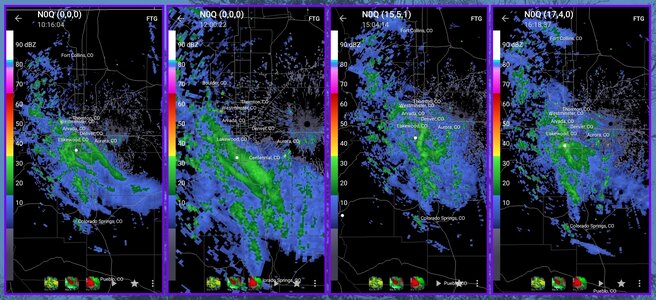
After the squall passed, light to moderate snowfall the rest of the night, and then continued most of following day - basically just sat over just a very limited area which happened to be where I am. (there's a little curve in the mountains south of here, and when the winds are just right it sets up something with upslope & makes a 'storm' sorta sit in place here - see radar image)
This again turned out to be fairly good, providing just under 5" of measurable snow (likely closer to 6" counting melted). Like a typical spring storm it was heavy wet snow and provided ~ 1/2" of water.

-------------
Overall I can say this winter has felt very weird...it really feels kinda like we didn't have winter.
In part because I haven't been working due to layoff last year.
But even moreso, its been the crazy weather.
In a "normal" year I'd have atleast some snow on the ground in the backyard from sometime in Nov or Dec til the beginning of spring. This year there was never any snowpack, when we'd get a little snow it would all melt before the next one came.
The warm temps felt almost spring-like in late Feb, and almost summer-like in mid Mar.
Looking in the mountains and seeing the high peaks look 'patchy' rather than pure white was just weird'
Some trees & shrubs were making little leafs or buds in Feb, and by early-mid March lots of trees were in bloom.

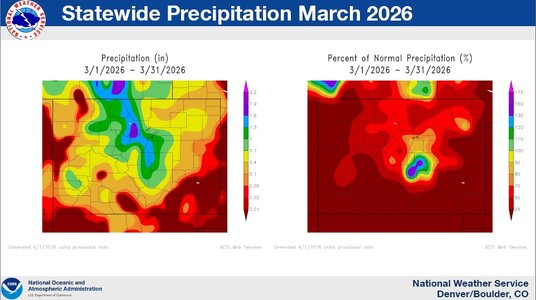
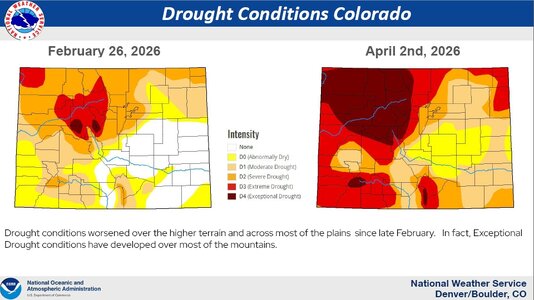
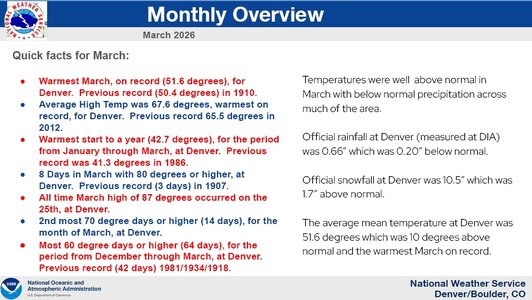
See attached images below for these (I didn't look beyond CO, but from what I've heard its just as bad - if not worse in surrounding mountain states):
Precip was far below average for most of the state.
Statewide drought has significantly worsened during March.
Down in Denver (and other cities too) they set multiple record high temps.
This week, forecast is showing some chances for rain almost every day, but we'll see if that actually verifies.
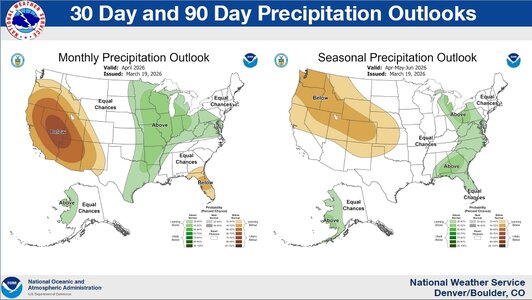
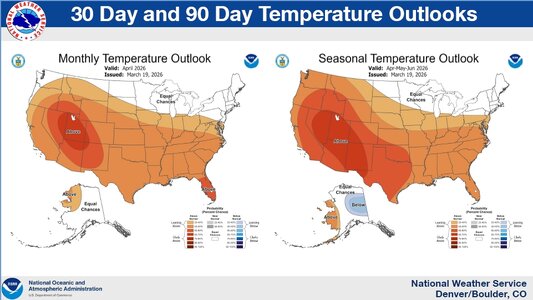
Long-term temp/precip outlooks are not looking good for the ongoing drought.

Weekend of Mar 28 I was out a bit farther east from my normal area and got a good look at the mountains, in a 'normal' year it woulda been shocking just how little snow was left up there. (couldn't get a pic since I was driving)
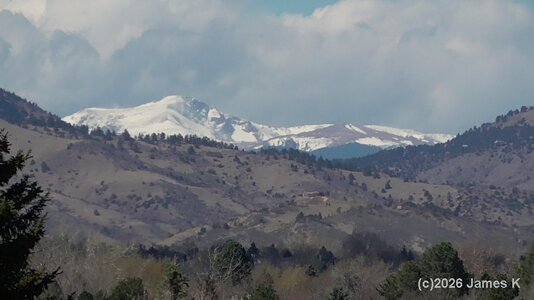
There was some more recent snow up there, last pic shows what it looked like April 2 on the 1 high peak I can see from home.
 

Attachments

  • nws-precip.jpg
    nws-precip.jpg
    221.6 KB · Views: 1
  • nws-drought.jpg
    nws-drought.jpg
    258.3 KB · Views: 1
  • nws-facts.jpg
    nws-facts.jpg
    313 KB · Views: 1
  • nws-outlook-precip.jpg
    nws-outlook-precip.jpg
    251 KB · Views: 0
  • nws-outlook-temp.jpg
    nws-outlook-temp.jpg
    250.6 KB · Views: 0
  • radars_3-15.jpg
    radars_3-15.jpg
    1.1 MB · Views: 0
  • mtn_S9100027.jpg
    mtn_S9100027.jpg
    309 KB · Views: 1
The Feds are pulling water from the Flaming Gorge reservoir to send water downstream to keep the hydro generators at Lake Powell from being damaged.

The water levels there are extremely critical.


In the mean time, the idiots in Arizona keep watering their grass and filling their swimming pools. Make it make sense. :rolleyes:

The American SW has its priorities completely screwed up.

 
Hannah.Taylor said:
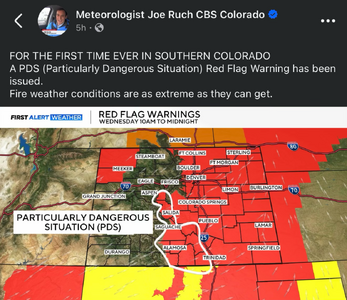
We have another PDS Red Flag Warning issued for Colorado. This is the first one for Southern Colorado effective tomorrow morning at 1000 AM MDT to Midnight.
I had seen the local Red-Flag for tomorrow (and Fire Weather Watch for thurs), but didn't see that PDS one down south. Not good so early in the year. Now also explais why they were talking power shutoffs down that way.

The Feds are pulling water from the Flaming Gorge reservoir to send water downstream to keep the hydro generators at Lake Powell from being damaged.
(...)
In the mean time, the idiots in Arizona keep watering their grass and filling their swimming pools. Make it make sense. :rolleyes:
Not surprised on Flaming Gorge, I'd seen a recent news story where it mentioned they may do that.
As for people in Arizona watering grass and filling swimming pools, all I can say is: WTF.
 
(1/2)
Oh boy. I've been waiting to make a post on this.

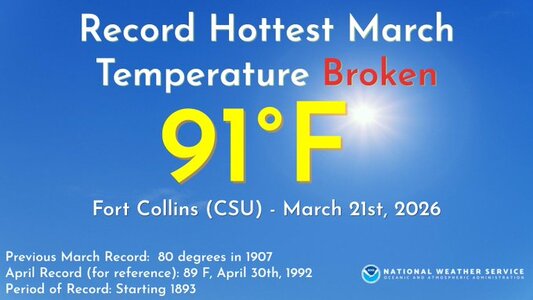
In addition to the already awful snowpack this winter, the West was targeted with one of the most anomalously strong heatwaves ever seen in North America during the latter half of March. For a full week at many locations, high temperatures broke the monthly record for March every single day, sometimes breaking the monthly records for April as well. In Fort Collins, CO, there were two days above 90 degrees in late March, when the previous record for earliest 90 degree day was MAY 5TH!!!
FortCollinsRecordTemp_03-21-26.jpg

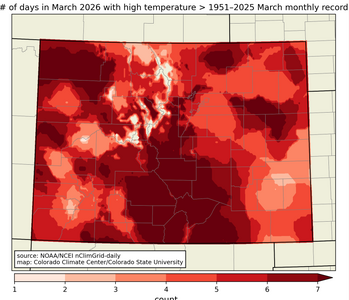
As I mentioned before, many locations broke the previous March monthly record for a full week. The Colorado Climate Center put together an excellent graphic showing this for the state of Colorado:
1776874480763.png

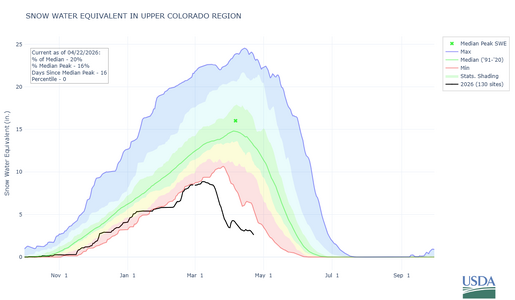
The impact that this heatwave had on the snowpack was unbelievable. It triggered the earliest and most rapid snowmelt ever seen across the region, leaving many basins at 50% of their previous record low snowpack on April 1st. A significant snowstorm in the first days of April and more seasonable temperatures throughout the month so far managed to stop the bleeding, but in all honesty the damage has already been done.
14_upper_colorado_region-2-wteq-por (1).png

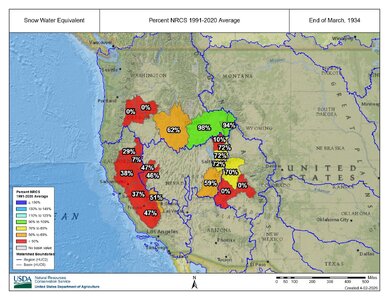
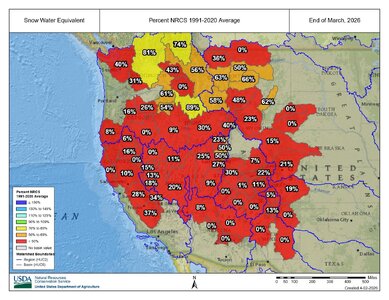
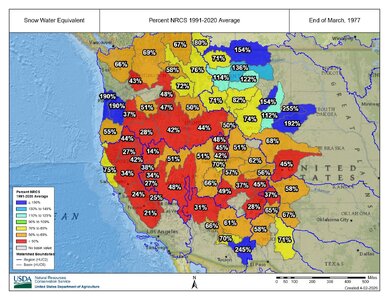
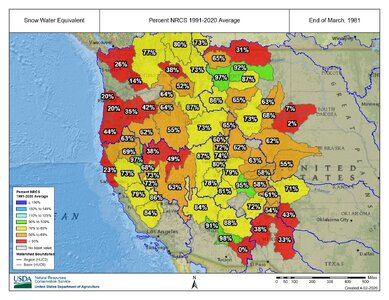
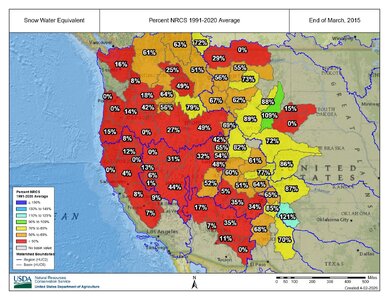
And to really illustrate the scale of the snow drought in the West, I'll now show you basin-scale snowpack charts on April 1st (a date generally assumed to be around peak snowpack, although individual basins may have a slightly earlier or later peak) for the worst drought years in history compared with 2026. Spoiler: 2026 was FAR worse than any previous year in this region, even including 1934 (for which there is only data in a few basins).

Side-by side, we have 1934 vs 2026
Snow_Water_Equivalent_Percent_NRCS_1991-2020_Average_End_of_March_1934.jpegSnow_Water_Equivalent_Percent_NRCS_1991-2020_Average_End_of_March_2026.jpeg

1977 vs 2026
Snow_Water_Equivalent_Percent_NRCS_1991-2020_Average_End_of_March_1977.jpegSnow_Water_Equivalent_Percent_NRCS_1991-2020_Average_End_of_March_2026.jpeg

1981 vs 2026
Snow_Water_Equivalent_Percent_NRCS_1991-2020_Average_End_of_March_1981.jpegSnow_Water_Equivalent_Percent_NRCS_1991-2020_Average_End_of_March_2026.jpeg

2015 vs 2026
Snow_Water_Equivalent_Percent_NRCS_1991-2020_Average_End_of_March_2015.jpegSnow_Water_Equivalent_Percent_NRCS_1991-2020_Average_End_of_March_2026.jpeg

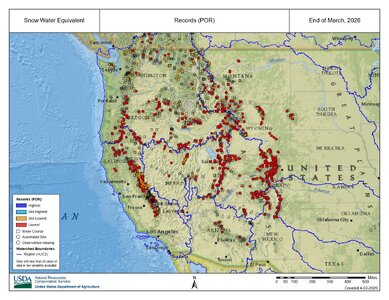
The areal coverage and severity of the 2026 snow drought is remarkable. Even the basins in the northern states (ID, MT, WA, WY), which were doing ok throughout the season saw record low snowpack levels during the March heatwave. To illustrate this, here's a chart of stations that recorded their second lowest or lowest snowpack on record on April 1st, 2026:
Snow_Water_Equivalent_Records_(POR)_End_of_March_2026.jpeg
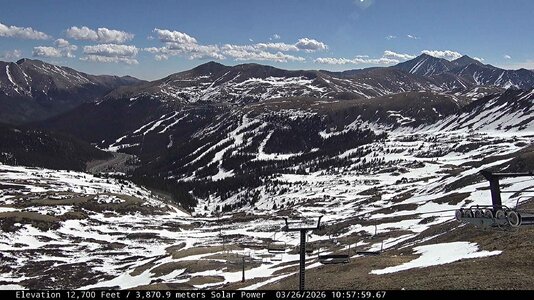
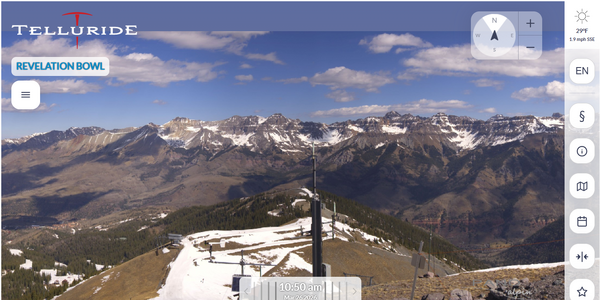
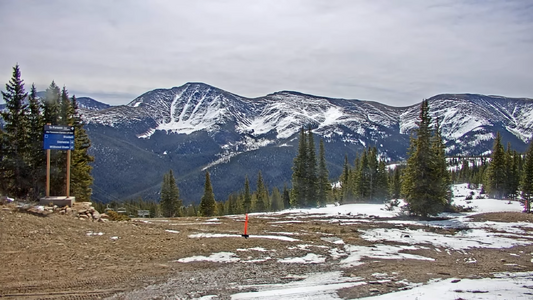
To give you an idea of what this actually looked like on the ground, I have several screenshots of ski resort webcams across Colorado during the end of March 2026. Remember, snowpack would typically be PEAKING around this time...

Loveland Ski Area, view to East from Continental Divide, 12,700 feet on March 26. 14,000 foot peaks Grays (left) and Torreys (right) can be seen at the right of the image.
LovelandDivideCam_03-25-26.jpg

I'll continue this discussion in another post because I have reached the attachment limit. Please see below:
 
(2/2)

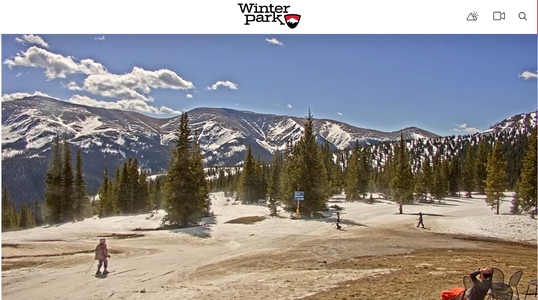
Winter Park Ski area, view to East from Lunch Rock Restauraunt, 11,200 feet on March 26, 2026.
Screenshot 2026-03-26 110040.png

The ski run itself in the foreground appears completely melted today, April 22, 2026. The camera view is shifted slightly to the right but you're seeing the same area.
Screenshot 2026-04-22 104056.png

Telluride Ski Area, view to North from Revelation Bowl, 12,500 feet on March 26, 2026. 14,000 foot peak Mount Sneffels can be seen right of center.
Screenshot 2026-03-26 110503.png


The effects that this will have on the Colorado River Basin water supply are immense. As Hannah said above,
The Feds are pulling water from the Flaming Gorge reservoir to send water downstream to keep the hydro generators at Lake Powell from being damaged.

The water levels there are extremely critical.

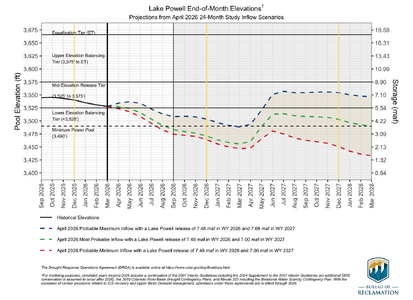
To illustrate what she means by this, I'll show you the latest reservoir inflow predictions from the Bureau of Reclamation for Lake Powell:
Powell24MS.png
The big takeaway from this graph is that lake elevations are forecast to drop below minimum power pool (the level at which water can still flow into the hydroelectric turbines of Glen Canyon Dam) in AUGUST of this year. Since its filling, Lake Powell has never once dropped below this level. Of course, the above graph only accounts for natural inflow into the reservoir, and the Bureau has other reservoirs upstream (namely Flaming Gorge) that it can, and will, release water from to save Powell. More details can be found in the following article by the Bureau of Reclamation: https://www.usbr.gov/newsroom/news-release/5326
The gist of the article is this: they'll have to drain 1/3 of the Flaming Gorge Reservoir, AND significantly reduce inflows to Lake Mead, all just to keep Lake Powell 10 feet above minimum power pool. It says in the article that they can't even use water from the reservoirs upstream in the state of Colorado because they're already too low themselves.


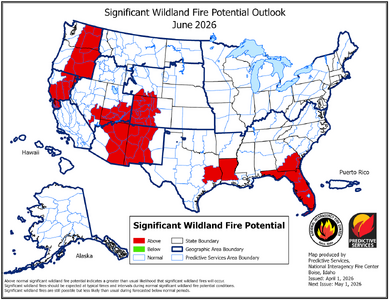
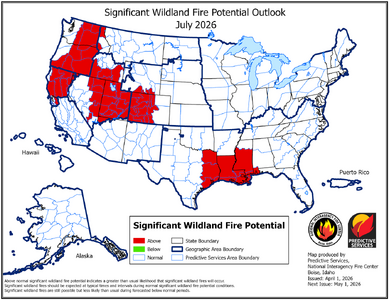
And beyond the consequences for the water supply, there will also almost cerainly be extreme wildfire conditions this summer. The National Interagency Fire Center (NIFC) has released its wildland fire outlooks for June and July, and ALL of Colorado's mountains are highlighted for higher-than-ususal (extreme, if we're being honest) fire danger.
1776877032027.png1776877048255.png

While an unusually rainy summer could help to mitigate fire risk, as seems possible with the coming El Nino and active monsoon season that are forecast, I get the feeling that it just won't be enough. Drought conditions across Colorado's mountains are currently much worse than during the summers of our previous extreme fire years, most notably 2020 and 2012.

I don't even know what to say anymore. This is far beyond any worst case scenario I could've ever imagined as we were going into this winter. We are truly in unprecedented territory here across the West.
 
Harlan U said:
In addition to the already awful snowpack this winter, the West was targeted with one of the most anomalously strong heatwaves ever seen in North America during the latter half of March.
(...)
Those graphics (particularly the ones comparing various 'drought years' ) are eye-opening to say the least!
 
Back
Top