• While Stormtrack has discontinued its hosting of SpotterNetwork support on the forums, keep in mind that support for SpotterNetwork issues is available by emailing [email protected].

SPC Outlook Changes in 2026

On a positive note, a three-tiered hatching for tornado intensity represents a natural progression in the forecasting processes over the years. On the other hand, it might also convey a level of authenticity, capability & accuracy that simply doesn’t exist at this time.
Rather, it provides a goal for them to continue to strive for, and certainly a good one at that, IMO.
 
On a positive note, a three-tiered hatching for tornado intensity represents a natural progression in the forecasting processes over the years. On the other hand, it might also convey a level of authenticity, capability & accuracy that simply doesn’t exist at this time.
Rather, it provides a goal for them to continue to strive for, and certainly a good one at that, IMO.

Watching the video and hearing the rationale for the change, it makes sense, yet at the same time I wonder if it’s not a bit over-engineered and adding too much complexity. And it’s false precision, as William said.

They did acknowledge that very concern in the video and said (with examples) they were able to hit or exceed their target verification percentages for tornadoes most of the time. It seems wind is the most difficult to forecast with precision (which I've observed just anecdotally from how the rare, truly extreme, destructive derechos have *not* coincided with the equally rare times the wind-driven high risk has been issued).

For hail, they won't be using the third (CIG3) level because, they stated, hail exceeding a certain size (off the top of my head, 5") is so rare that the public messaging value of differentiating it from 4-5" hail would be extremely limited.
 
Watching the video and hearing the rationale for the change, it makes sense, yet at the same time I wonder if it’s not a bit over-engineered and adding too much complexity. And it’s false precision, as William said.
I think you have to view SPC outlooks as having numerous important downstream applications, only one of which is direct-to-public communication. As Evan alludes to in the video, the direct-to-public application was never intended to be the primary one, even though social media has changed that in practice some over the most recent decade or so.

The greater precision of these new outlooks will be particularly useful for quantitative and/or automated downstream applications. For example, emergency manager networks, insurers, etc. should be able to model a realistic range of potential impacts (say, dollar losses or injures for an event tomorrow) more effectively with this fine-grain intensity information for each hazard.

The weenie and storm chaser in me tends to agree that this precision will have some downsides when consumed directly by humans: potential confusion for the general public, and probably a lot of additional pointless quibbling/debate by armchair experts and chasers who already engage in enough of it with the existing outlook format.

But ultimately, if SPC forecasters have proven over a years-long internal trial period that their forecasts for CIG1 vs. 2 vs. 3 verify as meaningfully different intensity distributions, it would be irresponsible not to go forward with it IMO. We as taxpayers pay world-class experts to sit down and spend hours analyzing an upcoming severe weather setup, culminating in some kind of deliverable. The goal should be for that deliverable to capture and convey as much of their expert judgment as can be scientifically justified. Any scientifically justifiable perceptions they have of an event while analyzing guidance (i.e., "the cap probably won't break S of I-40, but if it does, there could easily be a sig tor") that cannot be represented in the probability fields of the current outlook format is an inefficiency in the broader system that we should be happy to remedy.
 
I only skimmed the video, but something that stood out to me as a big positive was the decoupling of intensity and probability in the forecasts. In the previous system, mixing together "low odds of high severity" and "high odds of low severity" seemed weird to me.
 
A lot of merit to the above posts. My bias has been toward the violent tornadoes.
And frankly, the cascade of events that produces them very often makes them unpredictable.
Not my words per se, but the recently-retired Howie Bluestein from OU. Think about Moore, OK 2013 or Enderlin, ND 2025.
Many times the watch box probabilities, PDS or otherwise, are way off compared to reality. But of course we need to keep trying.
I suppose while I'm at it, the late Chuck Doswell did question the public's ability to process such probabilities as Luke mentioned above.
Don't most people just want to know if they need to take an umbrella to work with them?😁
 
a level of authenticity, capability & accuracy that simply doesn’t exist at this time.
Amen. We do not have the skill to do this consistently well.

The same thing with tornado emergencies. It was thought that TE's were "sure things." I don't think anyone contemplated that the verification rate would be an abysmal 17% (Dr. Patrick Marsh).

And, the same will be true when they attempt to "warn on forecast."

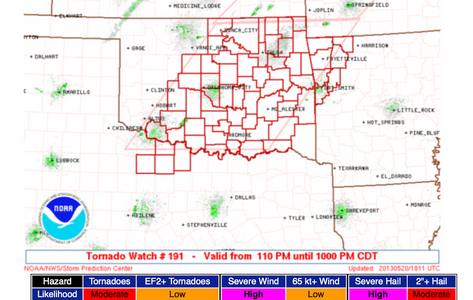
Note: the nearby "low" chance of ≥ EF-2 was issued just minutes before the Moore, OK EF-5.
 

Attachments

  • Screenshot 2026-02-26 at 11.18.34 AM.png
    Screenshot 2026-02-26 at 11.18.34 AM.png
    725 KB · Views: 5
Personally I think it's overkill. All the crossed lines, linear lines, dashed lines, hatched, not hatched, it's so much to digest and at some point there are diminishing returns to all the work put in. If the goal is to get the word out and make everyone aware that severe weather is imminent, to give time to everyone to prepare and to be prepared so when it does occur lives are saved, then we've met that criteria long ago and this does nothing to help.

If the goal is to show how awesome we are at forecasting or give insurance companies reason to raise rates even higher in particular zones with more specific data collection, carry on. I'm pretty sure if anyone is in that purple zone in Alabama, they'll know there's a pretty sizeable risk, crossed lines or not.
 
Last edited:
Back
Top