Hi Allan,
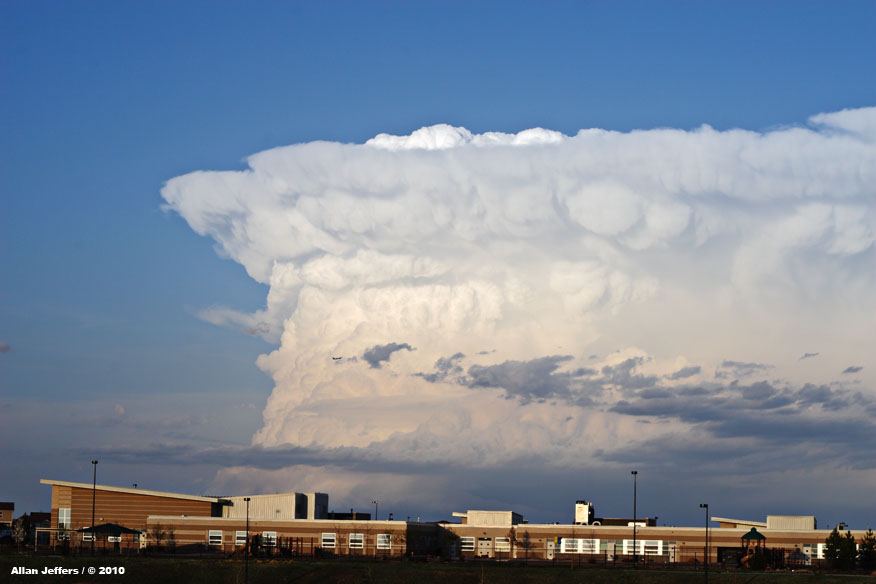
The primary definition for a supercell is a persistently rotating thunderstorm, as I am sure you well know. Now in some cases you can eyeball the rotation off regular radar but its not very accurate and usually requires strongly structured storms (ie hold their shape while rotating).
One common approach to identify supercells in the US is to look for evidence of a mesocyclone, so therefore you want velocity scans of the storm. Typically mesocyclones are identifiable by the couplet structure: that is a field of wind vectors going away relative to the radar, and a field going towards...usually these are delineated by colour so hence you have a pair of bright colours in close proximity. Depending on who you listen to these need to last a certain threshold time...usually 20 minutes is bandied about. This approach isnt foolproof however, as a downburst from a thunderstorm or strong outflow or even topographic flow modification can generate a similar appearance. So in order to confirm your suspicions you usually need to check out reflectivity. Another thing that can mislead with this approach is that cells in a low-topped environment may not show accurate mesocyclones to a sufficient depth to be identifiable.
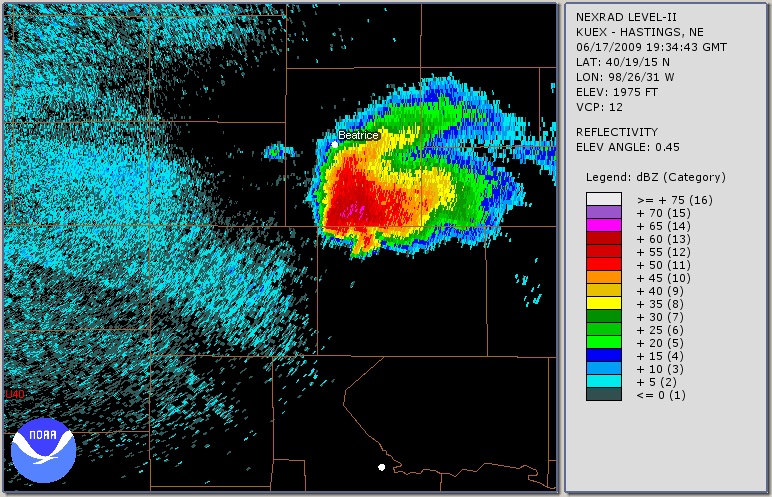
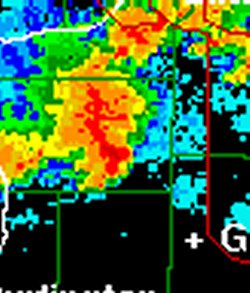
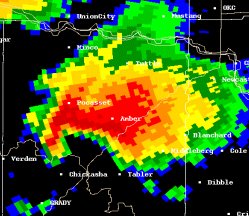
On reflectivity (depending if you have vertical scans using something like GRLevel 2A or something), there a few shapes characteristic of supercells:
- A kidney bean shape, where the area of rotation is in the front flank of the cell. This is the idealised return for a HP supercell.
or
- A very dry appearance or limited return with an area of strong rotation when you know there is convection, this can be an LP type storm. (can be misleading in weak storm environments). No real good example as they can look like anything, but yesterday in Woodward there was a case so have a look through the nowcast thread.
- A pendant or hooked appearance to a cell, this is the classic type storm and the type of return you see regularly atm.
Another point to remember is these are idealised radar images of supercells, clearly there can be massive variation from cell to cell as you can see from the HP example above...and of course the spectrum between LP and HP is continuous rather than discrete so bare that in mind
Now in Australia, we don't have the luxury of a grid network of doppler radars the areas which storms occur, and generally they are only available in capital cities. We also have a slightly different steering environment, so unlike the US where you can get right movers basically following steering, we get very strong deviant motion....so down here we look for the odd cell out...that cell which changes direction as much as 90 degrees to the flow of crapvection.
Have a look at this page, it goes into a touch more of the reasoning on this identification of supercells:
http://www.theweatherprediction.com/habyhints/237/
http://www.theweatherprediction.com/radared/radarfaq/
http://www.theweatherprediction.com/radared/radarfaq2/
HTH