I love
www.spaceweather.com and
www.spacew.com; another site that has yet to be mentioned is that of the auroral oval:
http://www.swpc.noaa.gov/pmap/pmapN.html
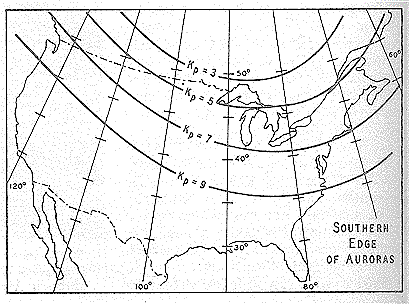
The map of the auroral oval can be very helpful in determining your chances of seeing an aurora at your location (right before the event, check out how far south the oval is).
Without going into specifics on just how this thing works, a basic rule of thumb is the higher the number, the higher the auroral activity is likely to be (provided that the normalization value, n, is less than 2--larger the number, the less confidence there is in the accuracy of the oval). If you're in the yellow band, you might see something but it will probably be rather faint. Once you get into the oranges or reds, you have a great shot at seeing a good aurora. Back in 2003, when I was in Washington, we were in the red quite a bit and saw a few spectacular auroras.
If you're in the blue, your chances of seeing an aurora are slim at best. As has been said above, this solar activity is pretty minor, so even the high latitudes may not see much of an aurora. I can't wait until the sun really kicks it into high gear!
Note the best time to see the aurora is usually around local midnight.
Back on topic, I can't add much more to the discussion on photography...I've never had the chance to photograph the aurora. In 2003, my sister took some photos with her point and shoot digital camera (this was before I had a digital camera), just on the fireworks/night setting, and they turned out brilliant. However, this was also October 29th, when we saw an amazing, very bright display of green and red curtains that filled over half the sky for nearly an hour.