Marcus,
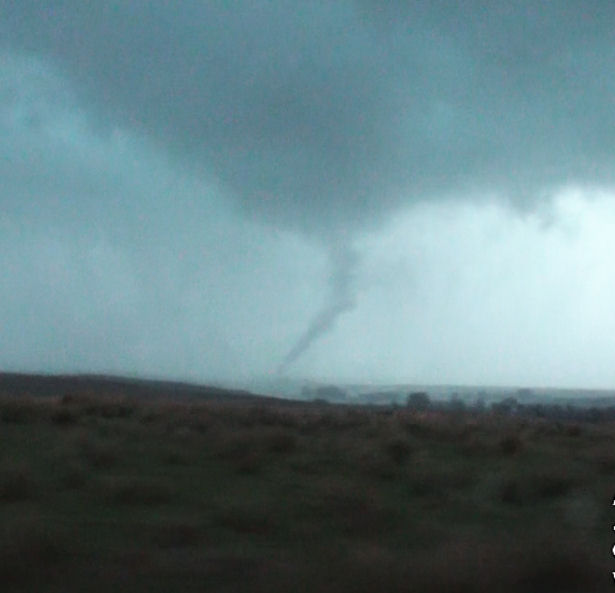
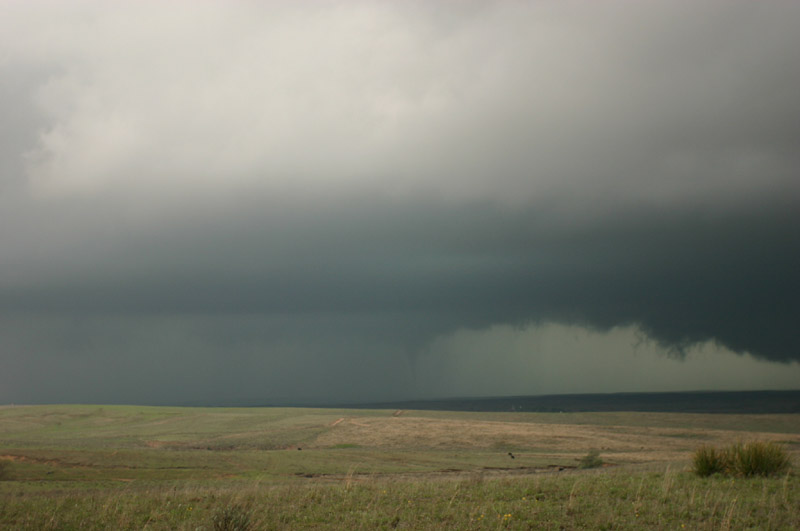
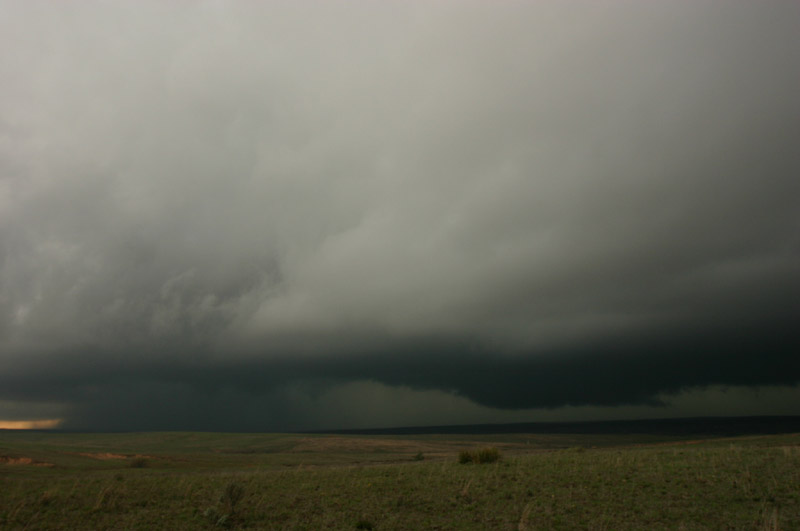
Well, I think for sure that it wasn't a single tornado N of I40 with "supercell B". When we turned NNW out of Alanreed, we saw one tornado just N of I40 (I was driving and didn't snap of photo, though contrast was low anyway), and another low-level meso to its N. These were distinctly-different circulations. While watching the northern meso (the tornado just N of I40 was more rain-wrapped and more difficult to see, IIRC), we saw several vortices with full condensation to the ground; these vortices were along the periphery of the meso, and they all rotated quickly around the center of the meso. Personally, I would call the first one of these (that moved quickly southward, then eastward on the back side of the low-level meso -- see
THIS PICTURE and start at the 6:50 mark of
THIS VIDEO) a distinct tornado, but the one (or two) that followed looked more like suction vortices associated with a low-level meso that was essentially extending to the ground (see
THIS PICTURE and starting at the 8:30 mark of
THIS VIDEO). In other words, after the tornado that occurred from 6:50-8:00 in the video, I think the subsequent vortices may have been associated with a larger (though not terribly intense) tornado with occasional full-condensation vortices. In my own opinion, then, I'd say there were three tornadoes (that I saw, at least) just N of I40 NE of Jericho to NNW of Alanreed associated with "supercell B". I can accept counting all tornadoes associated with the northern meso as being a single tornado, however, since the vortices were associated with the same low-level meso. Regardless, this still means at least 2 tornadoes from different areas of rotation. I typically "count" based on low-level meso, but this obviously can be tricky in situations like this...
We have at least one member that's a forecaster at the AMA NWSFO, so maybe he can share some additional info. I certainly imagine that, unless AMA has video of the event, they base their assessment on damage and/or radar data; there's really not much to hit out there, and some of these were pretty small circulations. I'm not sure how much video NWSFOs looked through on the internet to help them when it comes if, where, and when tornadoes occured in their CWA. Regardless, the asssessment you read from AMA is preliminary until the Storm Data logs are filled for this event in a few months.
EDIT: I think Skip's vidcap below (and end of his video) is the same condensation tube as the one the starts at 8:20 in
THIS VIDEO. I agree that this can safely be considered to be a subvortex from an m.v. tornado. However, the first tornado with this meso did not have that typical 'lean' to it (where the condensation funnel tilts away from the center with height, a trait that seems fairly common with individual vortices within a mv tornado), and it persisted for a considerably longer time.