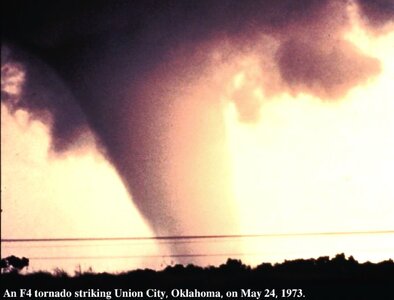
Photo taken by Joseph H. Golden, of a EF4 tornado striking Union City, Oklahoma, on May 24, 1973. This actually became an iconic event!
Welcome aboard, Christina!
Several
ST Members actually experienced the event to which you refer, myself included. At that time, I was a meteorology graduate student at the University of Oklahoma (OU) and worked at the National Severe Storms Laboratory (NSSL) under the tutelage of Dr. Golden. The following is a summary, from my recollection, of what chasing the Union City tornado that day was like. The photograph you show above was one of the ones taken by Dr. Golden during his chase as described in the following paragraphs.
In 1972, Dr. Bruce Morgan, a research scientist from Notre Dame University, approached NSSL with a field proposal about the feasibility to intercept tornadic storms at a safe distance using instrumented vehicles over the existing network of roads in Central Oklahoma, and, thus, NSSL’s “Tornado Intercept Project” was born! Luckily for me, Dr. Joseph Golden was tapped to lead NSSL’s “ground-vehicle” intercept mission. But other projects were also going on at NSSL at this time—including instrumented aircraft and radar data-collection programs. Thus, over time, the term “Tornado Intercept Project” came to be an over-arching reference describing everything that was going on at NSSL during those years of the early 1970s.
As fate would have it, on the afternoon of May 23rd, 1973, Dr. Morgan and I sat down and chatted…more like ruminated about how “tough” the data collection had been going thus far during the 1973 tornado season. For Dr. Morgan, his days in Norman were rapidly coming to an end, and he really wanted to have a “big day” storm event. Ironically, 1973 had been actually a very active tornado season overall—with over 1,000 reported tornadoes nationwide—but very few up to that point had touched down in Central Oklahoma where the data-collection was confined (the reason: Central Oklahoma was where the two experimental Doppler radars were situated).
I remember going into the OU Map Room, as we called it, earlier that day and scanning the facsimile forecast maps (“prognostication products,” or “progs”) from the early-day runs but I thought the next day would be very marginal for storms, let alone tornadoes, over Central Oklahoma. However, Dr. Morgan—the eternal optimist—was much more optimistic than I for the next day’s chances, and was “talking up” plans for “tomorrow’s chase!” His excitement was contagious. I felt better after our little talk.
Little did either of us know at the time, that 24 hours later, Union City, a little farming community about 25 miles west of Oklahoma City, would be wiped off the map by an F-4 tornado! As fate would have it, Dr. Morgan, Dr. Golden, NSSL researchers Dan Purcell and Charles Vlcek, and a photojournalist, Robert Gannon, for
Popular Science magazine, as well as veteran OU chasers John McGinley, Chuck Doswell, the late Al Moller, and I—in two separate vehicles—converged on this tornado. For the chase crew I was part of, we suddenly found ourselves right in the center of the damage swath just minutes after homes and structures had been destroyed and residents were first emerging from their storm cellars, while both Central OK-area Doppler radars were simultaneously scanning and instrumented aircraft were flying.
The efforts of OU students, NSSL researchers, and other-university scientists involved with the Tornado Intercept Project that day resulted in the most comprehensive collection of meteorological data that had ever been gathered (up to that point in time) for any single tornadic storm in NSSL’s history. That day and that tornado turned out to be a legendary event, not only for me, personally, but also in NSSL’s history, and helped to advance the understanding of tornado structure and formation leading to life-saving Doppler radar applications just a few years later (in the early 1980s).