

Dan Robinson
EF5
The outflow boundary from morning storms was expected to be the focus beginning by early afternoon. So, my target was home this day.
I headed into the city for the first round of storms just after noon. One of these appeared to be setting up to reach out toward intersecting boundaries (the east-west main outflow boundary from overnight storms and this storm's own outflow). It was still very early in the day and no heating had been able to work on the stable low levels. Nonetheless, I felt this wasn't something to ignore. As I made my way downtown, this area began looking ominous as a rear-flank downdraft was visible on radar pushing out toward the boundary intersection, and a hook echo was developing. I arrived at my viewing location just after the tornado warning was issued. This was my aerial view of the storms over and west of the city:
This storm remained north of the outflow in the stable air, so it thankfully never got close to producing a tornado as it tracked almost exactly in the same path as the May 16 tornado last year.
This storm and another just behind it continued to reinforce the outflow with fresh surges of stable rain-cooled air. This made the boundary sag to south of I-64 before stalling. No storms were firing upstream. By 3pm, there were no viable options for imminent tornadoes in the metro area (and again, that was a good thing).
Finally, storms began going up west of the city, in position to reach the outflow boundary. The problem was that they all went up too close to the advancing cold front, which rapidly undercut them. Finally, a storm managed to go up ahead of all of this near Sullivan, quickly organizing into a supercell with a strong mesocyclone apparent on radar. I positioned on the Illinois side of the river to await this, but the cold front ended up catching it and wiping it out before it reached the river.
Now out of viable tornado options, I decided to just go downtown and see if the sunset-lit back side of the storms would offer anything interesting. There was indeed some nice lightning to the east, so I set up in the golden light shooting short time exposures. Alas, the best sky-filling 'anvil crawler' flash happened in the brief gap in between exposures.
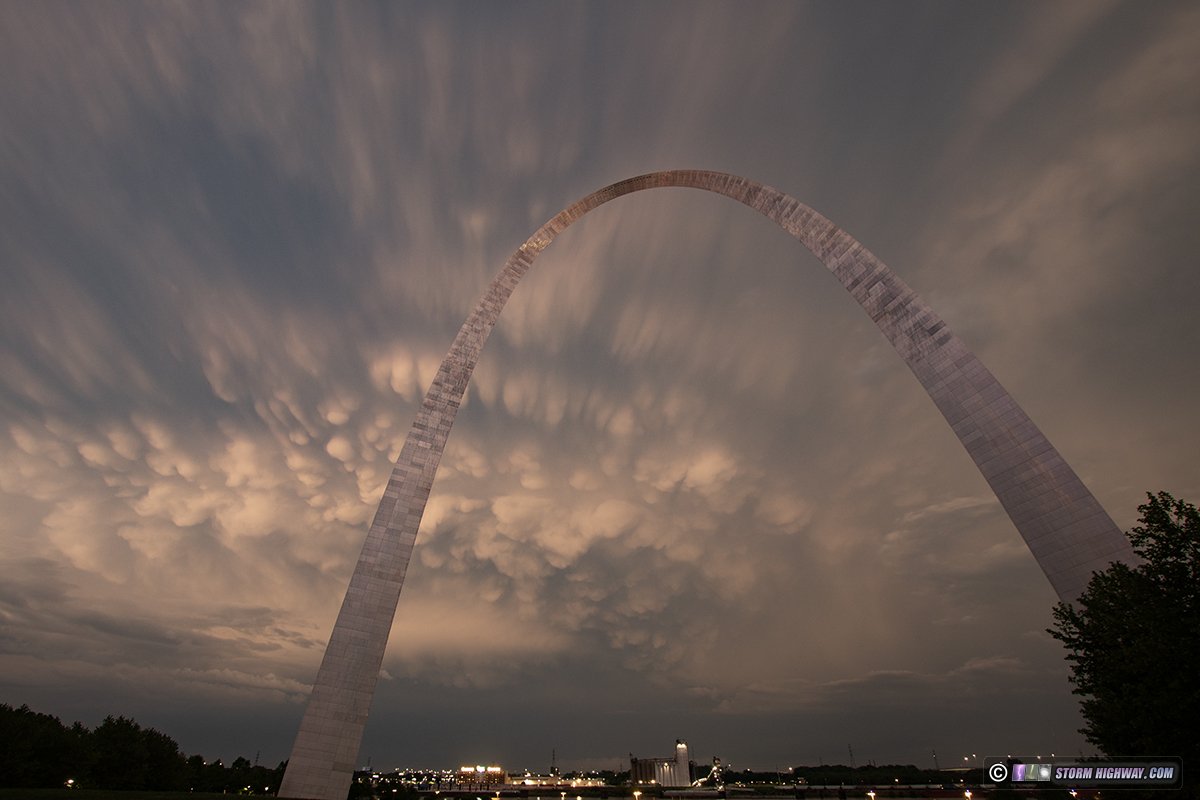
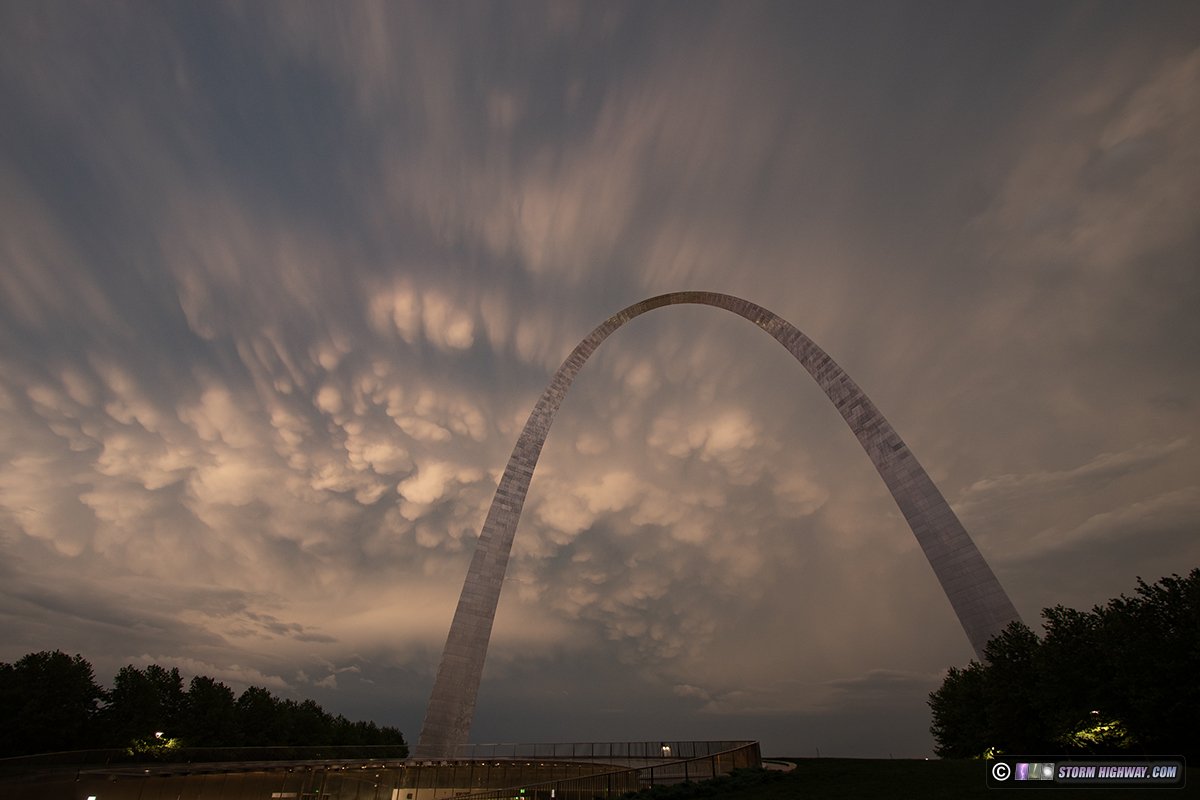
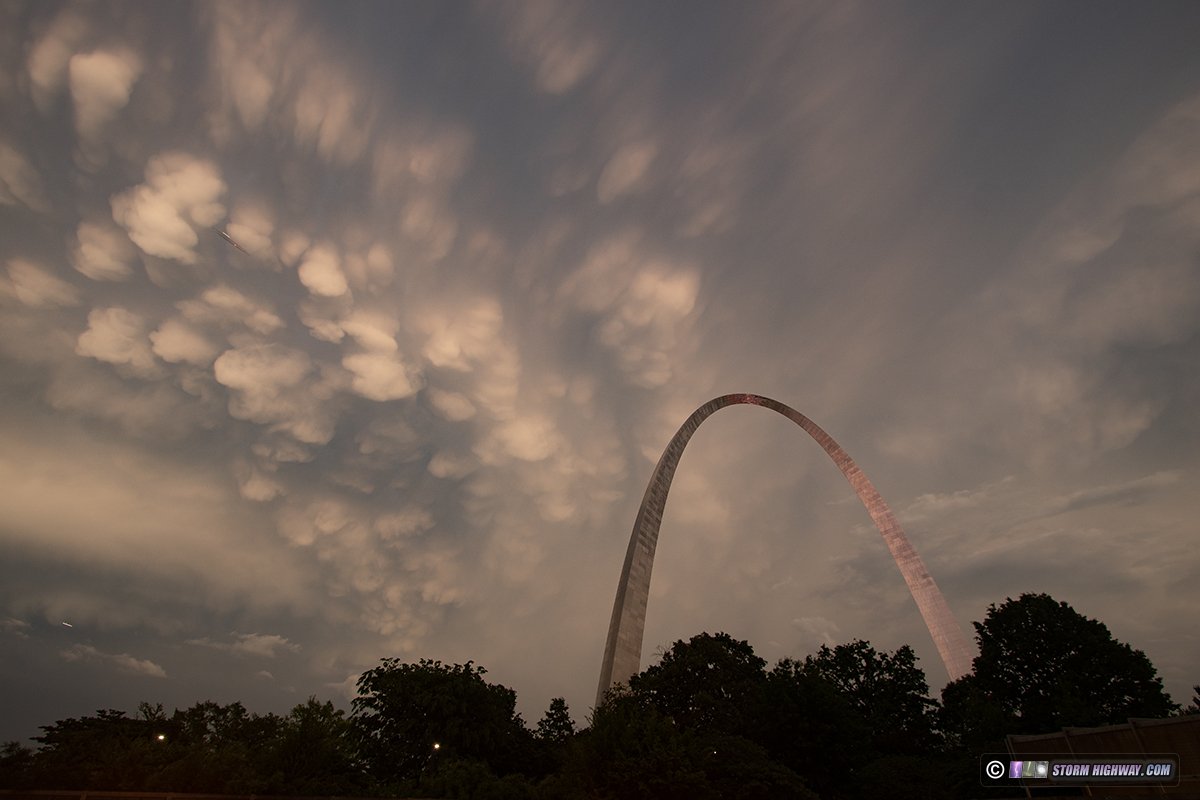
After this moved too far away to shoot, I packed up and got back into the car. But just as I started driving away, the sky suddenly exploded in a display of high-contrast, dramatic sunset-lit mammatus - the best I'd seen over downtown St. Louis. I parked again and ran down to the Arch grounds to grab what shots I could before it was gone. These were the best:
While this was going on, the cold front storms had managed to ingest the earlier east-west outflow boundary and produce at least two rain-wrapped QLCS tornadoes to the east: one right north of home at New Baden. I arrived to find the power out in the western end of town and along I-64 to the west.
I made a pass through the radar-indicated track, finding damage in a path that was almost exactly like the EF2 tornado last March 14 (2025), just shifted 1/2 mile north. This tornado was not as strong: I only found two locations of clear tornado damage. The worst was just south of Trenton where a home along Highway 160 had suffered extensive tree damage with several large tree trunks snapped.
I headed into the city for the first round of storms just after noon. One of these appeared to be setting up to reach out toward intersecting boundaries (the east-west main outflow boundary from overnight storms and this storm's own outflow). It was still very early in the day and no heating had been able to work on the stable low levels. Nonetheless, I felt this wasn't something to ignore. As I made my way downtown, this area began looking ominous as a rear-flank downdraft was visible on radar pushing out toward the boundary intersection, and a hook echo was developing. I arrived at my viewing location just after the tornado warning was issued. This was my aerial view of the storms over and west of the city:
This storm remained north of the outflow in the stable air, so it thankfully never got close to producing a tornado as it tracked almost exactly in the same path as the May 16 tornado last year.
This storm and another just behind it continued to reinforce the outflow with fresh surges of stable rain-cooled air. This made the boundary sag to south of I-64 before stalling. No storms were firing upstream. By 3pm, there were no viable options for imminent tornadoes in the metro area (and again, that was a good thing).
Finally, storms began going up west of the city, in position to reach the outflow boundary. The problem was that they all went up too close to the advancing cold front, which rapidly undercut them. Finally, a storm managed to go up ahead of all of this near Sullivan, quickly organizing into a supercell with a strong mesocyclone apparent on radar. I positioned on the Illinois side of the river to await this, but the cold front ended up catching it and wiping it out before it reached the river.
Now out of viable tornado options, I decided to just go downtown and see if the sunset-lit back side of the storms would offer anything interesting. There was indeed some nice lightning to the east, so I set up in the golden light shooting short time exposures. Alas, the best sky-filling 'anvil crawler' flash happened in the brief gap in between exposures.
After this moved too far away to shoot, I packed up and got back into the car. But just as I started driving away, the sky suddenly exploded in a display of high-contrast, dramatic sunset-lit mammatus - the best I'd seen over downtown St. Louis. I parked again and ran down to the Arch grounds to grab what shots I could before it was gone. These were the best:
While this was going on, the cold front storms had managed to ingest the earlier east-west outflow boundary and produce at least two rain-wrapped QLCS tornadoes to the east: one right north of home at New Baden. I arrived to find the power out in the western end of town and along I-64 to the west.
I made a pass through the radar-indicated track, finding damage in a path that was almost exactly like the EF2 tornado last March 14 (2025), just shifted 1/2 mile north. This tornado was not as strong: I only found two locations of clear tornado damage. The worst was just south of Trenton where a home along Highway 160 had suffered extensive tree damage with several large tree trunks snapped.
Last edited:


